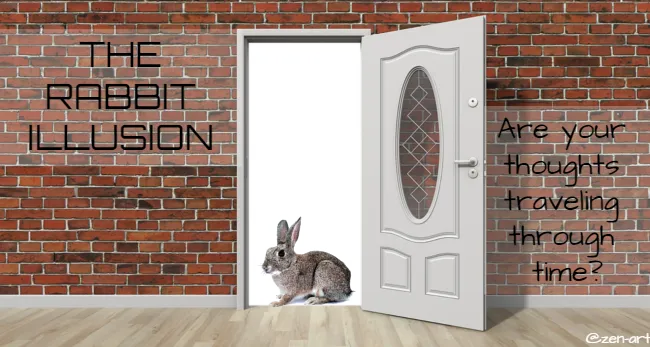
Spoiler alert, this little experiment actually has nothing to do with rabbits. Sure, they are cute but besides the analogy with rabbit being magically pulled out of a magicians hat, this illusion is about time travel and your mind filling in the blanks to create what it wants to create. Our brains are funny like that, they sometimes make us believe in things that are actually not there. It kind of makes you wonder, how much of our experiences are actually entirely made up?
Our memories often seem like they are solid and strong but they are far more complex than we usually realize. They are subject to change, unreliable, and reconstructed as we age. We can even create new false memories through effective suggestion and be tricked into remembering events that never happened. This phenomenon ranges from simple things like incorrectly recalling that you turned the light off to those more serious things like falsely remembering details of an accident you witnessed. False memories are one of the leading causes of false convictions.
"A false memory is a mental experience that is mistakenly taken to be a veridical representation of an event from one's personal past." Johnson, M. K., 2001
Misinformation and misattribution of the original source can influence false memory but the existing knowledge can also interfere with the formation of a new memory and cause the recollection of an event to be entirely false. False memories can also be strongly induced through suggestion.
Your memory changes
depending on the questions about it.
One of the groundbreaking research from 1974 was when participants watched the video of an automobile accident and were then asked questions about what they saw in the film. Some participants were asked 'How fast were the cars going when they smashed into each other?' while others were asked the same question but the words 'smashed into' were replaced with 'hit.' A week later, when they were asked to describe the accident, those that heard smashed into were more likely to have a false memory of seeing broken glass in the film and recolected that cars were going faster then they actually did.
Psychologists Pierre Janet and Sigmund Freud were investigating trauma victims including those of childhood sexual abuse and Freud wrote a book The Aetiology of Hysteria, in which he discussed repressed memories of childhood sexual trauma in their relation to hysteria. After those two men, Elizabeth Loftus came with her work in 1974 (that experiment with the crash video was hers too) and has been a leading memory researcher ever since.
Would you believe that people can be convinced that an entire event had happened when in fact it did not? They can. One of Elizabeth Loftus' psychology students created the experiment in 1997 in which he produced four booklets containing recollections of events from childhood and gave each to a family member. One of them was different than the other three.
The stories in the booklets were true except for the one given to Coan's brother. It was a description of him being lost in a shopping mall as a child when an older man found him and returned him to his family again. It was completely made up, such a thing had never happened to his brother but he not only remembered it but also recalled additional details and was unable to identify it as being the false story.
Music and similar words...
Another interesting thing is that subjects in experiments performed at the University of Virginia that were in a more negative mood were less likely to recall false memories implanted previously. They played two different music types to them. Those that were induced into a more positive mood produced more false memories. This technique is often combined with the Deese-Roediger-McDermott paradigm to create false memories. People listen to words such as sun, hot, relax, beach, tan and when asked to repeat them, recall words like vacation or sunbathing because they are semantically linked.
And now we can adress the topic at hand, the rabbit illusion or the experiment that leads to thinking how our thoughts are traveling throug time or the phenomenon known as POSTDICTION. In prediction, we forecast the future but in the postdiction, a future stimulus influences how you see the past. A direction is different.
How does it work?
Watch the video below, it only lasts 50 seconds so forget about the excuse that you do not have time for this. There will be a cross on the screen, focus on it and then watch out for the flashes at the bottom of the screen. All you have to do is count how many flashes you saw. Easy, right? Good luck and see you in 50 seconds...
The researchers made a video that had three parts:
A beep and a flash on the left side of the screen
A beep
A beep and a flash on the right side of the screen
Each part of the video is separated with 58 milliseconds and even though there are only two flashes, most people perceived three. How many did you see? Did you see a flash in the middle of the screen when the second beep buzzed? It appears that your brain used postdictive processing to fill in the gap.
"When the final beep-flash pair is later presented, the brain assumes that it must have missed the flash associated with the unpaired beep and quite literally makes up the fact that there must have been a second flash that it missed. This already implies a postdictive mechanism at work. But even more importantly, the only way that you could perceive the shifted illusory flash would be if the information that comes later in time — the final beep-flash combination — is being used to reconstruct the most likely location of the illusory flash as well."
Noelle R. B. Stiles
The second experiment that accompanied the first is similar but this time, there really are 3 flashes but only first and the last one have the buzzer. People watching did not see the second flash that did not have the buzzer sound accompanying it.
This shows that sound can lead to a visual illusion and that the brain combines senses over space and time to generate a sense of perception. The study's senior author, Shinsuke Shimojo explained how the significance of this is twofold:
1. Postdiction is a key process in perceptual processing for both a single sense and multiple senses (sight in the first and sight and sound in the second)
2. These two illusions are among the very rare cases where sound affects vision, not vice versa which indicates dynamic aspects of neural processing that occur across space and time
"Postdiction may sound mysterious, but it is not — one must consider how long it takes the brain to process earlier visual stimuli, during which time subsequent stimuli from a different sense can affect or modulate the first."
Shinsuke Shimojo
You can read the entire research article about these illusions here:
by Noelle R. B. StilesI, Monica Li, Carmel A. Levitan, Yukiyasu Kamitani, Shinsuke Shimojo from Biology and Biological Engineering, California Institute of Technology, Pasadena, California, United States of America, Cognitive Science, Occidental College, Los Angeles, California, United States of America, Graduate School of Informatics, Kyoto University, Kyoto, Japan, ATR Computational Neuroscience Laboratories, Seika, Soraku, Kyoto, Japan
Nope. This is where objectivity proves to be more precise. Your brain can play tricks on you and science has been aware of this for a long time. Just because you saw something does not mean it is there and just because you think something does not make it true. This is why we have double-blind studies in science. They help eliminate the possibility of influencing the research by our opinions and memories. What is true for you may not be true for others and sometimes may not be true at all. Don't you just love our brains? :)
To read more about this subject, check out these references:
Oh, ONE LAST THING!
All my titles had a little rabbit in them, right?
Image sources AND LICENCES in order of appearance:
- all images used in this post are free for commercial use, they are royalty free with the links to original images provided under them
- line divider that I use is from FREE CLIPART LIBRARY, and is here
- title pictures are made by me using the CC0 images from pixabay that can be found here
- my bitmoji avatar was created on https://www.bitmoji.com/, visit the site to create yourown