
A 20 year old idea gets a name: the Shortest Possible Schedule theorem; An adversarial robot helps researchers understand human perceptions about human-robot collaboration; A former FBI General Counsel argues against mandatory encryption back doors; A TED talk about ending energy poverty in Africa; and a Steem essay that offers insights into the emerging health-care technology industry
Fresh and Informative Content Daily: Welcome to my little corner of the blockchain
Straight from my RSS feed | Whatever gets my attention |
Links and micro-summaries from my 1000+ daily headlines. I filter them so you don't have to.
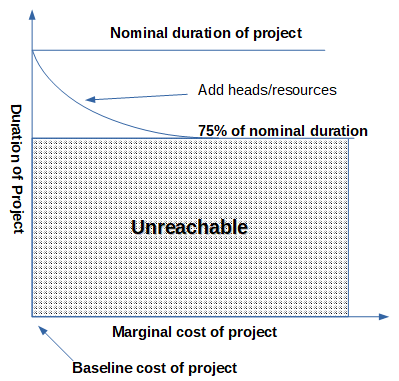
Shortest Possible Schedule theorem - illustrated
- The Shortest Possible Schedule Theorem: Yes, You Can Throw Money at Software Deadlines - In this post, Bertrand Meyer takes on the old saws that, "Nine men can't make a baby in a month", and that "adding people to a late project makes it later" (Brooks' Law). He agrees that the first is trivially true, but suggests that the second is not a fact of life, but may, instead, be a sign of mismanagement. According to Meyer, a method for determining whether/when to add manpower to a project has been known for 20 years. He credits it to Steve McConnell, and attempts to popularize it here by naming it the Shortest Possible Schedule theorem. (McConnell is also known for his work at the foundation of the technical debt concept.) In short, the concept seems to be that if you have planned your project to find the optimal project length with current staffing levels, you can cut the delivery time by up to about 25% by adding staff. Meyer suggests that this 25% reductions seems to be a sort of a universal constant in software engineering. To explain the concept, Meyer also uses a diagram similar to the one that I slapped together, here.
- Rebel robot helps researchers understand human-machine cooperation - Researchers created a robot that could use the direction of eye gaze to anticipate a human operator's intent and operate in three modes: helpful, defiant, or neutral. Unsurprisingly, human operators perceived the robot to be most cooperative when it was operating in the helpful mode. The study used the level of frustration in human operators as an indicator of how well the rebellious robot was able to anticipate the operator's plans.
Video here:
- Rethinking Encryption - In this essay, former FBI General Counsel, Jim Baker, argues for strong encryption instead of government mandated backdoors. This represents a change in opinion for Baker, a change which he attributes to his desire to follow a principle from Ray Dalio, “[e]mbrace reality and deal with it.” Reality, Baker says, is (i) that congress has been slow to respond to law enforcement fears about "going dark"; and (ii) because of the likelihood that foreign adversaries are working to compromise networks, the DoD needs to treat all networks as zero-trust networks, and this requires end to end encryption. In short, he says there are many competing interests that need to be balanced, and there are more interests that benefit from full end-to-end encryption than there are interests who benefit from mandated back doors. Plus, some of the interests who would benefit from mandated back doors are powerful and dangerous actors. From the article, the following excerpts probably capture the crux of the argument: "All public safety officials should think of protecting the cybersecurity of the United States as an essential part of their core mission to protect the American people and uphold the Constitution." and "If law enforcement doesn’t want to embrace encryption as I have suggested here, then it needs to find other ways to protect the nation from existential cyber threats because, so far, it has failed to do so effectively." h/t Bruce Schneier
- How to bring affordable, sustainable electricity to Africa - This TED talk was posted in July and came across the TED RSS feed on Monday. In the talk, Rose M. Mutiso discusses the problem of energy poverty in Africa. She says that (i) we don't have a deep understanding of what energy poverty actual means; (ii) we are avoiding complex systemic issues in favor of quick fixes; (iii) and we are misdirecting concerns about climate change. Her main point, she says, is that "countries cannot grow out of poverty without access to abundant, affordable and reliable electricity to power these productive centers, or what I call 'Energy for Growth.'" and adds that there are no "low energy" / "high income" economies. On the first problem, then, she says that solving energy poverty means powering industry, and that requires a modern and robust power grid. On the second problem, she says that the technology is secondary to solving the pervasive problems with institutions, governance and the broad macro-environment. On the third point, she says that increasing energy availability and reducing emissions are not mutually exclusive, and that "the world cannot expect Africa to remain in energy poverty because of climate change." Instead, she says that we must move away from the either/or framing of the climate change discussion, and stop romanticizing solutions that distract resources away from the corre challenges of energy poverty. This is from her conclusion: "To solve energy poverty, we need generation of electricity from diverse sources at scale and modern grids to power a high-energy future, in which Africans can enjoy modern living standards and well-paying jobs."
- Insights into an Emerging Industry: Health Tech ! - Reporting on a recent study,
notes that last year's revenue for the health technology industry was $7.21 billion, and this year's is expected to be around $7.88 billion. The industry outlook remains strong, and growth over a period of five years has led to $27 billion invested in the sector. Additionally, there are presently 14 companies that are valued at more than $1 billion.

In order to help bring Steem's content to a new audience, if you think this post was informative, please consider sharing it through your other social media accounts.
And to help make Steem the go to place for timely information on diverse topics, I invite you to discuss any of these links in the comments and/or your own response post.
Beneficiaries
- Burn Steem/SBD -
- 5%
- Cited author(s) -
- Fundraising for the Rustin Golden Knights Marching Band -
- 10%
- Posting and/or scheduling service (steempeak.com) -
- 5%
- Science, Technology, Engineering, and Math (STEM) curation on Steem -
- 5%
- Steem/API services (anyx.io) - anyx - 5%
- Steem/RSS services (steemrss.com) - torrey.blog - 5%
About this series
Sharing a link does not imply endorsement or agreement, and I receive no incentives for sharing from any of the content creators.
Follow on steem: 
If you are not on Steem yet, you can follow through RSS: remlaps-lite, remlaps.

Thanks to SteemRSS from philipkoon, doriitamar, and torrey.blog for the Steem RSS feeds!