Frogs and toads are very vocal animals. When mating season comes around, these amphibians fill the night sky with a chorus made up of incredibly varied calls. Some breeding calls are low bellows, like those of the American bullfrog; others like the oak toad make sharp peeping sounds. Carpenter frogs even produce a sound that closely resembles a hammer striking a nail! Acoustic communication is incredibly important to a frog; sounds can be heard much further than the limits of visual communication and can convey a great deal of information. A frog's call can reveal it's gender, size, general health and over all fitness, allowing females to determine the perfect mate even from a great distance. For male frogs, these breeding calls are the best means to attract a mate.
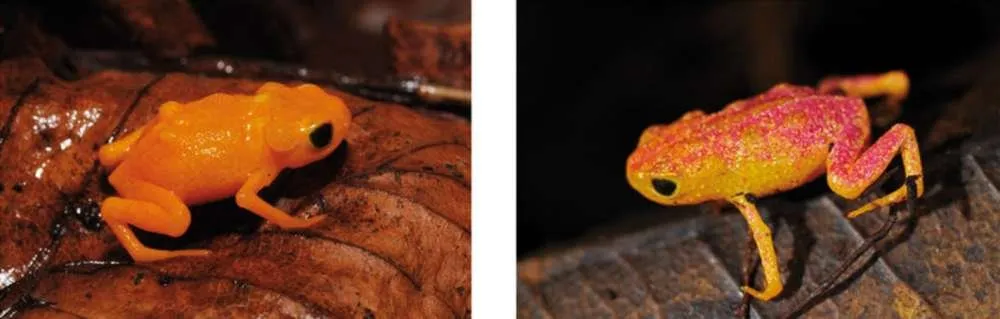
Then there is the pumpkin toadlet (pictured above). These little guys are native to Brazil’s Atlantic forest and are among the smallest frogs in the world. Like other frogs, when it comes time to mate, these little frogs sing hoping to attract a female. However, Dr. Sandra Goutte (post doc at Universidade Estadual de Campinas, São Paulo, Brazil) noticed a significant problem: while most frogs and toads produce loud calls that can carry quite a distance, the pumpkin toadlets produced a very low call. If other frogs are screaming for their mate, these ones were only whispering, and Dr. Goutte questioned how they could possibly hear one another over the sounds of the rainforest.

Dr. Goutte played recordings of the toadlets' call back to the amphibians in the forest, and was surprised by the results. There was absolutely no reaction to the call at all, no observable change in the frogs' behavior. They didn't even position to face the source of the call as would be expected of other species. A follow-up study in a laboratory proved that the tiny frogs were completely deaf and their middle ear had become vestigial.
"We have never seen this before: These frogs make sounds that they cannot hear themselves." -Jakob Christensen-Dalsgaard, Associate Professor, University of Southern Denmark Source

This raised even more questions than it answered. Why would the frogs continue calling if they couldn't hear them? While vocal communication is important to a frog, it does have its drawbacks; being loud when advertising alerts predators to your location and essentially rings the dinner bell (though herpetologists do point out that the pumpkin toadlet is poisonous and doesn't seem to have any natural predators). Producing a call also takes up valuable time and energy; if your mate cannot hear the call you are making, it seems like doing so would be a major waste of both. With so many drawbacks and other toadlets being deaf to the calls, the researchers where unsure why the species hadn't evolved away from calling.
"One would think that if a signal is not perceived by its target audience, it would be lost through evolution." -Goutte Source

Because the frogs are diurnal (active during the day) and are brightly colored, the team hypothesized that the frogs had evolved to favor visual communication over acoustic. This theory was strengthened by the fact that these frogs would send signals to one another by gaping their mouths or waving they forelimbs back and forth. Visual communication may not work over a long distance like acoustic communication, but it does have a couple advantages; predators are not as easily alerted to your position from a distance, and you can still communicate even when the surrounding environment is quite noisy and hard to hear over. So why were the frogs still bothering to call? The team points out that the throat movements made when producing the call does constitute a visual signal, and the frogs would react when they could see another frog calling. The bizarre conclusion is that the sound produced is actually a by-product of the true signalling behavior.
"The singular communication system in these pumpkin toadlets is a first example of vestigial sound communication." -Christensen-Dalsgaard Source

The team is looking forward to continuing their studies on this remarkable amphibian. They hope that doing so will reveal many of the mechanisms underlying the evolution of communication systems in a broad range of animal species.
Article Links: https://www.sciencedaily.com/