
The dark; for a long time we’ve suspected it’s up to no good, only existing to provide a hiding place for goblins, vampires and random pieces of lego.
But it turns out that pretty much the entire universe is made up of stuff that we cannot see, cannot interact with and have no idea what it is.
Source

In fact, things we can see only make up a pathetic 5% of existence. So if you think your room looks messy now, think what it would be like if you caught a glimpse of the other 95%. Yet we stumble through life like drunk, deaf moles, barely taking in a fraction of everything around us and somehow still manage to come up with space travel, cancer treatments and frozen yoghurt.
So what is the huge amount of other stuff? Where did it come from? Can I poke it and will it care if I do? Does the dark matter?
The problem with the universe is that it’s getting too fat and we need to find a way to account for this. Once we had realized that the universe was expanding, we came up with two possible outcomes. First, that the density of matter and energy would eventually halt the continuous expansion initiated by the big bang and then the universe would collapse, disappearing back into a “big crunch” singularity.
Source

The second option was that it would keep expanding forever but the expansion would slow down by smaller and smaller increments. The trouble was, when we pointed the Hubble telescope at distant supernovae, not only did we accidently catch them in the shower, but we realized that in the past the universe expanded slower than it did now.
Source

That means not only is gravity not slowing our expansion, something must be speeding it up; we named this “something” dark energy. Dark Energy makes up 70% of the universe and dark matter makes up 25% but these two things, despite their name, didn’t appear as part of the same concept – we needed each one to account for different phenomena. For dark energy,
Source
it was the swelling belly of the universe, but dark matter was needed to explain the unusually large mass of galaxies.
Source
Jacobus Kapteyn and Jan Oort,
Source
after forming the ministry of unusual names became astronomers and theorized the idea of dark matter but it was Swiss Astrophysicist Fritz Zwicky
Source
Who after also leaving the ministry of unusual names, made the first formal theory about its existence in 1933. Zwicky was looking at a distant cluster of galaxies and worked out that the motion of the galaxies at the edge of the cluster was much faster than it
mathematically should Be.
Source
Where was all this extra gravitational pull coming from – there must a huge mass we aren’t able to observe. So the idea of dark matter was born; matter which has mass, therefore gravity, but almost no other interaction with baryonic matter, which is what physicists call normal matter, because they just have to have to come up with a funky word for everything.


Alright then, so there is this huge amount of stuff hiding in the cupboard. Or, more accurately, we’re stuck in a tiny cupboard and we have no idea what’s in the rest of the house. So do we know anything at all about dark matter?
Well yeah, we do. We know that it’s primordial, meaning it came from the big bang, since there’s no realistic way for it to be continuously created.
https://ipfs.pics//ipfs/QmcPWXHdYE5w8vtvgbBw8954aquqbikCQ5BWTB1CXGtZ9c
Source
Alright, that’s a start. But then if it was all from the big bang and it still exists now, then it must also be stable, otherwise it would have changed into something else.
Source
So we assume dark matter conserves something called parity, meaning that it can’t decay into ordinary matter. The simplest theory is that all dark matter is of just one type called a WIMP; weakly interacting massive particle.

So, they’re heavy but they are extremely anti-social, rarely interacting with their own kind, let alone with baryonic matter. But try as we might, we’ve yet to see a particle of dark matter.
Source
But who wants a world full of WIMPs? Bogdan Dobrescu and Don Lincoln
Source
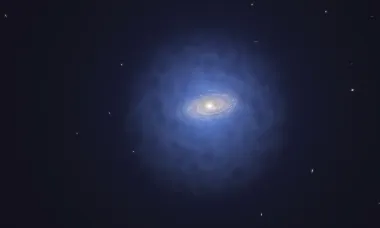
have discussed the idea of complex dark matter, these are dark particles that interact with themselves in the same way that ordinary matter does. So it sounds like dark matter could just be a mirror of baryonic matter, with all the same rules and regulations. But we know that this can’t be exactly true, the similarities must end at some point because we see that the mass given by dark matter around galaxies is spread out in a sphere, rather than a flattened disk that our galaxies Have.
Source
But like ours, it could have hot and cold particles. Baryonic are cold matter but we also have hot matter, better known as neutrinos – these move close to light speed and have almost zero mass.
Source
Dark matter could have a similar spread with hot and dark particles; which sounds like an erotic sci-fi film, the cold dark particles would be the WIMPs we discussed earlier.
Source
The question is; are we ever going to find any evidence for this? There are a number of different experiments currently going on. Some are just hoping to observe that incredibly rare interaction between baryonic and dark matter, by creating an extremely insulated space where very little of the regular rays, waves and particles pass through,
Source
Creating all their noise, and making it difficult to see if any dark interactions are happening.
Source
One such example is the Large Underground Xenon Experiment.
Source
Another way may be to use the Large Hadron Collider.
Source
We won’t be able to observe it directly in the detector but, in these powerful collisions, it’s possible we could find some energy that’s missing, perhaps showing that dark emissions have occurred, accounting for this lost energy.




And when it comes to finding dark energy, well that’s equally problematic and we can
probably only observe its effects on a much grander, galactic scale. The Hobby-Eberly Telescope
Source
in Texas is hoping to build a 3D map of the early universe and so see more clearly what dark energy’s role was in the development of the universe.
Source
Who knows how much influence this dark energy and dark matter will prove to have on the world we see around us.


Thanks for reading