
Why red, in fact, may not be red at all. If you go to the store in the department where TVs are sold, you can see that different brands of TV, in different ways, show the same colors. Of course, this is determined by a different design, or most likely an algorithm of processing and solving in a color block. I think that a person also processes colors. There is no wrong, not man, but our brain.
When we see our eye perceives the picture, and then the INFORMATION is transferred to the brain department, which processing the image, gives us or our consciousness, or our virtual world, I do not even know how to name it, understand, perceive this picture. What we see separately, what is manifested on the retina of the eye - this is another picture and the third picture is the one that creates our brain virtually.
[ Human eye ]( By che(Please credit as "Petr Novák, Wikipedia" in case you use this outside Wikimedia projects.) - Own work, CC BY-SA 2.5, Link)
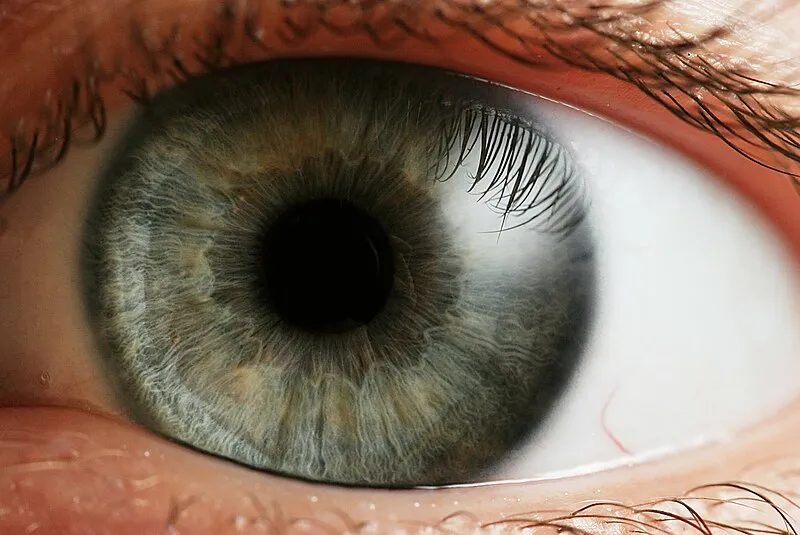
And immediately a question. So what do we see? Image - the subject of visual perception, perceived - is the reality in color. The image on the retina is already a copy. To understand what a copy is, imagine that you are making a drawing, for example, an apple. In most cases, your drawing will turn out to be very "similar" to the subject, but it will contain in itself everything with the help of what you created it. That on which you draw, than draws, the way of drawing and technique. A copy is not an original or a copy at all, in fact, but a new one created, but very similar and perceived by us (the brain) as an analogue of information about the subject. Our brain constantly produces copies of the original.
Okay, let's say we got a copy, but how do we understand that this is the copy that we need, that this is the right copy. Probably, we need to compare something. And now we come to how we define colors.
So each of us has our own vision apparatus, and it is natural to assume that they are all different, as are the TV brands. It turns out that each of us sees a completely different picture. Of course the geometry or shape of the object will not be different, or it will still be different, but quite a bit, since it is determined by optical properties. But the colors can be different for everyone? We can all perceive the same colors only if a sample of this color already exists (sewn) in our DNA, in that part that is responsible for the organs of vision and perception of the image. Of course, we could come up with a name in the process of human development, which was probably the case. Otherwise, how can one explain that the same color has different names for different peoples. Definitions of color in everyday life and its identification with a certain occur in the process of learning and development. BUT, our brain must know that it is red and unblemished. How does the computer perceive the red code - # ff0000, AND IF I TRANSFER THIS into the binary code - 0 AND 1, then we get 11111111.
[ Daoist Bagua ]( By Pakua_with_name.svg: 2006-09-23T21:16:47Z BenduKiwi 547x547 (101558 Bytes)derivative work: Machine Elf 1735 (talk) - Pakua_with_name.svg, CC BY-SA 3.0, Link)

If someone does not know, then the computer - computer, understands only electrical signals. I do not know for sure, but suppose 1 corresponds, for example, to a signal of 8V and zero to 5V. This is the difference. If the signal is 8V, then the machine perceives this as 1 and accordingly 0 at 6V. The computer does not read colors or sounds, only electrical voltage.
[ Neurons generate electrical signals that travel along their axons. When a pulse of electricity reaches a junction called a synapse, it causes a neurotransmitter chemical to be released, which binds to receptors on other cells and thereby alters their electrical activity ]( By user:Looie496 created file, US National Institutes of Health, National Institute on Aging created original - http://www.nia.nih.gov/alzheimers/publication/alzheimers-disease-unraveling-mystery/preface, Public Domain, Link)

Our brain is the same computer, only created perfect and impeccable. He is capable of a lot and even more if properly taught. And most likely, the colors in our brains are also encoded in some way, which is not yet known to us. Therefore, we will always distinguish between red and blue or white. Of course, if we do not train, in the ways that humanity uses, we will not know the name invented by people and naturally cannot explain or tell another person what kind of color it is. But we will definitely distinguish colors, not even knowing what colors it is or what else.
If you do not know something in life, then you go from the opposite and explain it by saying that it is different or does not correspond. The name does not really define color, it's a way of communication. Color determines the color itself and our perception and processing of information or color code.
What exactly "shows" to us our brain .......... It can all be an invention ...