
The Greenhouse Effect - Climate Change
Hey Steemians, today I’m going to talk about a couple of basic concepts around climate change. While some may argue against the legitimacy of climate change, the milder Winters and Summers have definitely left a worrying impression on me. (Side note – I have to wait another year for my Winter to come. Blame the White Walkers!)
The Green House Effect
So what is climate change?
Climate change is a global or regional climate shifts in patterns, in particular a change apparent from the mid to late 20th century. This is attributed largely towards the increased levels of atmospheric carbon dioxide (CO2) produced by the use of fossil fuels resulting in the release of greenhouse gases.
Ermmm…What are Greenhouse Gases?

Collectively, Greenhouse gases are gaseous compounds that are able to trap radiation within the Earth’s atmosphere. You can probably imagine wearing a breathable thermal, heat gets in and retains to let you feel nice and warm. But what if you were forced to wear one every day under the blazing sun? Things are going to get pretty warm all round and those ice cubes are going to melt eventually.
Greenhouse gases include:
Carbon dioxide (CO2) – From both natural and human emissions, the use of fossil fuels has accelerated this considerably. Oil, gas and most of the things we take from the Earth to burn and use as energy contributes to CO2 release. There are also natural sources of CO2 from nature. Oceans, plants and other animals or landscapes emit carbon into the atmosphere but this is magnitudes less in comparison to human made emissions.
Source
Methane (CH4) – A more organics compound which are often a result of livestock, gas leakage and more. Thankfully the lifespan of Methane is drastically shorter but there is research that points to be even more harmful than CO2.
Source
Nitrous oxide (N2O) Fluorinated gases – Man made gases that stay in our atmosphere for a VERY long time. While making up a smaller percentage of the atmosphere, they contribute over 300 times towards warming in relation to CO2.
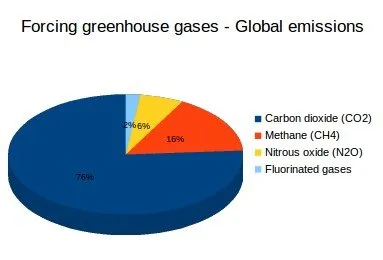
While we see that CO2 makes up the majority of greenhouse gases in the atmosphere, any reduction that can be made from the mentioned compounds will assist in reducing the greenhouse effect.
Paris Agreement

A year or so back, I attended a lecture at the Institution of Civil Engineers (ICE), One Great George Street. The topic of the evening was “What does the Paris agreement on climate change mean for Civil Engineering”. A number of speakers presented their ideas surrounding the agreement and current industry movements aiming to tackle the emerging climate change issues.
The 21st Conference of the Parties (COP) to the United Nations Framework Convention on Climate Change (UNFCCC) was held in Paris in December 2015. The Conference reached a global agreement on action on climate change. The transition to renewable energy generation across the world is vital to stay within a global 2C temperature increase.
UK Stance
The UK has contributed to this movement after its reveal with an action plan, assessing its current emission levels and determining it is not viable to set a new UK emissions target with it already stretching targets to meet previous targets. Achieving current targets will yield positive contribution to global climate action.
In line with the Paris Agreement, the Government has indicated it intends at some point to set a UK target for reducing domestic emissions to net zero and have committed to continuously strive towards this goal.
The most important contribution the Government has foreseen in light of the Paris Agreement is a plan to publish robust plan to meet the UK carbon budgets and to deliver a set of policies in line with the plan.
It’s encouraging to see that a collective effort to tackle the issues at hand. Recognising realistic targets and phasing towards a carbon neutral environment will give steady progress.

With heavy investment into disruptive technologies, the UK is striving to meet its 2050 goals by reducing emissions by 80% (UK Climate Change Act). As 2018 commences, the second carbon budget period has begun. Government policies however are causing disruption and will heavily influence whether these targets will be met.
Seeking Real Progress

Source
A speaker highlighted advancement in technologies to create battery powered technologies to reduce carbon emission. Though figures indicate that substantial advancement was being made in Australia, we fail to recognise the entire footprint of the manufacturing process of these technologies. To have ‘clean’ energy we outsource production and transport it here. In my opinion this isn’t solving the issue of carbon emissions, it’s simply masking it.
We should be focusing on the origin and processes involved to create these technologies. This brought a valuable learning, making me aware of the importance of having a wider perspective when seeking solutions.
As innovative solutions are found, strategic approaches will be used to leverage an economic solution to climate change mitigation.
Technology for Change
I’ve posted about Smart Cities, Digital Engineering and other construction related processes. This extends into lowering carbon emissions. Smart energy, battery technology and other advancements are being made. With nations opting for a sustainable future it won’t be long before we see industry and society mould itself to meet a low carbon goal in a battle with climate change.
Age of The Tesla…And More
Source

It’s no secret that Elon Musk has managed to get the edge on battery tech over the last years. The age of autonomous vehicles is fast approaching and battery powered cars are here. Tesla set the pace with megawatts of juice being pumped out and their new range of cars benefit tie in with financial benefit schemes.
First year tax allowance, Plug-in / charging grants, congestion avoidance and more are strong signs of encouraging adoption. But as we all know, markets face competition and this may be healthy with many other firms following suit. It has now become a race to see who can get to the honey first. Many start-ups and existing competitors are approaching battery technology and vehicle design in their own way. I think this is healthy and will pave way for mass adoption in the future.
Crypto Flux

The PoW system on cryptos has received negative light from many. But we have to face reality, it takes resources to maintain data and some research shows the issue isn’t down to the energy usage. It’s where we get the energy from!
Large mining farms that use fossil fuels are only contributing to our carbon footprint. I do feel however, that with enough attention on renewable energy resources…It might be a matter of time before you’re driving your tesla to mine some crypto.
Cryptos rise in value, algorithms change but the footprint remains. Our networks need to move towards alternative energy resources and it is certainly interesting to see how blockchain will evolve to meet the mentioned ethos (if at all). I hope to see new PoS systems prove themselves in the near future with emphasis on low energy approaches.
Turning Off the Lights

Source – Be Smart ;)
No, I'm not telling you to power down your STEEM.
So now we know what the problem is and what industry is doing to combat climate change, what can we do in our day to day lives?
Leaving appliances plugged in still wastes energy. If we are not able to switch energy sources just yet, perhaps striving to reduce our energy waste is the next best thing. Switching lighting (LEDs) will save money and the environment. Smarter decisions made as a population will make bigger impacts than one or two secluded projects. Perhaps this is really a case of “Power to the People”.
Being aware of our global issues is important. I’ll be trying to make some smarter choices at home from now on.
For now though, It’s time to turn off the lights and warm the house with a miner.
Thanks for reading and look out for my next post : )
Momosan