
The philosopher Ludwig Wittgenstein famously once said that "If a lion could speak, we could not understand him." It's a somewhat odd claim, but it makes sense- to quote Wittgenstein again, "Shared human behaviour is the system of reference by means of which we interpret an unknown language." We lack that shared system of reference with lions. Even were a lion able to talk, it would have a completely different relationship to the words than we would. The lion essentially lives in a different world than we do- one dominated by it having four legs, being a meat eater, having a very different social structure to ours, not caring about plants like we would, etc, etc. The lion's world can be referred to as its umwelt. *While umwelt literally translated from German means "surroundings" or "environment", it really discusses the relationship between the observer and its environment. So if a lion's umwelt makes its speech incomprehensible, what would an alien's umwelt mean for communication?

Before we try to answer that question, let's talk about cnidarians. Cnidarians- the group of animals that include most jellyfish- are in many respects the most alien creatures on our world. They lack centralized nervous systems, and instead have neural tissue distributed throughout their bodies. They can in no regards be claimed to be among the geniuses of the animal world. In fact, they shouldn't actually be able to run their relatively complex sensory apparatus with as little neural tissue as they do. Some species of sea jellies, such as the box jellyfish, have up to 24 separate eyes, which would take an immense amount of brain processing power to run. How do they do it? Well, they actually use each eye for a different purpose. Some eyes look for obstacles, others look for predators, others look for prey. The neurons they're attached to are only used for handling that specific task- they're highly specialized.
This isn't the only oddity in cnidarian cognitive function, either- their neurons are highly distributed and reprogrammed. In the 50s, a (very unethical by today's standards) scientist took to cutting apart jellyfish into still-connected ribbons without killing them. He found that the jellyfish could actually reprogram the remaining neural connections in order to transmit information along their new paths. This level of neural plasticity is certainly unusual.
Box jellyfish are much more active swimmers than most sea jellies, and as such their twenty-four eyes come in handy in steering and navigating through the water. [Image source]

So what lessons do cnidarians have to teach us in regards to aliens? Well, first off, the multiple sets of specialized eyes indicate that animals might actually have multiple overlapping umwelts of their own. This seems self-contradicting- an umwelt is, by definition, all-encompassing. Due to the lack of a central nervous system in cnidarians, it's really hard to say whether it actually possesses a central self that could have an umwelt- instead, each sensory processing system might have its own unique umwelt. It would certainly be interesting, to have a sentient extraterrestrial species with as many widespread umwelts as cnidarians- though it's hard to imagine them achieving technological civilization this way.
Some philosophers deny humans have an umwelt, and that we're the only animals capable of dwelling in the world as it is due to language and reason. This does seem to go against much of the existing animal cognitive research, however. Let's take a look at gibbons really quick. Gibbons were long thought to be much less intelligent than other apes, until one researcher had a surprisingly simple insight. Most of the intelligence tests the gibbons were put through involved picking up objects off the ground, the same as other apes. Gibbons, however, have hands that are poorly suited to picking up objects on the ground or other flat surfaces- they're much more dedicated tree dwellers than we are, so their hand behave more like hooks. When the tests were adjusted for gibbon hands, they immediately started scoring much, much higher than they had been. The tests themselves had been designed with the human hand in mind, at least subconsciously. The researchers had been testing for similarity to our hand as much as they had been for intelligence- a fairly clear indication that we do, in fact, have an umwelt.
Gibbons brachiate- travel through trees- faster and with more agility than any other non-flying mammal. As such, their hands are perfect for that, but poorly adapted towards picking objects up off a flat surface. [Image source]

This goes even farther. There are increasingly vigorous debates revolving around our definition of intelligence right now- a great many researchers think that the definitions are currently far too restrictive and narrow. One of the major divides in cognitive research is between biologists specializing in cognitive research and linguists- the biologists are more likely to be accepting of broader definitions of intelligence, while the linguists think that language is the sign or even cause of intelligence. I tend to err more towards the side of the biologists- we're quite outpaced by other species in some ways. Chimpanzees, for instance, have far better short term memory than we do- they can perfectly remember long sequences of shapes flashed briefly before them in a way that would be impossible for most humans.
Using the various examples that I have so far, I think I've adequately illustrated that aliens might be extensively mentally different than us due to their physical and neurological morphology. It somewhat beggars the imagination to think that a narrow, human centered definition of intelligence would adequately encompass any technological extraterrestrial civilizations we encounter. How, then, does Wittgenstein's claim about lions apply to beings that are literally far more alien?
Bottlenose dolphins have the second highest encephalization ratio (brain mass proportional to body mass) of any living species- second only to humans. [Image source]

One of the best ways to discuss this is by discussing much less alien creatures- dolphins. Dolphins seem to have 'words' in a quite exact sense- sounds that stand for ideas, such as fish. This isn't any great achievement, really. Meerkats have words for danger, food, etc. Parrots have names. The list goes on. Dolphins do, however, seem to use their words in a more complex, structured way. We've still had huge difficulty understanding them, however. There are some practical reasons for this, of course. For a long time we were only trying to translate the segments of dolphin speech in our hearing range, but dolphins can produce sound in far greater ranges than us, including using their sonar. Dolphins also have much, much thicker neurons than us, meaning they think much faster, whether or not they're as intelligent as we are. So much of the early research into dolphin communication is flawed in that it tries to parse dolphin song and calls at human speeds, rather than slowing it down.
It should also be noted that dolphins are very much as curious about us as we are about them- they're certainly trying to communicate with us as well, though (despite what hippies will tell you) they're definitely not as smart as we are- at least on our scale of intelligence. (Here's where we have to balance between allowing for more divergent types of intelligence than we've had in the past and allowing for so many different sorts that we can't compare them.) Our language is far more complex than theirs, so far as we can tell- noting, of course, that many researchers, especially linguists, will point to our failures to translate dolphin language as strong proof of its absence. To bring a bit of pessimism into this discussion, if dolphins and us are both working to communicate with one another and yet still failing, what odds does that give us to speak with a truly alien organism?
Mnemiopsis leidi, the sea walnut, scourge of the Black Sea. While it looks like a jellyfish- a cnidarian- it's actually a ctenophore. [Image source]
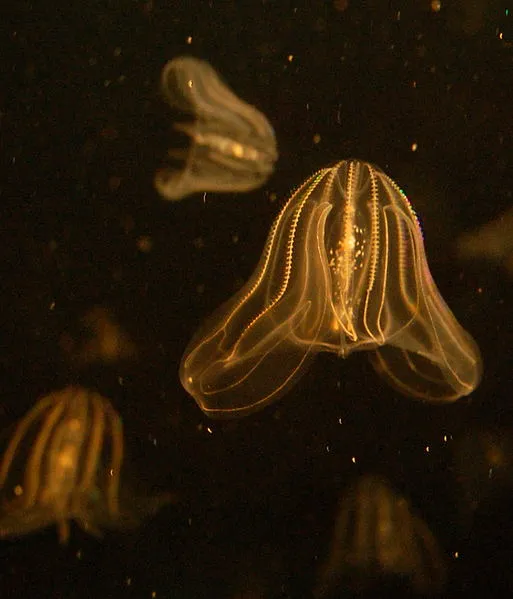
Before we go, however, there's one more type of animal I'd like to bring up- the ctenophore, or comb jelly. Ctenophores are easily confused with cnidarians- they look very similar, just lumps of jelly floating through the oceans. They're very, very far away on the evolutionary tree, however- they actually split away before the evolution of nervous systems. And yet, they have nervous systems of their own- completely unrelated to ours, or jellyfish, or octopi, or dolphins. They evolved their nervous system completely separately, using a whole different set of neurotransmitters and other chemical building blocks in one of the most stunning cases of convergent evolution in our planet's history. Nervous systems weren't a one time fluke, and if we find other life out there, well, the odds just went way up that some of it is intelligence. It makes the universe feel a little less lonely.
Bibliography:
- Are We Smart Enough to Know How Smart Animals Are?, by Frans De Waal
- Spineless: The Science of Jellyfish and the Art of Growing a Backbone
- *Voices in the Ocean: A Journey into the Wild and Haunting World of Dolphins
- https://en.wikipedia.org/wiki/Umwelt
- https://archive.nytimes.com/www.nytimes.com/books/first/b/budiansky-lion.html
- https://www.theguardian.com/science/2003/jul/03/research.science
- https://aeon.co/essays/what-the-ctenophore-says-about-the-evolution-of-intelligence


