
First quantum transmission of multi-bit photons through the air
Record-breaking: Researchers have transmitted a quantum signal with more than one data bit per photon for the first time - and this in a particularly difficult environment. For the quantum message was exchanged in the middle of the city of Ottawa over 300 meters between two houses. The double coding of the data made the quantum signal even legible despite the air turbulences, as the scientists report.
© University of Ottawa

Quantum cryptography is considered to be the encryption method of the future because it allows data to be sent almost "unbreakable". By interlacing photons, quantum signals also reach their receivers almost instantaneously - even over long distances. In the future, quantum communication could therefore make data exchange in urban fiber optic networks, but also with the orbit, safer and faster.
More than one bit per photon
Up to now, the simplest encoding is used to transmit quantum messages: A photon transmits one bit - a zero or one. However, by manipulating and reading out two or more properties of the photon, it is also possible to encode several bits per light particle. However, whether this so-called high-dimensional quantum fragmentation also functions in the case of transmission through the air, has so far remained open.
Ottawa intracity quantum communication link. © www.osapublishing.org

Now, Ebrahim Karimi from the University of Ottawa and his team have demonstrated this for the first time. For their experiment, they carried their laser equipment, normally used only in the laboratory, on two roofs, about 300 meters apart, on the university campus. The instruments produced entangled photons whose quantum states encoded two bits per particle. Each photon can carry four possible signals: 00,01,10 or 11. This technique is therefore also referred to as 4D quantum cryptography.
Quantum transmission through the city air
Would this quantum information outperform the turbulent city air? The problem is that the fragile state of the entanglement is relatively susceptible to interference. Especially in the atmosphere, turbulence and other disturbing influences can easily cancel the entanglement. As a result, only a few quantum signals are produced.
Colleagues thought our experiment was impossible, the researchers report.
But the experiment succeeded - even better than expected: the quantum message sent with the double-coded photons was still readable even after 300 meters of air transport.
For the first time, we successfully sent messages using high-dimensional quantum encryption under realistic city conditions, says Karimi.
Less glitchy
Simulated encryption of an image with structured photons.
© www.osapublishing.org
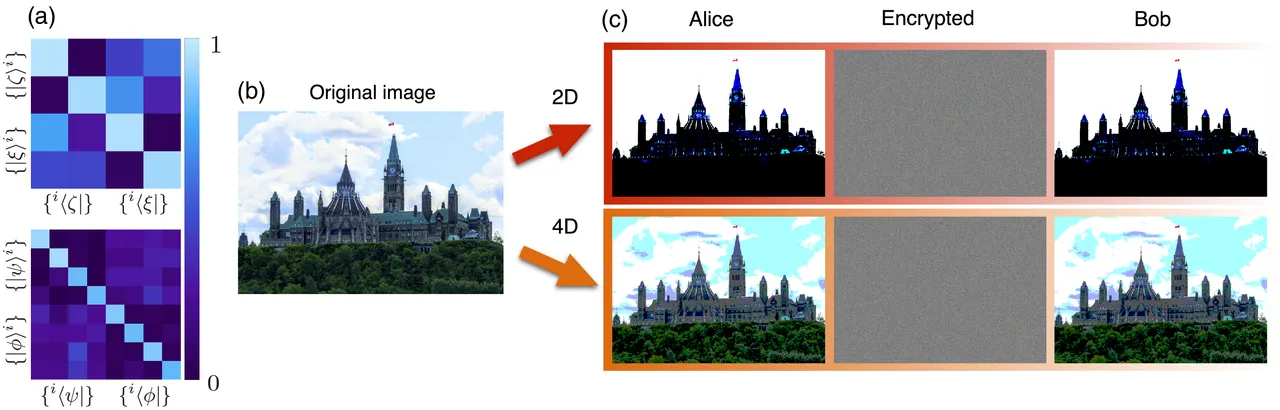
The reason for the physicists is that the 4D coding is less sensitive to interference.
This higher interference threshold means that the 4D quantum cryptography could be used wherever the conventional 2D transmission fails, says Karimi. The quantum communication demonstrated by us could be used to communicate with satellites or to transmit encrypted data between locations that can not be connected via fiber.
Even the airplanes could be sent with quantum signals.
Next, the researchers want to test their 4D quantum transfer on a longer distance. They are already planning a network of three stations, which are 5.6 kilometers apart. In the longer term, this test network is to be connected to an existing quantum communication network already in Ottawa.
Source: Optica, 2017, doi: 10.1364 / optica.4.001006
