
The evolution of humans beings brought about various ways in which problems could be solved, most especially, those which had to do with the human health. Scientific experiments had long begun and this led us to discovering answers to questions which before now had baffled us for decades and centuries.
For the success of a lot of these biological experiments, living creatures were very much needed, but since experiments didn't always end with the expected or desired result, a creature which could perform the role of the subject in these biological experiments had to be chosen. Convincing humans to put or risk their lives for science, proved to be a somewhat daunting and difficult exercise, but which other creature could possibly take this slot?
Yes, you guessed it right… RATS!! *

Rats. Common scavengers, mostly regarded as dirty and germ infested. However, it may seem that these rodents have done so much for us than eat our already prepared homework scripts during the weekend. Have you ever thought about the reasons why rats were picked as the most preferred creatures for experimental testing? let's find out, shall we?

Logistical Reasons

First and foremost, rats are very little creatures, (maybe not too little) and are quite easy to handle, move across different locations and carry out experiments on, quite different from larger or less predictable animals. Just envisage pricking an elephant or a giraffe with a needle; it probably wouldn’t be as easy as it is with a tiny rat; because the whole laboratory could be down in minutes.
Additionally, rats are harmless when compared to other animals. In the course of carrying out experiments, animals are usually forced to undergo some variety of conditions, much of which could be very much provocative and annoying, thus if you successfully irritate a rat, the best it could possibly do is to nip at your fingers. On the other hand, how about you try touching a Lion or a crocodile with a sharp object to see what happens? you most likely might not live to finish the research.
Terrific Breeders
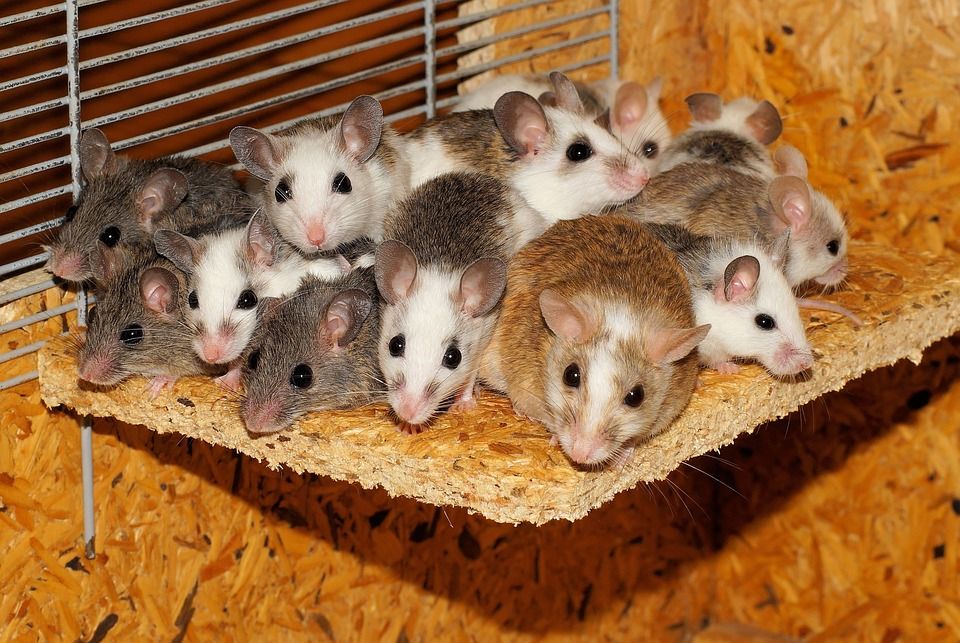
We are family. Image source: Pixabay
Having discussed on the factor which relates to the logistical facet of experimentation, let’s now take a look through at the biological benefits attached to picking rats to use as experimental subjects
We might already know that rats are formidable breeders; as they comparatively breed quite fast. What this means is that by just investing a little amount, you'd end up with as many rats as possible for experimentation. Rats also have a very short lifespan as such they would die after a short time, thereby giving way for the new generation to birth forth. This would ultimately facilitate the study of various generations of rats within a short span of years.
Similarities With Humans
You probably didn't know that rats are remarkably similar to humans. Well, consider yourself notified today, because according to The Koshland Science Museum:
Rats share a staggering 90% of genes with humans.

Skeletal structure of a Rat. Image by Internet book archive. Culled from *"The cyclopædia of anatomy and physiology"* 1847, via Flickr. CCO.
This is the reason why they are the most preferred to represent humans in experiments to retest the nature of interactions of different genes found in humans. One big reason they're preferred to chimpanzees (who share a whooping 98% DNA similarity with humans) is the simple fact that they are smaller and larger in numbers when compared to the quite endangered Chimpanzee species.
Additionally, a lot of the bodily systems of rats perform in very similar way as human beings, this makes it even more convenient to carry out studies on the effect of a wide range of drugs and medications on the human body.
If we consider it, another great thing about rats is the fact that they can be changed genetically. What this means is the specific genes could be turned on or turned off, in order to observe how these changes affect the rats. Rats with these altered genes are referred to as Knockout rats, and have proven to be of tremendous help in determining just how certain genes could bring about some certain diseases. The transgenic rats, are a certain breed of rats of which foreign DNA has been inculcated into them. These breed of rats are of great help in mapping out models of certain diseases which affects humans.
Hence, looking at how relevant rats have been and the contributions it has made to the welfare of human beings, we ought take out a moment to thank these little creatures who, even without realizing it, are indirectly very much important to every single human being existing.
Thank you for reading.
References:
Live science: why med scientists use mice for experiments
HSW: How studies on rats apply to humans.
Wiki, Animal testing on rodents.
