
Only cyborgs will be able to tolerate space travel
First some quotes from Astronaut Scott Kelly's account of returning from space:
It's March 2016, and I've been back on Earth, after a year in space, for precisely 48 hours. I push back from the table and struggle to stand up, feeling like a very old man getting out of a recliner.
I struggle to get up. Find the edge of the bed. Feet down. Sit up. Stand up. At every stage I feel like I'm fighting through quicksand. When I'm finally vertical, the pain in my legs is awful, and on top of that pain I feel a sensation that's even more alarming: it feels as though all the blood in my body is rushing to my legs, like the sensation of the blood rushing to your head when you do a handstand, but in reverse
I can feel the tissue in my legs swelling. I shuffle my way to the bath room, moving my weight from one foot to the other with deliberate effort. Left. Right. Left. Right. I make it to the bathroom, flip on the light, and look down at my legs. They are swollen and alien stumps, not legs at all. "Oh shit," I say. "Amiko, come look at this." She kneels down and squeezes one ankle, and it squishes like a water balloon. She looks up at me with worried eyes. "I can't even feel your ankle bones," she says.
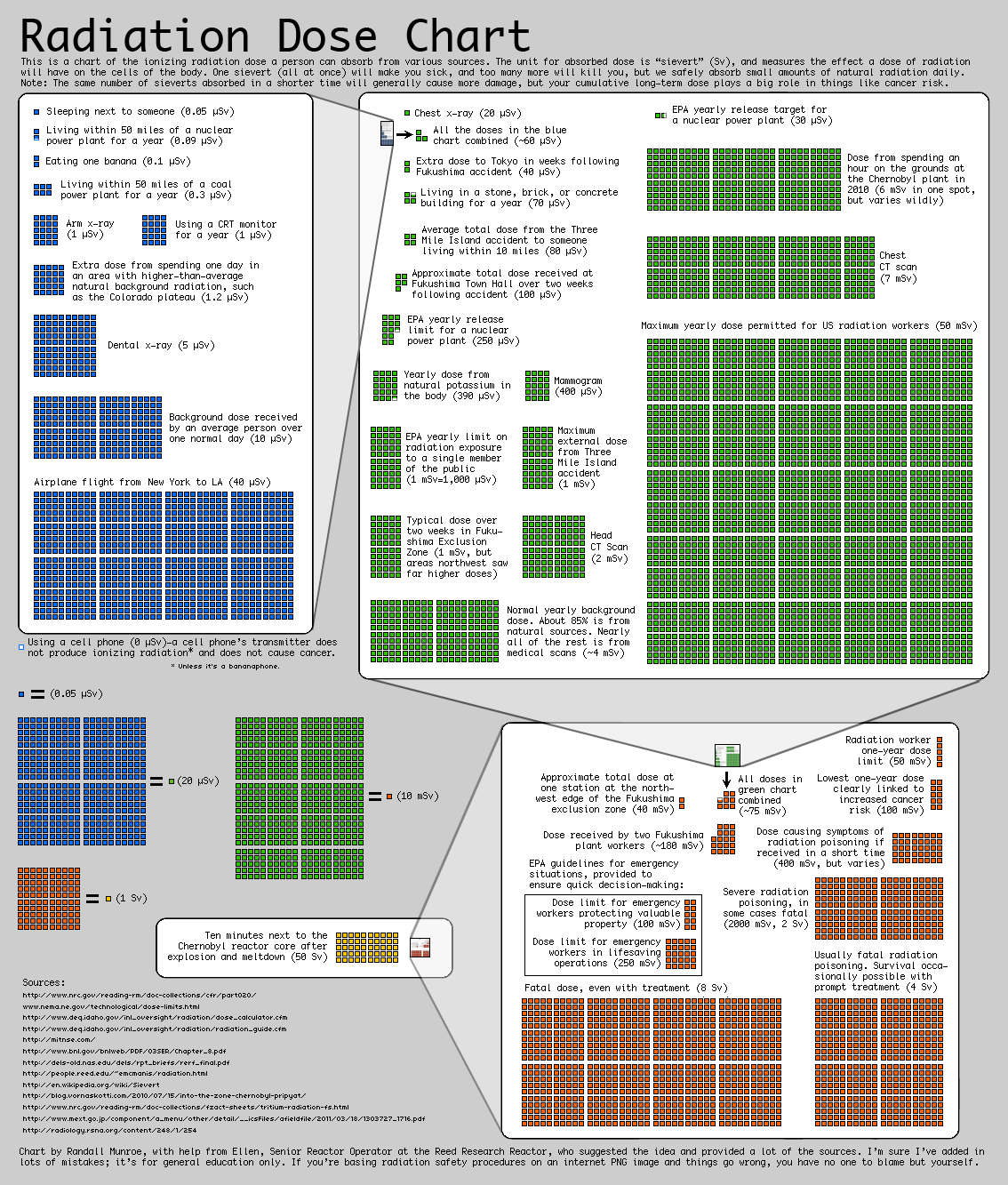
I recently read an account from an astronaut who spent 1 year living in space. What he described was the horrific impact that zero gravity environments have on the body. An impact which included weakening of his heart, bone loss, muscle loss, on a scale which resembles accelerated aging. We know for instance that humans begin losing muscle mass generally after age 30 or so at a rate of around 1% a year. We know humans lose bone density as well as humans age. The astronaut also mentioned that the amount of radiation he was exposed to was equal to 10 x rays per day where an xray is 0.10 units of radiation each and so 10 would be 1 unit of radiation per day which is a lot considering in a year a person is exposed to around 3 units.
By Randall Munroe (creator of xkcd) & Ellen [CC0], via Wikimedia Commons
This begs the question of what would it take for humans to participate in space travel? My conclusion is humans are not and never will be fit for space travel. We will have to become cyborgs for space travel beyond merely wearing a space suit but including possibly nano bots in the blood and microchip under the skin. AI will in my opinion best be suited for space exploration and in my opinion the only suitible use case for AGI is space exploration because of the potential abuses of AGI as a weapon and likely arms race for control of it's power and that is if the AGI doesn't get out of control.
Transhumanism is the key for space travel and why AGI belongs in space
By Donald Davis [Public domain], via Wikimedia Commons

Today a lot of people don't understand what transhumanism is or they may think it's some sort of plot of the elites. The truth is that the only way humanity is ever going to get off this planet is by transcending our human limitations. Humans aren't designed for space travel just as fish aren't designed to live on land or trees aren't designed to grow in the ocean. This means humans will have to use advanced technology to upgrade humanity enough to withstand the harsh realities of space travel. There may be many other planets which can sustain life but human life is only suited for this planet and even then in a very narrow range with regard to temperature, weather, oxygen level, etc.
AGI (advanced artificial intelligence) is safest in space in my opinion where it can study the universe far aware from humans with a lower risk of humans fighting over it or trying to shut it off in a panic. In addition the AGI could even be put to the task of terraforming other planets to make them more suitable for human like life.