
In this post, simplified examples are given to help understand the basic money flows of Steem.
Assumptions
- The market cap of STEEM is fixed to $1 million
- No moves(power up/down) between STEEM and Steem Power
- Annual inflation rate is 100% (approximate to the real number)
Basic Scenario
I will first explain a basic scenario in which 90% of STEEM exist as Steem Power and only 10% is liquid STEEM. The total supply is 100k STEEM, so a unit price of STEEM is $10. Let's assume that a Steem Power supply measured in VESTS is 1,000 M(illion). Since 90% of STEEM is in the VESTS fund pool, the exchange rate is 90 STEEM/VESTS, and hence the VESTS price will be $900.
- Total STEEM supply: 100,000 STEEM
- STEEM: 10,000 STEEM
- Steem Power: 1,000 M_VESTS (Fund pool: 90,000 STEEM, so the exchange rate is 90 STEEM/VESTS)
- STEEM Price: $10
- Steem Power(M_VESTS) Price: $900

After a year, with a creation of 100,000 more STEEM, we can find 90% of newly created STEEM went to Steem Power fund pool and 10% went to Rewards fund. With the doubled supply, the STEEM price will be halved to $5 ($1 million / 200,000 STEEM). However, since Steem Power fund pool increased to 180,000 STEEM, the unit value of VESTS does not change ($5 * 180 = $900). Additionally, we can see that $50k (or 10k STEEM) rewards are created. So where does $50k come from? The answer is STEEM holders. Their wealth decreased by $50k, while contents providers and curators got $50k.
- Total STEEM supply: 200,000 STEEM
- STEEM: 10,000 STEEM
- Steem Power: 1,000 M_VESTS (Fund pool: 180,000 STEEM, so the exchange rate is 180 STEEM/VESTS)
- Rewards: 10,000 STEEM equivalent
- STEEM Price: $5
- Steem Power(M_VESTS) Price: $900
What If All STEEM Is in Steem Power?
In this extreme case, 100% of STEEM exists as Steem Power. The exchange rate is 100 STEEM/VESTS, so the VESTS price will be $1,000.
- Total STEEM supply: 100,000 STEEM
- STEEM: 0 STEEM
- Steem Power: 1,000 M_VESTS (Fund pool: 100,000 STEEM)
- STEEM Price: $10
- Steem Power(M_VESTS) Price: $1,000
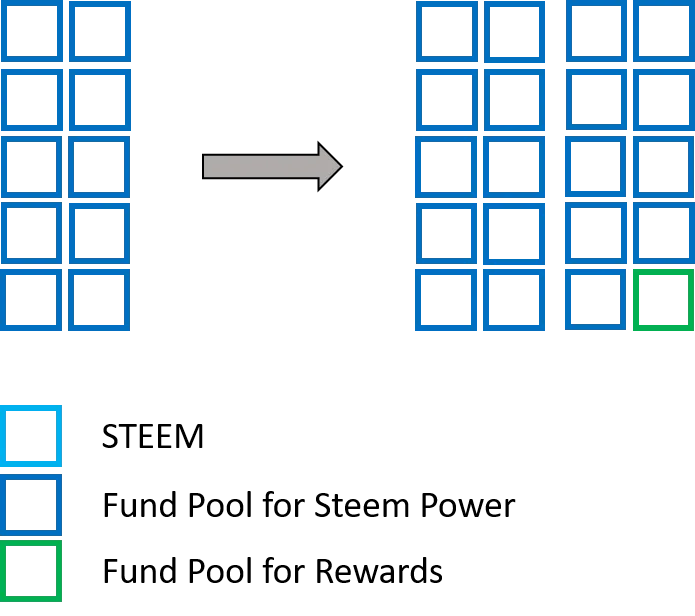
After a year, we can find that the value of Steem Power decreased by 5%. That is, under higher Steem Power ratio than 90%, Steem Power holders pay for rewards (Surely STEEM holders too).
- Total STEEM supply: 200,000 STEEM
- STEEM: 0 STEEM
- Steem Power: 1,000 M_VESTS (Fund pool: 190,000 STEEM)
- Rewards: 10,000 STEEM equivalent
- STEEM Price: $5
- Steem Power(M_VESTS) Price: $950
Too Many Liquid STEEM
What happens if exceed amount of STEEM is floating around? I assume that 50% of STEEM is liquid and the others are in Steem Power.
- Total STEEM supply: 100,000 STEEM
- STEEM: 50,000 STEEM
- Steem Power: 1,000 M_VESTS (Fund pool: 50,000 STEEM)
- STEEM Price: $10
- Steem Power(M_VESTS) Price: $500

After a year, interestingly, Steem Power holders obtained more wealth (in total $200k) and contents providers got $50k. This money comes from STEEM holders pocket. Their wealth a year ago was $500k but now its only $250k.
- Total STEEM supply: 200,000 STEEM
- STEEM: 50,000 STEEM
- Steem Power: 1,000 M_VESTS (Fund pool: 140,000 STEEM)
- Rewards: 10,000 STEEM equivalent
- STEEM Price: $5
- Steem Power(M_VESTS) Price: $700
Conclusions
In these simple examples, we discovered that rewards mainly come from STEEM holders by depreciating a unit STEEM value. But if Steem Power has exceeding weights (more than 90%), Steem Power holders also pay for rewards. It should be noted that if the ratio between STEEM and Steem Power (in terms of STEEM) is under 90%, there is a incentive to convert STEEM into Steem Power until the ratio gets to 10:90. Currently, the ratio is about 96.4%, so I expect there will be more Power downs until it's balanced.
Hopefully this post helps!