
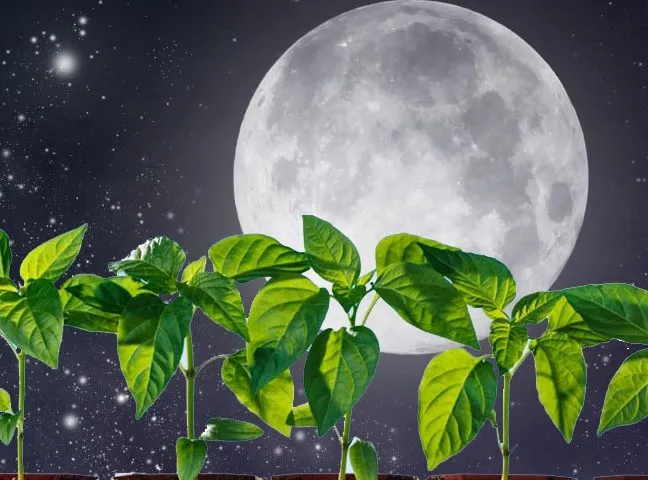
Influence of the Moon on the sowing, when to plant?
As a child I always listened to my grandfather who was a farmer talking about the lunar phases but I did not understand this, nowadays I still hear the same phrases, in fact when I go to plant, they always recommend me to know what moon phase I should do it, so I decided Find out a little more and this is what I found and now I share with you.
The saps of the plants, the photosynthesis or the rooting of the seeds are some of the stages of development that are affected by this satellite. Therefore, sowing one day or another, or what is the same, in a lunar or other stage, will mean that the plant thrives in a concrete way.
Therefore, it is worth knowing what the different lunar phases are and what effects they may cause on crops.
The influence of the moons in the oceans (high and low tides), in agriculture (tree pruning, sowing, harvesting, etc.) is nowadays an indisputable phenomenon. What most interests us in this article is to know the most convenient moons in the crops of vegetables, cereals and fruit trees as well as in the pruning and picking of the garden.
In ancestral agriculture, observation of the sun, the moon and other stars were common practices. This observation, together with the experience, is the origin of the popular wisdom transmitted from generation to generation and that in the current practice has been lost. Biodynamic agriculture tries to recover this ancient connection between the energy of heaven and earth. For this we can find in the market lunar biodynamic calendars that will guide us on the best moments for the realization of the various tasks of the garden, depending on the lunar phases, planetary aspects, etc.

The influence of each lunar phase in the cultivation of vegetables is as follows:
First quarter
The availability of moonlight is increasing and the plants have a balanced growth, which promotes the growth of foliage and root.
In this period within the soil there are large movements of water that affect their availability for the roots. As there is greater availability of water in the soil, the seeds will have the opportunity to absorb water more quickly and germinate in the foreseen time, as long as the climatic and soil conditions are favorable.
That is the reason why the seeds of fast germination (vegetables) that are planted two or three days before or at the beginning of this phase germinate faster and more homogeneously than those that are sown in other periods.
Full moon
In this phase the lunar light continues to increase and there is little root growth, but much foliage growth.
The plants have a greater amount and internal movement of water and sap. In the case of propagation through stakes and cuttings (pieces of stem) that are used for vegetative propagation, it is not convenient to cut them in this phase, since there is a lot of water inside them, the hormones that promote rooting (auxins) will be very diluted and will not help to stimulate the emission of roots. In addition, the water that is inside the stakes will tend to come out, causing rapid dehydration.
When the transplant is made in this period the plants tend to grow fast and produce a lot of foliage.
Fourth quarter
In this phase the intensity of the lunar rays begin to diminish.
This is a good period for the transplant and has seen a rapid and vigorous growth of roots. When there is little light, the growth of the foliage is slow, which is why the plant can use a good part of its energy in the growth of its root system. With its vigorous and well-formed root, the plant can obtain sufficient nutrients and water for a successful growth.
New Moon
In this phase the intensity of the lunar rays continue to decrease to lower levels.
In this phase, a slow growth of the root system and foliage has been observed. Apparently this is a period of little or very little growth, like at rest, where plants can easily adapt to the environment without suffering any damage.
Many farmers prefer to perform their agricultural work in this period of rest, because they believe that plants can adapt more easily to changes and prepare for the next period (New Moon to growing quarter) in which balanced growth of plants is expected . The tasks performed are hilling, weeding, pruning, desahyjes, tutorados, fertilizers, etc.
FRUITCULTURE
- All operations performed in a new moon or in a growing quarter, will produce a greater vegetative development, resulting in a delay in the production of the fruit.
- The work carried out in full moon or waning quarter, will favor fruit production, favoring less vegetative development.
- With regard to pruning, if the tree is small or we are interested in developing it vegetatively, it is best to prune it in a new moon or in a growing quarter. If by the contrary what we are looking for is a brake on its vigor, or an early entry into production, it is best to prune it in a full moon or in a waning quarter.
CEREALS
If we seek that the soil is fine, spongy and with a greater water retention capacity, the plot should be carved in full moon or quarter waning, during the month of August.
Reference to the sowing, in fertile lands it will be done in a waning quarter in order to favor the fructification, avoiding in this way that the cereal grows too much. If the land is not too fertile, or does not have irrigation possibilities, it will be necessary to spread the seed in a growing quarter. In this way, plants with a tendency to vegetative development will be achieved, avoiding excessive fruiting.
The rest of operations (weeding, mowing, threshing, harvesting ...) must be carried out at the end of the waning phase to ensure that the grain is in the best conditions for storage.
On the other hand, it is good to know that the oats, wheat, barley and rye favor the sowing of the waning moon in the rising moon and the harvest in the same moons.

AGRICULTURE, HORTICULTURE AND GARDENING
The works of the field, such as tilling, planting, transplant, fertilize, etc., are usually more effective if we perform them in the descending moon.
When we need to remove the soil of the sandy type with either plows, milling or cultivators or a simple hoe, it will be preferable to match the descending moon with the crescent moon.
On the other hand if the earth is of the clay type it will be preferable should coincide with the waning moon.
If the task we wish to carry out is to clean competent grasses, we will do it better from the full moon, that is, when the moon begins to decline, preferably from the waning crescent moon. Likewise, if it is desired to till and prevent the germination of wild herbs, it will be preferable to carry out such work on moonless nights, since light triggers the process of germination.
To prevent the birth of vines and thistles, we must work the earth when it is dry. To clear thorns, brambles and other invasive plants perform it better in a waning moon approaching a new moon.
Seeding and planting: in addition to the appropriate moons we must bear in mind that it is preferable to plant in the morning and plant in the afternoon.
So that we understand well the concepts of planting and planting, we will say that for example, potatoes, radishes, carrots, wheat, barley, etc., are sown while fruit trees, various plants, etc. they are planted.
ANIMALS
- Lifting livestock: Between the first quarter and the fourth quarter.
- Matching cows and mares: Between crescent and full moon.
- Spare sheep: between crescent and full moon
- Clothing of hooves: in crescent moon
- Label cleaning: During the crescent moon
- Treatment against worms: two or three days before full moon or new moon.
- Match rabbits: between new moon and crescent
- Polls and chickens: if you wish to leave eggs to incubate, it is preferable to collect them in the fourth quarter moon. If it is desired to have chickens of the eggs that we incubate, it is preferable to incubate the ones collected in a crescent moon.