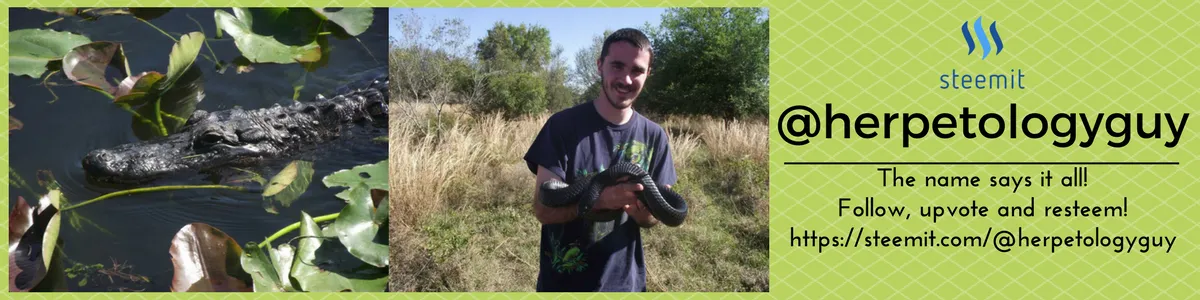
I love writing on steemit; on no other platform have I ever captured such a large audience or connected with people in so many distant places. Through posts, comments and steemit.chat, I have had lengthy conversations with people from Australia, India, Thailand, Indonesia, as well as much of Europe, Asia, Africa and South America. Being able to talk about my passion for reptiles and amphibians on a global scale (and have people listen!) is something I didn't really expect when I joined steemit...but it is awesome! I have found that people are really interested in what I have to say about these animals that are often feared or misunderstood, and I have connected with many others with similar interests. However, I did find that steemit presented a major challenge to me as a herpetologist, one I had never considered until I was communicating with others on a global scale.

Steemit is not my first herpetological blog. I run a (much less successful) blog for our facility, where I share tidbits about our animals and their lives here in captivity. Unfortunately, the blog sees very little traffic (partly because it is so difficult to find on our webpage, but what do I know?); I only get a few views per blog post, and perhaps a single comment once every few months. It is frustrating to say the least; because it requires a decent amount of time to write posts and receives so little attention, there is little incentive to post regularly. When I joined steemit, I expected the same kind of deal and most of my earliest posts were fairly similar to my previous blog; I would write about local reptiles and amphibians and my experiences, but as I got more attention, I started seeing a small problem (one I still have to consider for each post I write).
The problem is that it is difficult to talk about herptiles on a large, global scale. When talking about reptiles and amphibians, in terms of identifications, behavior, etc., there are certain "general rules" we follow but, of course, there are always exceptions to these rules. I had always been so focused on local species and I realized that, as I started reaching a larger, more distant audience, my information was not always accurate. For example, here at our facility, I tell visitors that you can identify a venomous snake by its triangular head and thick, short body. This rule works perfectly here in Virginia, where all of our venomous species are pit vipers; however, outside Virginia, this rule no longer applies; venomous species like cobras often have rounded heads similar to nonvenomous species, and may have a very long and thin body. People following the triangle head rule can run into serious trouble.

Even writing generalities can be dangerous. My most recent posts have been focused on venomous snakes, and I have mentioned that these animals, though potentially hazardous, are generally docile, preferring only to strike in defense. By and large they are, however someone living in Sub-Saharan Africa might find such a claim to be false; the black mamba is a highly venomous snake known to be quite territorial and may even actively chase a human. I've also stated that nonvenomous species heavily outnumber venomous species so you are less likely to run into one, however such a claim is almost laughable to someone from Australia, where venomous species actually outnumber nonvenomous species.

This may not seem like a huge problem, but it makes writing posts just a bit more challenging for 

While I am confident in the claims I make here on steemit, always be prepared for an unusual scenario. There are no universal rules in the world of herpetology, and I may write something as fact that you know to be untrue in your region. Many of my posts take days or even weeks for me to properly edit and publish; when writing about venomous or particularly dangerous species, I want to be as careful as possible that my posts do not put people into potentially dangerous situations by providing incorrect information. This is where I urge you to learn more, to keep yourself safe and better understand the natural world around you! Hopefully my posts can ignite a passion in my readers, but it is up to them to continue that education!