

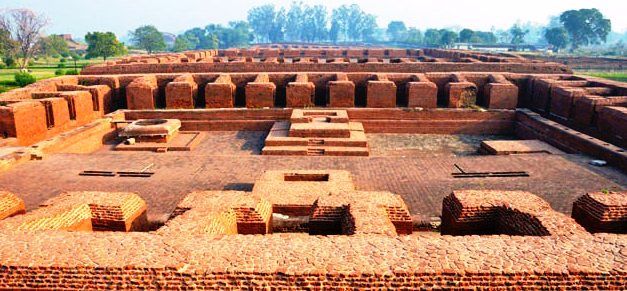


Nalanda University was one of the first universities in the world, founded in the 5th Century BC, and reported to have been visited by the Buddha during his lifetime. At its peak, in the 7th century AD, Nalanda held some 10,000 students and 2000 teachers when it was visited by the Chinese scholar Xuanzang.
Historical studies indicate that the University of Nalanda was established during the reign of the Gupta emperor Kumargupta. Both Xuanzang and Prajñavarman cite him as the founder, as does a seal discovered at the site.


Nalanda an ancient religious higher learnign center located around 88 km south east of patna in state of bihar India.
is now one of the most visited historical and architectural land marks of the country.
The institution was supported by the gupta rulers, Buddhist emperors like Harshavardhana as well as the later pala emperors.
History of nalanda university
The establishment of the ancient Nalanda as an undisputed seat of learning was a natural consequence of the time and place in which it was situated. Ancient Magadha was characterized by an intellectual ferment unlike any known to mankind. Nalanda University was able to meld multiple discourses and to embrace knowledge in its entirety to become uniquely attractive for all seekers of pure knowledge.
Historical sources indicate that the University had a long and illustrious life which lasted almost continually for 800 years from the fifth to the twelfth century CE. It was a completely residential university believed to have 2,000 teachers and 10,000 students. The Nalanda ruins reveal through their architectural components the holistic nature of knowledge that was sought and imparted at this University. It suggests a seamless co-existence between nature and man and between living and learning.