
The lunar eclipse or Blood Moon this weekend was, besides the Mars opposition, the celestial highlight of the month. Of course, I did not miss the opportunity to take part in this event and to take a few photos of this spectacle. Unfortunately, the luck was not with me. The Moon rose up behind the neighbor's house when he was already out of the core shadow (Umbra).
In this post, I also would like to discuss how the lunar eclipse works and why the Moon turns into this "bloody" red.
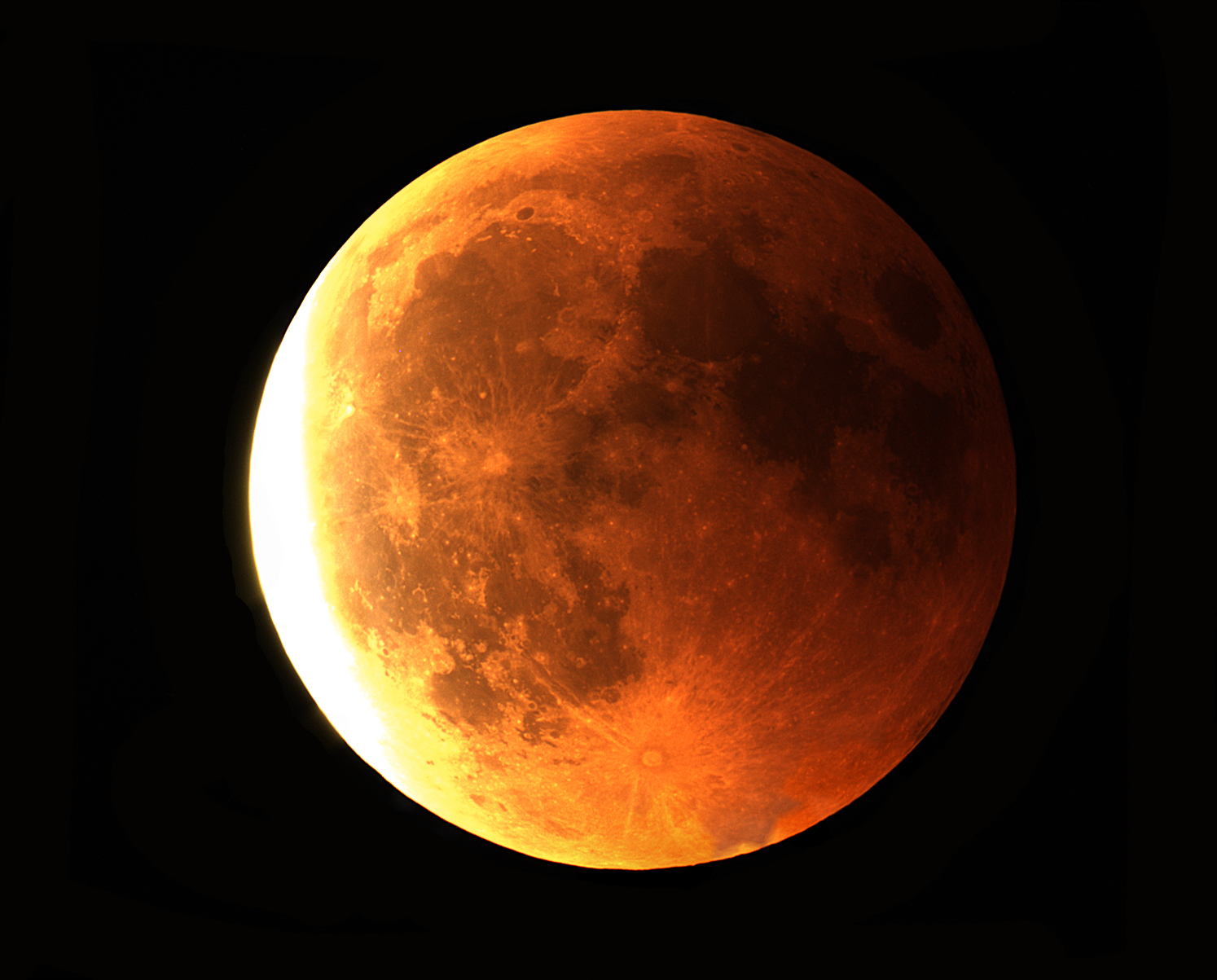
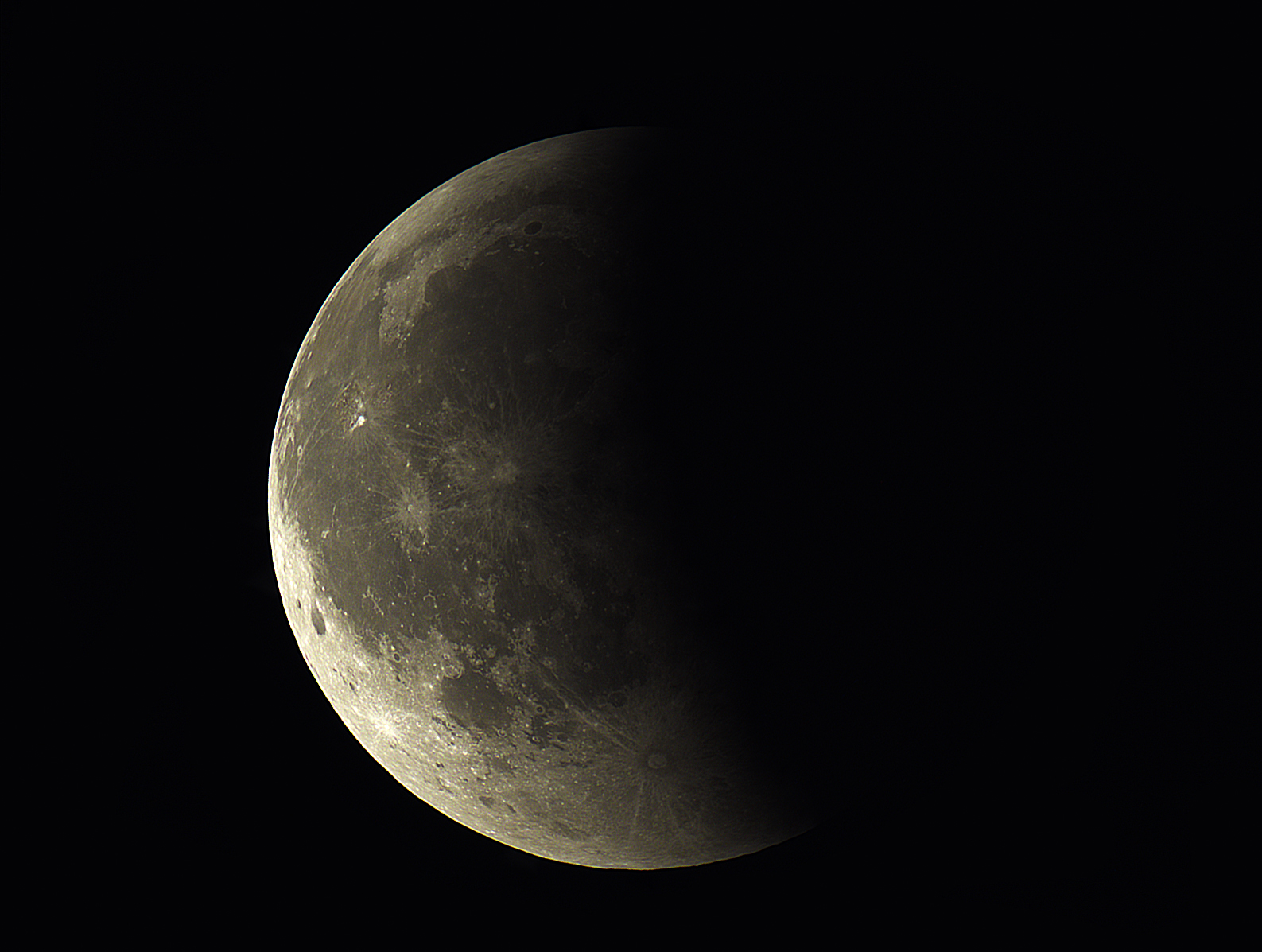
This was the first image I was able to take on this evening. It was made on 23:18 CET, right after the Moon was visible for me.
You see that the left and overexposed part has already left the core shadow (Umbra).
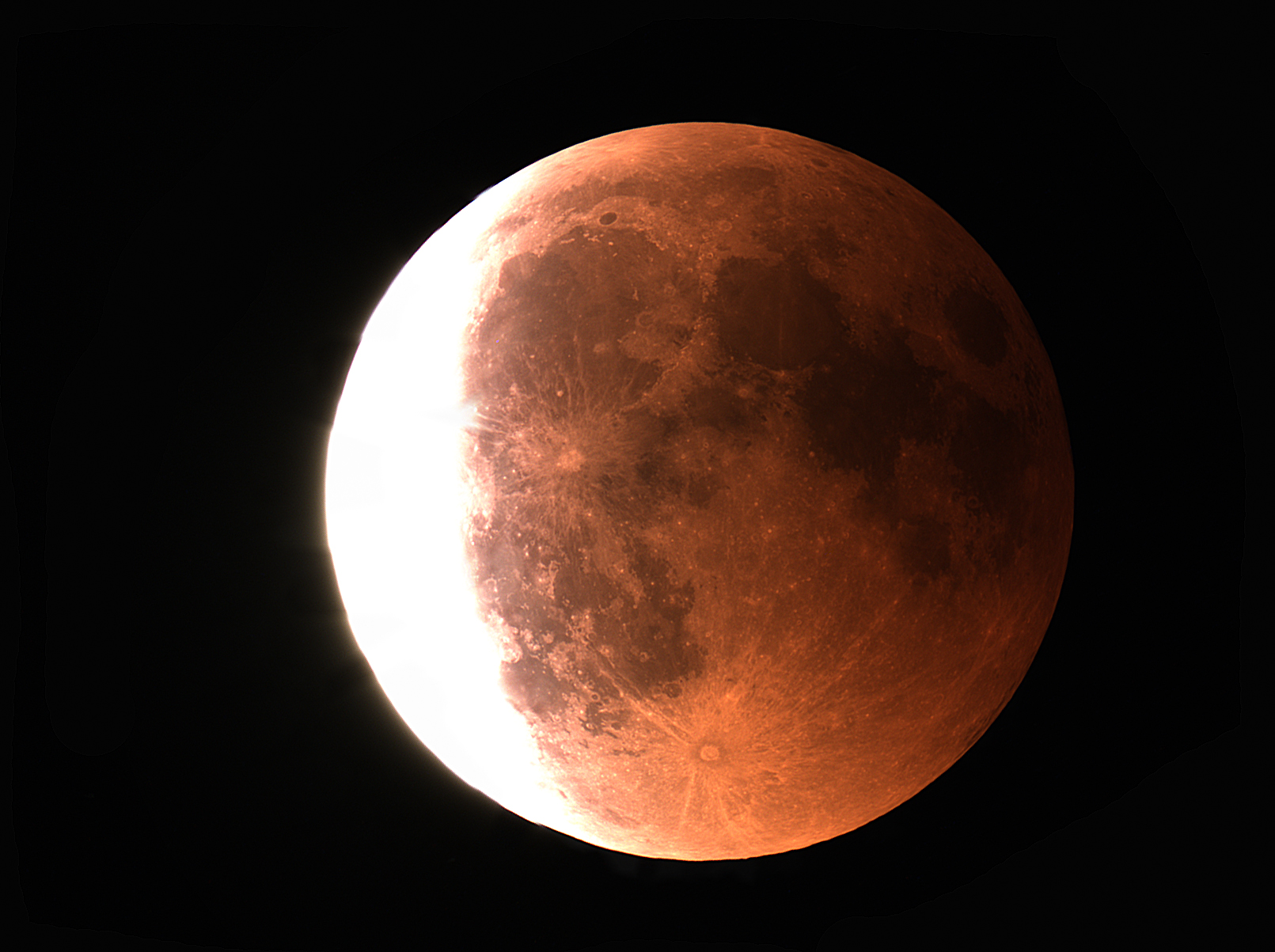
The second image was taken on 23:24 CET. As you can see from the changed size of the full lighted area, you can see how fast the shadow moves.
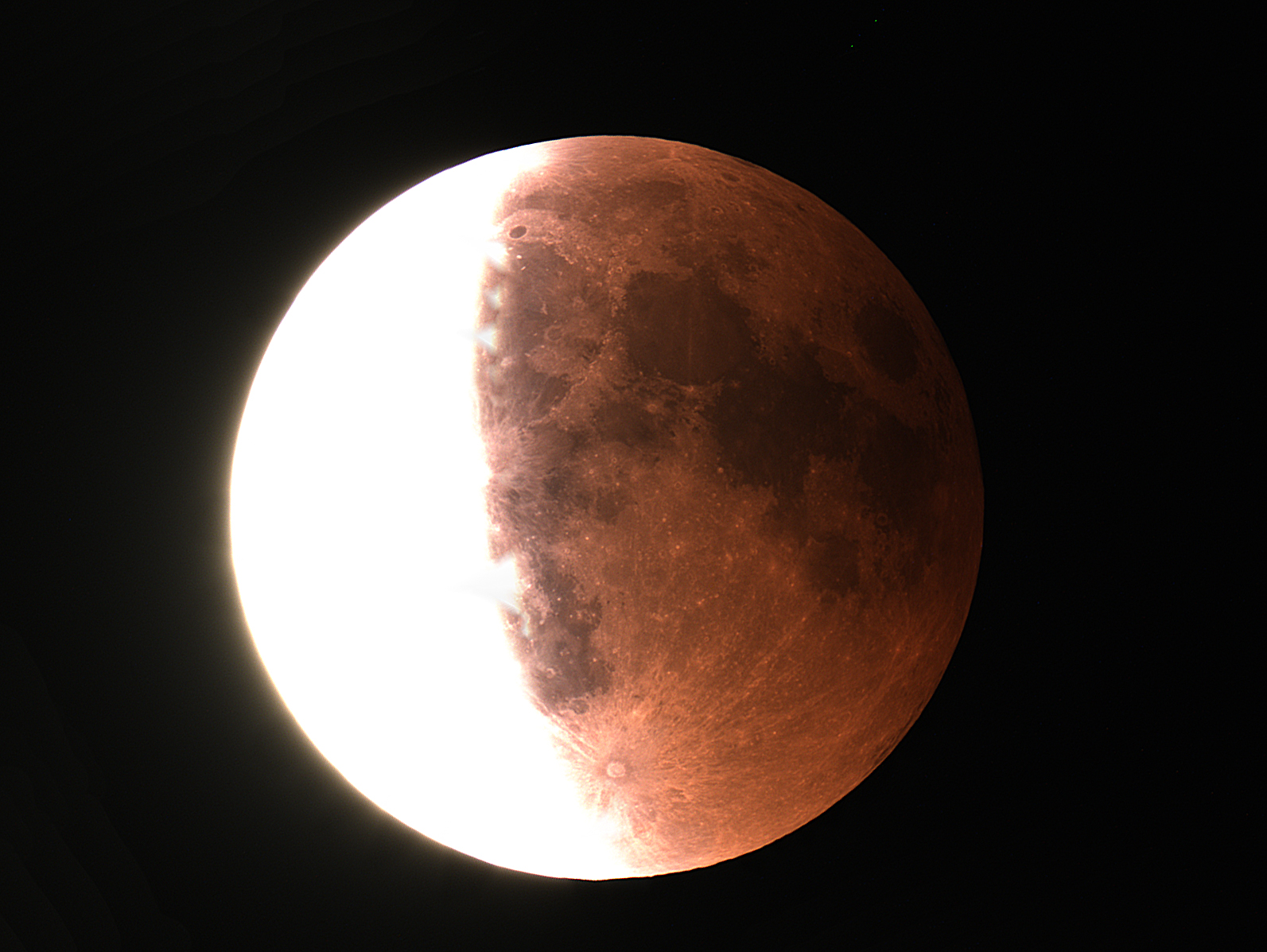
And this image is from 23:35 CET.
I also tried to get images of the part of the Moon that has already left the Umbra. The picture was taken on 23:39 CET.
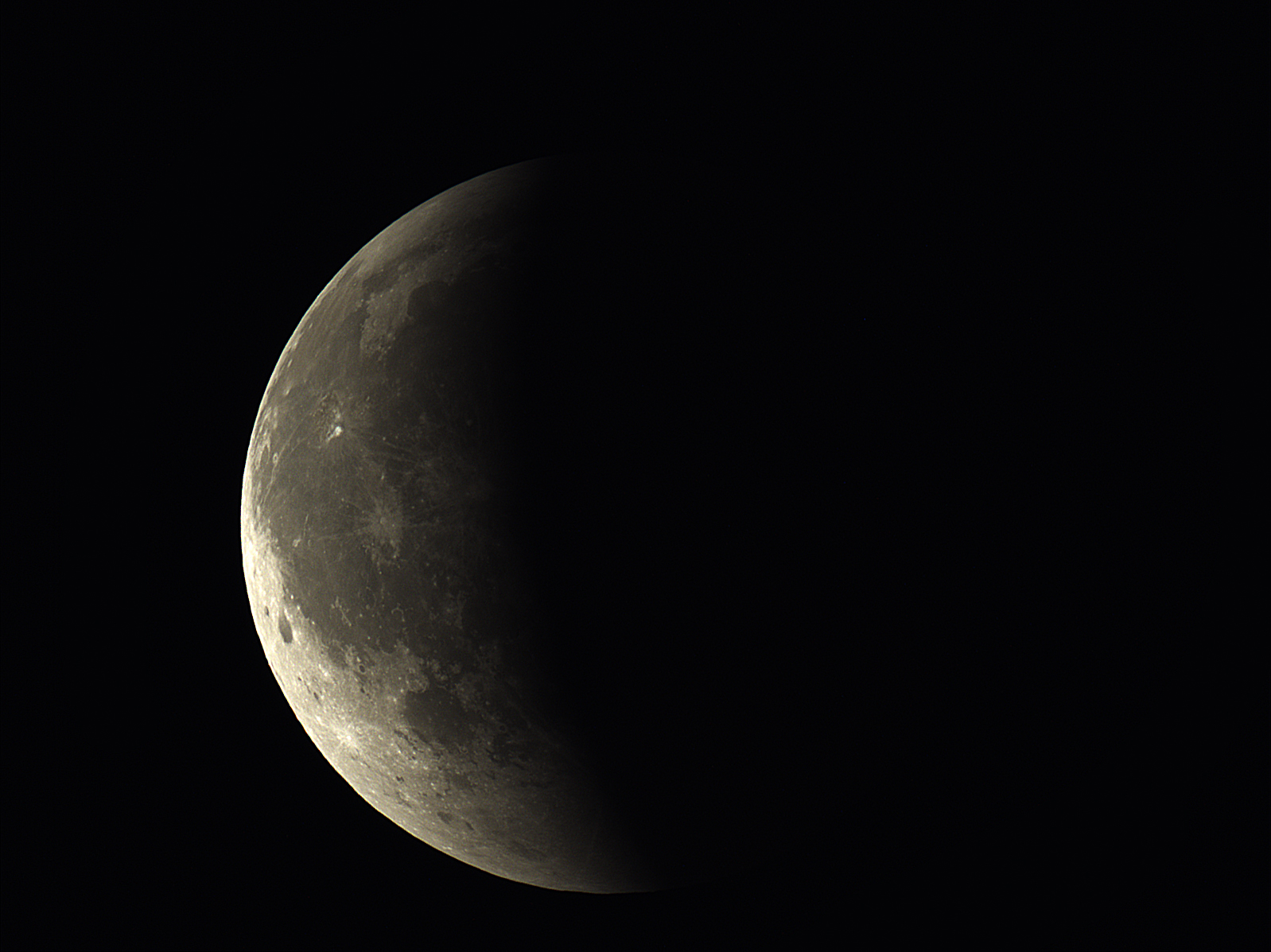
And this image is from 23:48 CET.
How fast does the shadow move across the Moon's surface?
We can do a little math to calculate the speed roughly.
Due to the stacking process, the pictures do not have precisely the same size. So first we need to bring the first and the third picture of the blood Moon to the same size. Now we can measure the width of the Moon and the lighted area in the image.
The width of the Moon = 948 pixels
The width/movement of the lighted area (difference from picture 1 to picture 3) = 248 pixels
The Moons circumference is 10,921 km, so its half circumference (total visible distance on the photo from left to right at the Moons equator) is 5,460.5 km.
We can calculate how far the ligthed area moved in the following way:
5,460.5 km / 948 px * 248 px = ~1,428.49 km
We also know the time it took to travel this distance. Its difference in time between the first and the third image.
23:35 - 23:18 = 00:17
The shadow moved 1,428.49 km in 17 minutes. Extrapolated to a full hour, this results in a speed of (1,428.49 km / 17 min * 60 min) = ~5,041.73 km/h
So the shadow comes and goes with a speed of around 5,042 km/h on the surface of the Moon right under the equator.
How does a Moon eclipse work?
A lunar eclipse is not as rare as a solar eclipse. However, it can only occur at a full Moon and when the Moon is at a particular angle to the Earth. When the Moon is precisely in the shadow of the Earth, you can observe a lunar eclipse from almost every part of Earth where it is at night. If the Moon enters the Earth's shadow completely, then it is a total lunar eclipse like we had this weekend. In contrast, if the Moon dives only partially into the shadow of the earth, it is a partial eclipse.
This image will visualize the angle and the position the Moon must have that a lunar eclipse can happen. A lunar eclipse can occur at the lunar positions 1 and 4. At the lunar positions 2 and 3, a solar eclipse will occur.
Copyright: Ben-Zin, CC BY-SA 3.0
To visualize the movement of the Moon through the shadow of the Earth, I have tried to make this little animation in Blender, Photoshop, and Premiere. OK... I have seen a lot better animations, but after 3 days of tutorials and "trial and error", I hope it helps a little bit to understand.
Please note, this animation is not to scale.
Distance from Sun to Earth nearly in scale
For fun, I have tried to represent the distance from the sun to the earth and its sizes in scale. Funnily, the picture is no longer displayed. It has a resolution of 695 x 75,269 pixels. If you want to see it, you have to download it and view it in a picture program in the 100% view. The earth and the Moon are pretty much on the right side. Unfortunately, this image is also not 100% true to scale, as there are no half and 3/4 pixels.
Oh yes ... Attention, the sun is dazzling.
Sonne_Erde_Mond_Massstab.png
Why is the Moon red during a total lunar eclipse?
The Moon appears in a red hue because the sunlight is refracted inward by the earth's atmosphere. As a result, the blue, short-wave light components are weakened most by scattering, resulting in a higher proportion of long-wave light. Because red light has the longest wavelength in the visible range and therefore is not scattered so much, the Moon shines in this "bloody" red.
Hence the name "Blood Moon".
In my first picture, you can see the red / yellow gradient, as you can see in the graphic.
Copyright: NASA's Goddard Space Flight Center; public domain
Details of the pictures that were captured by me:
The pictures were taken from my backyard with the following settings and equipment.
Light frames where captured as uncompressed AVI video with around 1000 frames for each picture. For stacking, I have used the best 80% of the frames.
Camera: QHYCCD247C
Scope: TSAPO65Q · 420mm · f6.5
Guide camera: QHY5L-II
Guide scope: TSL60D · 240mm · f4.0
Mount: Skywatcher AZ EQ-6
All is controlled by my Astro-PC over Remote-Desktop and wireless LAN.
Software: SharpCap, AviStack 2.0, Photoshop CC
References:
https://de.wikipedia.org/wiki/Mondfinsternis
http://www.clearskyblog.de/2016/07/21/die-groessen-im-sonnensystem-als-vergleich
https://svs.gsfc.nasa.gov/11828
If you like those pictures and if you are curious about space, the universe and all the big things far away from our planet, visit @terrylovejoy. Also, do not miss his photos of the lunar eclipse, which were taken from nearly the other side of the Earth.
https://steemit.com/teamaustralia/@terrylovejoy/2018-july-lunar-eclipse-from-brisbane-australia
Thank you very much for visiting and reading!
I hope that this has been a useful article for you. If you have any questions or suggestions, please don't be afraid to let me know of anything you thought about this post!
Yours,
@astrophoto.kevin
All images, otherwise clearly indicated, in this post are my own work.
You can use it for free if you credit them to @astrophoto.kevin