
Belemnitida is an extinct order of cephalopods that roamed the oceans for close to 140 million years. It was wiped out around 65 million years ago at the end of the Cretacious Period. It is presumed that the same extinction event that got the dinosaurs got this cephalopod as well.
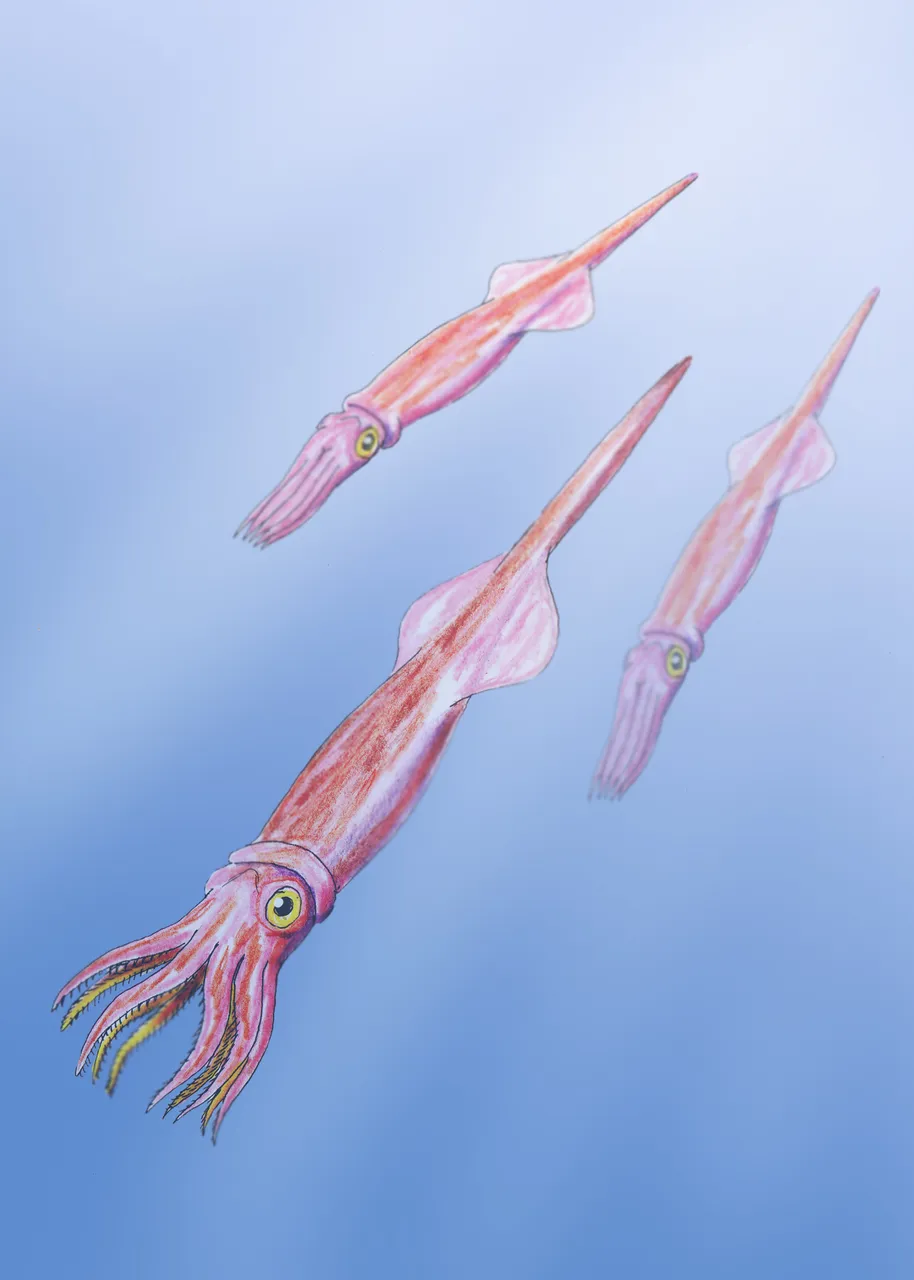
The above picture is an excellent depiction of what the belemnites looked like. Belemnites were squid-like cephalopods. They had 10 equal length arms that were studded with small inward-curving hooks that were used to grasp onto prey and then relay the prey into its beak. Belemnites, unlike modern-day squids (except the spirula), had hard internal skeletons. This helped with using their chambered shell to help with buoyancy. Some other cephalopods such as nautiloids, spirula, and ammonoids have a chambered shell to assist with buoyancy too, but they lack a counterweight in the back like the belemnites had. What was this counterweight? It's called a rostrum or guard: a heavy, solid "bullet-like" structure at the end of the belemnite. The rostrum/guard of belemnites is one of the most common belemnite fossils that are found as they are spread worldwide. Below I have posted some pictures of belemnite fossils I have found while fossil hunting in the Little Pee Dee River.
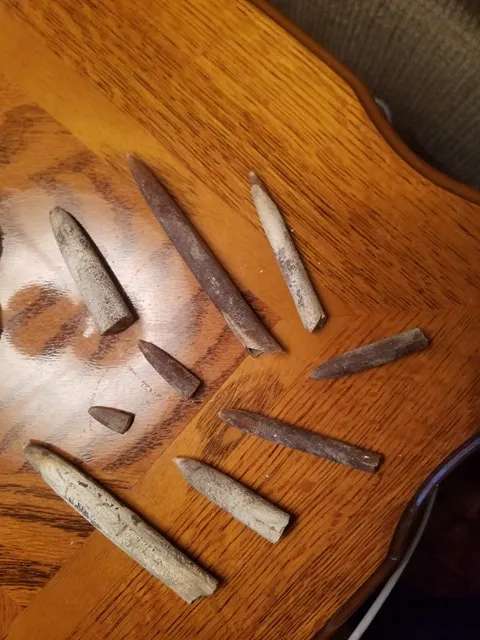


Guards are composed of calcite which can explain why they fossilize so well. I believe these to be guards from Belemnopsis bessina and Cylindroteuthis, please correct me if I'm wrong. I used this website as a reference for which species of belemnite the guards are from.
Indicators
Belemnites are used as indicators for palaeo-temperatures, oxygen isotopes, and carbon isotopes.
there is strong evidence that belemnite rostra preserve original isotopic values despite pervasive diagenesis of the host rock. Well-preserved belemnite shells (non-luminescent to slightly luminescent) typically show stable isotope values of +4·3‰ to –0·7‰δ13C, +0·7‰ to –3·2‰δ18O, and trace element contents of <32 μg g–1 Mn, <250 μg g–1 Fe, >950 μg g–1Sr and Sr/Mn ratios >80 (Rosales et al., 2001).
The above values essentially mean that belemnites are pretty good indicators of what the climate and general ecosystem of the Earth were during the Mesozoic.
Internal Skeleton
The rest of the internal structure consisted of a phragmocone, a protoconch, an alveolus, and the proostracum. The forward side of the phragmocone is where the protoconch can be found while the guard can be found on the other end. The protoconch is attached to the phragmocone and is located underneath the guard. The thin area between the phragmocone and guard is called the alveolus.
The phragmocone is a chambered, conical shell. The protoconch can be spherical or cuplike and is the remains of the leftover shell. The proostracum is spoon-like, fragile, and extends over the dorsal section of the mantle.

Soft Parts
In 1826, Mary Anning discovered an ink chamber inside of a fossilized belemnite. So, like many of today's cephalopods, belemnites had ink sacs. Other fossils have been found that show an ink sac, large eyes, a tail fin, a hard beak, and muscle fibers in the mantle that suggest they were strong swimmers.
Predation
Belemnites were probably active hunters. This is speculated because of the aforementioned hooks on their arms. Smaller belemnites probably preyed on crustaceans such as ostracods and the larger belemnites probably preyed on fish and larger crustaceans. This is just speculation but more than likely to be the case when comparing the structure of the bodies to modern-day predators of similar body types (other cephalopods).
Belemnites swam in near-shore to mid-shelf oceans (Monks et al., 1996).
This reinforces the predation on crustaceans as they are typically found near shores and at mid-shelves.
Swimming
Since belemnites had hard internal structures it is unlikely that they were able to swim as well as modern-day squids, but their body suggests that they were built for speed. As the artist's drawing of the belemnite showed, their bodies were quite streamlined: designed to present little resistance to air or water flow and allow easier movement and increased speed. They were neutrally buoyant, thanks to their counterweights, so they did not have to expend extra energy to stay upright, this would make them even more efficient at hunting during their time period.
Prey
Belemnites were common food for many marine reptiles. This is known because remains of belemnite hooks have been found inside fossilized stomachs of the reptiles.
Sources:
https://en.wikipedia.org/wiki/Belemnitida
https://www.tonmo.com/pages/belemnites/
https://ukfossils.co.uk/2012/08/28/an-introduction-to-belemnites/
https://statesymbolsusa.org/symbol-official-item/delaware/state-dinosaur-fossil/belemnite
https://simple.wikipedia.org/wiki/Belemnite
Rosales, I., Quesada, S. and Robles, S. (2001), Primary and diagenetic isotopic signals in fossils and hemipelagic carbonates: the Lower Jurassic of northern Spain. Sedimentology, 48: 1149–1169. doi:10.1046/j.1365-3091.2001.00412.x
Neale Monks, J. David Hardwick and Andrew S. Gale 1996. The function of the Belemnite guard. Paläontologische Zeitschrift 70, Numbers 3-4, 425-431, DOI: 10.1007/BF02988082

