
Let's talk about science: Bose-Einstein Condensate.
Hello steemians, today I would like to return to the usual theme of my post and talk about something that many may not know and is that there is currently a fifth state of matter and is the Bose-Einstein condensate.
Condensate of Bose-Einstein.

Public Domain
It is a quantum phenomenon that originates at macroscopic levels. This new state of matter was prophesied by Albert Einstein. Einstein took advantage of the statistical approach proposed by Bose and applied it to an ideal gas with the same atoms that they found in thermal equilibrium within a box.
The Bose-Einstein condensate is basically a state of matter in which a gas behaves like a large quantum system instead of many separate quantum systems, or a congregation of atoms. It originates at extremely low temperatures, almost close to absolute zero.
The main characteristic of this state of matter is that the atoms behave in the same way, acting all as a superatom.
How was it verified?
The Bose-Einstein condensate was taken at the beginning as a simple prediction, by many scientists thanks to the impossibility that had to be proven for almost 70 years. However, in 1995 a group of physicists managed to carry out an experiment through which they were able to verify the truth in Einstein's prophecy.
The verification of what is now known as the fifth state of matter was thanks to an experiment that consisted in the implementation of lasers to reduce the temperature of the particles to a point close to the absolute zero temperature, so that later these particles grouped themselves into a large cluster of individuals whose atoms were synchronized in their quantum states in such a way that they behaved like a single great atom.
This basically means that all the atoms are absolutely the same. There is no measure that can differentiate one from the other. It is a state of impressive microscopic quantum coherence.

Author: vulgarisation
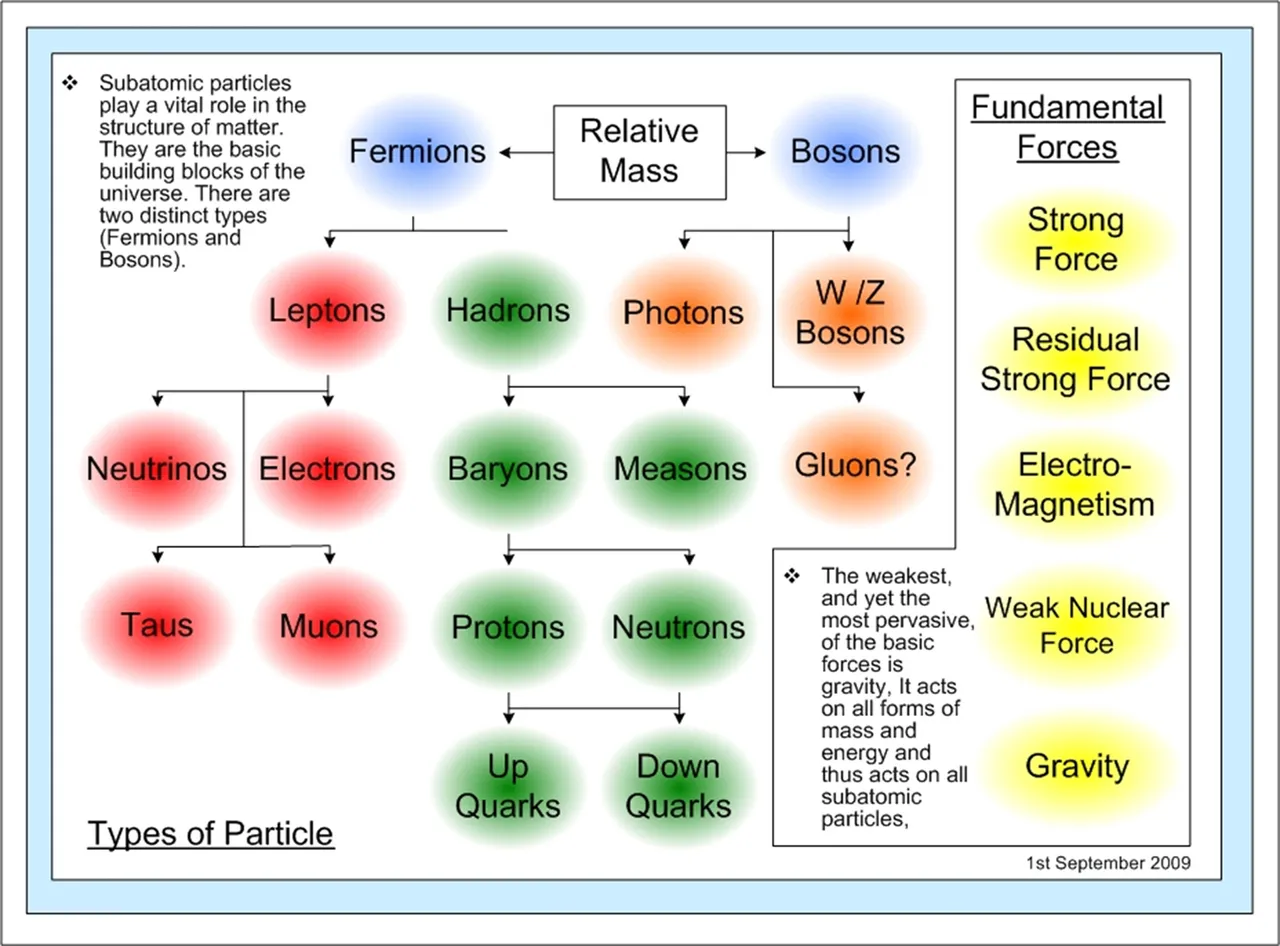
However, not all particles are capable of having a condensed state:

Public Domain
Fermions: By complying with the Pauli exclusion principle, they can not be grouped in the same quantum state at the same time. Some examples of fermions are quarks and leptons.
Bosons: They do not fulfill with the Pauli exclusion principle, so two or more bosons can be grouped in the same quantum state. Some examples of Bosons are photons and gluons.
Public Domain
There is a general rule to determine the type of particles and is that the groups of particles made by an odd number of fermions are fermions, and any system made by an even number of fermions or any number of bosons are bosons.
Thanks to this feature of the bosons, if a very diluted gaseous sample lowers its temperature to values very close to absolute zero, a significant number of these particles will lose practically all of their kinetic energy.
How important was the verification of the Bose-Einstein condensate?
The verification of what many years before theorized these two geniuses of science, meant the opening to the investigation of great quantum phenomena through the application of these macroscopic quantum systems and also the development of quantum computers, which have really revolutionized the world of scientific research, but perhaps the most interesting contribution that has been made in the verification of this state of matter has been the possibility it offers to erect simulations of complex systems, of unimaginably large numbers of particles with each of their interactions, that would contribute to the understanding of phenomena so far too complex and complicated for us.
References.
- Bose–Einstein condensate - Wikipedia
- What are the properties of a Bose Einstein Condensate? -
- States of Matter: Bose-Einstein Condensate - Livescience
- Bose-Einstein condensation - Youtube
- Bose-Einstein condensate - Britannica
- The First Experiments with Bose-Einstein Condensation of 87Rb - JILA, University of Colorado
- The Discovery of Bose-Einstein Condensation: Confirmation After 70 Years - Stanford Encyclopedia of Philosophy
SteemSTEM
SteemSTEM is a community-driven project that now runs on Steemit for more than a year. We seek to build a community of science lovers on Steemit and to promote well written/informative Science Technology Engineering and Mathematics (STEM) postings in order to make Steemit a place for fascinating STEM content.
So if you want to read more scientific articles of good quality, visit the hashtag #steemstem and scienceON.

Disclaimer:
[1] All the content exposed in this post is a compilation of different sources besides my knowledge in the subject.
[2] All the images used are correctly labeled for reuse.