
Scientific News #10
This week's edition of the Science News is a colorful bouquet of diverse, intriguing research. I hope you find this selection as exciting as I do!
Source of Original: pixabay

Topic #25: Impressive Concept for Retinal Prostheses
Thanks to our sense of sight we get a lot of important information about our environment. The loss of this sense is a massive burden and requires an equally tremendous adaption. Degenerative diseases of the retina - eg. retinitis pigmentosa - lead to irreversible damage or even loss of retinal photoreceptors. Eventually this results in blindness.
In developing retinal prostheses research faces huge challenges, hence they must be biocompatible, light-sensitive or, even better, wavelength-sensitive, allow for good spatial resolution and signal generation, transduction and processing in the smallest possible space.
Source: pixabay
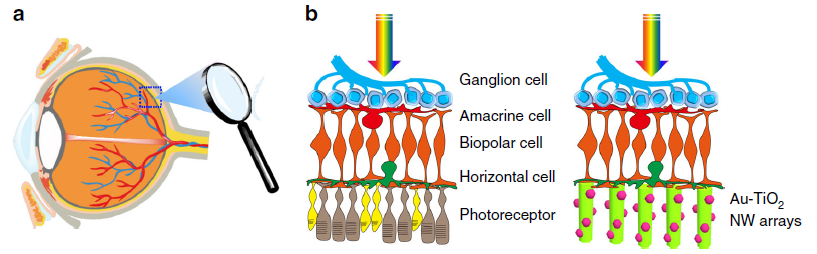
Inspired by the structure and function of the natural photoreceptors in retinas, Jing Tang and colleagues have developed artificial photoreceptors, that consist of titanium dioxide nanowires which surfaces are decorated with gold nanoparticles. If these semiconducting nanowires are produced in an ordered, one-dimensional form, that gives an array, which basically has necessary and similar properties as the natural model:
- high surface area
- large charge transport mobility
- excellent biocompatibility
- high stability
- highly anisotropic arrangement
a. Illustration of an eye. b. Illustration of the biomimetic structure of the nano-wire-interface retinal prosthesis.
Quelle: Nature Communications
The proposed and produced photoreceptors were tested in blind mice with degenerative photoreceptors and gave quite decent results. After irradiation with UV light, the researchers found a strong reaction of the ganglion cells behind the photoreceptors, indicating biocompatibility and bioacceptance of the artificial sensors. This finding also applies to green and blue light, but the number of responding ganglion cells was much lower there. The possible spatial resolution was determined to be about 100 μm.
Their work is still a long way from the medical application, but it is a decidedly good idea and the so far shown performance gives hope for more potential. In any case, it is driving the development of a new generation of optoelectronic, subretinal prosthetic devices.
The comprehensive paper is freely accessible and can be found here:
- Jing Tang, et al. Nature Communications, 2018, 9, Art. Number: 786
Topic #26: Research on more efficient crop cultivation
The ever-growing human population needs a huge amount of food. For reasons of sustainability and also for purely practical reasons we can not simply plant larger and larger fields and grazing areas. Hence our crops have already been breed to more efficient varieties which are used nowadays.
But our population does not stop to grow and not only soil and its' nutrients are necessary for growth, but also precious water, which is a scarce good in many places. For this reason, a research team aimed to develop an as universal method as possible to reduce the water requirement per unit mass of crop produced.
Source: pixabay

The stoma of plants is both responsible for the necessary uptake of CO2, but it also facilitates the transpiration and therefore loss of water. Since Carbondioxide is converted to the relevant substances in the process of photosynthesis, they developed an approach that aimed to influence the photosystem.
They studied a number of transgenic tobacco plants in which the Photosystem II Subunit (PsbS) expression is increased. This seems to have been the right approach, because they found that variants with increased production of this photosynthesic essential protein consume up to 25% less water. These results are normalized to the simultaneous uptake of Carbon-dioxide what should prove consistent photosynthetic efficiency.
Since the role of PsbS in the photosystem is the same in all higher plants, this seems to be a really neat approach to feed future generations!
For more information, have a look at:
- K. Glowacka, et al Nature Communications, 2018, 9, Art. Number: 868
Topic #27: The Problem with Fake New
Vosoughi and colleagues performed the so far most comprehensive study on true and false information spreading on social media. They examined an incredible 126,000 news items circulating among 3 million twitter users.
There have always been 'untrue' news, because people make mistakes or lie deliberately. However the extent and consequences of them have been amplified many times by social media. The influence of (targeted) false reports on the outcome of the US presidential election or on the UK Brexit vote is part of extensive debates. In order to provide a partial answer, a team from the MIT started a study about the spreading of news on social media.
Source: timeshighereducation.com
For their work, they classified Twitter messages as 'true' or 'false' by cross-checking the contents using six established fact-checker sources. Next they investigated the correlation between the truth and popularity of tweets. The therefor necessary data was provided by Twitter itself.
- Findings -
Their analysis showed that messages classified as 'true' - according to the fact check - spread more slowly and reach fewer people than false stories. Even the most popular true news barely reached more than 1,000 people, whereas the top 1 % of the most popular news stories reached between 1,000 and 100,000 people!
False messages reaching 1,500 people did this 6x faster than true news. And also the probability for a retweet is about 70 % higher for fake news!
In fact, also after they considered automated fake-news-bots, the trend in the results was still unequivocal. So it seems to be really due to human behavior. To understand this, they explored the news more closely, noting that fake news are more likely to provoke fear, disgust, and surprise, whereas true news generate sadness, joy, or trust. The intensity of these emotions seems to be decisive here.
In my opinion, I have to conclude these findings with a quote from a 'legendary' US president: "SAD!"
Reference:
- P. Ball Nature Briefing, 2018 (online, accessed 10.03.2018)
- S. Vosoughi, D. Roy, S. Aral, Science, 2018, 359, pp. 1146-1151
Economic-scientific Note
Since September 2017, Merck has been examining options for the 'over-the-counter' medicines business. These preparations are also referred to as so-called OTC's. According to sources of the news agency Bloomberg there are already bids from Nestlé, Reckitt-Benckiser, Mylan and Bain and Cinven for this particular division.
Experts estimate that Merck can expect revenues of up to € 4.2 billion! In 2016, Merck has already achieved sales of 860 million euros with their OTC business. - Ref.
For previously presented topics have a look at:
- Happy Scientific News #5 – Merry Research Edition
- Scientific News #6 – Fact-astic New Year's Eve Edition!
- Scientific News #7 – Southern African Scientists face ‘Day Zero’
- Scientific News #8 – The Power and Energy Edition
- Scientific News #9 – All about Humans
I hope you enjoyed this article!
If so, please consider any promotion of the extensive work for this series. :)
Best,
mountain.phil28