Archimedes wrought weapons of war to defend against the Roman Legions. The Roman Navy descended upon the land of Syracuse in 212 BC. Determined to expand, the warmongers set their sites on conquest.
ScienceABC

The victory was inevitable, save for the presence of Archimedes. Servent and friend to King Hiero, Archimedes set the power of the sun upon the fleet and burned the Roman ships to cinders upon the water. Dio Cassius
Prologue
 Image by
 It seems so easy to associate words like "solar power" with images of a green Earth, happiness, and cost savings. Society tells us repeatedly about the positive effects coming from solar power use. It happens so much that many of us believe it to be accurate with little question. Is solar power a viable path to our future?
Introduction
Image by Robert Fotograf from Pixabay

Welcome, fellow Steemians, to our fourth installment in the Energy series. In this post, we will discuss solar power and build upon the information presented in our first installment (Energy - Overview).
Types of Solar Power Plants
The technology primarily responsible for Commercial Solar Power currently exists in the two forms discussed below.
Photovoltaic Solar Energy Plant
Image by David Mark from Pixabay

Theory
Energy Information Association

The technology seems other-worldly. The photovoltaic (PV) cells absorb sunlight that knocks an electron loose from the material. The system design allows those loosened electrons to flow in only one direction, causing the generation of current. Wires collect and distribute the current to relevant areas for energy use (Energy Sage).
So, PV cells generate electricity, but in the Direct-Current (DC). The power plant needs to convert DC into Alternating Current (AC) and step-up the voltage before transmitting it to the end-user.
The power plant will use inverter s to convert AC to DC and then step-up transformers to boost the AV voltage in preparation for transmission to the end-user.
Why AC over DC?

It isn't that AC is better than DC. Both currents have their advantages and disadvantages (Energy Education). In the case of power generation and transmission, we need AC because it is better suited for transmission.
During transfer across transmission lines, AC incurs a significantly smaller drop in voltage than DC. This very observation makes it preferable to DC. So, the power plant converts the photovoltaic generated DC-current into AC.
Solar Thermal (Concentrating) Energy Plant
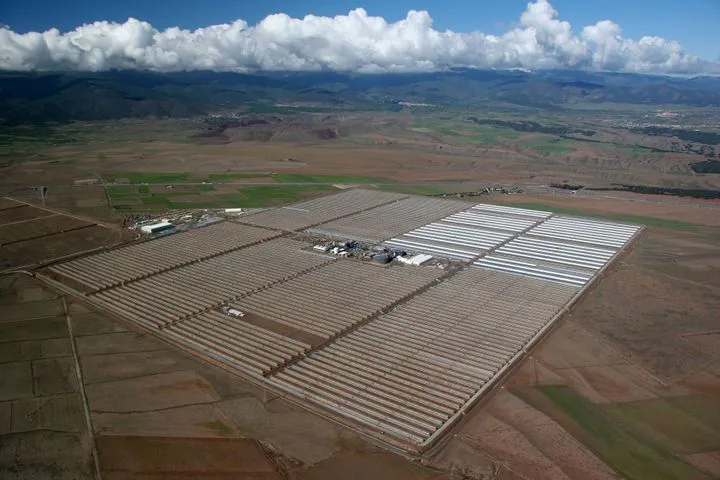
Theory

Solar thermal power plants produce electricity like coal and nuclear. Again, the difference is in the heat source. Coal and nuclear power plants must mine, process, and refine their fuel. Solar plants only use sunlight as their source (SEIA).
Concentrating solar power uses mirrors to focus sunlight to heat a specialized fluid to a specific temperature range. The specialized fluid then passes to a secondary system that allows heat transfer to water within a steam generator. The remaining process of electrical generation is similar to coal and nuclear. The steam generated sends dry steam to a turbine causing it to rotate. The turbine turns a generator that produces electricity.
Solar power plants utilize different types of mirrors for a variety of reasons (SEIA). Computerized systems track the weather and sun's position throughout the day — the system positions each mirror to capture the maximum amount of sunlight and maximize the heat generation process.
Environmental Impacts of Commercial Solar Power

Environmental Impact
Solar power, arguably, in my opinion, generates the smallest environmental impact during the production of electricity. I've studied all the common forms of power. You cannot compete against solar when it comes to a comparison of clean technologies.
Hazardous Materials
The allure of solar power was too great to ignore. It was so great that we failed to acknowledge the errors of our past before mass production began.
Now, while I mentioned solar power had the least environmental impact, I did apply that statement to "during power production." Making PV cells is dangerous work. Also, photovoltaic cells consist of hazardous elements like cadmium and arsenic. Manufacturers and power plants must handle these devices carefully to prevent contamination of the surrounding environment (The Balance). Hopefully, we learned enough from the past to consider how we handle the impact of solar technology from the cradle to the grave.
Land Use
It would be best if you had a lot of lands to make solar power effective at producing electricity. Perhaps more land is needed than coal or nuclear. It would help if you had plenty of mirrors to make the conversion of light to electricity possible.
Archimedes Effect
Where Archimedes used solar power to defend his city, our current use of Concentrating Solar Power plants tend to scorch birds from the sky. The company that built the Mojave Desert's Ivanpah Solar Plant did so along the migratory route for different birds. The result is that the power plant scorches at least 6,000 birds per year (Science Alert). The birds, while being naturally attracted to the light generated at the power plant end up bursting into flames when they approach.
Power Plant Advantages
Image by DarkAthena from Pixabay

Photovoltaic Solar Energy production is one of the few types of power production that doesn't utilize the typical generation practice we have already discussed. Coal and Nuclear use similar methods of power generation, with the significant difference being the heat source (Nuclear (Coal). The Photovoltaic power plant doesn't utilize heat as the driving force of power production. It directly converts various wavelengths of light into electrical power.
You won't need to spend billions upon billions building up a power plant that requires an army of legislators, oversight groups, or operators to make the plant run. You won't need to worry about toxic spills or reactor meltdowns during power production. You most certainly won't find the greenhouse gas emissions at a solar plant that you would at other more conventional power plants.
Power Plant Disadvantages
Image by Christian Dorn from Pixabay

The obvious response is that the power plant doesn't produce electricity at its maximum whenever something obscures the sun during the day. I mean, you can't get around it. If the sun doesn't shine, you won't get much power.
There are not many places on earth where we can build solar power plants that provide as healthy an ROI and practicality as other forms of power. You can't make a solar power plant in Maine and expect it to be operating all year long.
Providing continuous power is an expectation of any civilization. Currently, the only way to build a solar power plant, at least in the U.S., is with a substantial investment of federal subsidies. I doubt tax-payers want to front the bill for this technology when it rains all the time.
The ideal application of this energy source will be to add battery storage of power to avoid loss of energy during less than ideal conditions. However, a battery storage system capable of holding power at the gigawatt capacity does not exist at this time.
At the local level, however, battery storage does exist. However, it is costly. An example of a home battery storage unit is the Tesla Power Wall. For the low, trivial cost of $13,000, you can have two of these babies attached to your home. If your area experiences an electrical outage, it could provide up to 7 days of continuous supply.
Accidents
Ivanpah Solar Plant (Mojave Desert)
On May 25, 2016, a misalignment of mirrors occurred, focusing sunlight upon a power generating tower incorrectly. The result was fire and melted piping. The remaining two towers were unharmed.
Technology Summary
If the environment supports constant sunshine, then commercial solar power production is the way to go. It will supplement that region's electrical production during daytime hours. PV power plants appear to function more efficiently than Concentrating Solar Plants, but perhaps time and technology will put them on par.
The most effective use of solar power in most cases is through the use of local solar panels on a home where the residents can benefit from solar and battery backup. It would almost certainly ensure their energy independence if they can afford it.
Solar power produces clean energy at a level Coal, and Nuclear Industries will never match, but certainly not at the same level of electricity produced today by the fossil plants. Again, time and technology may see Solar power surpass them.
In Closing

Thanks again, fellow Steemians, for following on with this series. Our next article will be on hydroelectric power generation and covers similar topics as coal, nuclear, and solar.