
Hello wonderful people on #Steemit! A very warm greetings to one and all. Hope you all are doing well in your life! In today's article, we're going to be discussing about an unusual Pulsar that we've known about for a long time known as the Black Widow. But we're going to be talking about a new discovery coming after pulsar that was published in a paper in May of 2018.

Hope you people will read my article and provide your valuable suggestions and thoughts by commenting below. So, without any further delay let us start the exploration!!


So, we are here on Earth right now and the Pulsar we're going to be looking at is really far away and this is about 1,500 Light years away from us toward the center of the Milky Way Galaxy. It's known as the Black Widow. It's actually one of the few named pulsars out there with the peculiar and somewhat scary name. I'm going to go there just to show you what you'll see and basically this is a typical neutron star. This one is not very realistically represented in space and unfortunate because it doesn't seem to have any accretion disks. But this specific pulsar doesn't just have an accretion disk; it has an entire cloud of stuff flying in its nearby areas which we will going to visually see in the later part below when we recreate this in Space Engine.


It has a partner which is right there as you can see below. This partner is currently what seems to be a brown dwarf. Basically, it's a super large planet or a very small star (a so-called failed star) and because of this brown dwarf we call this Pulsar a Black Widow. If you know anything about spiders black widows are the spiders that basically eat their partners after mating and because of this unusual feature this is why we named this Pulsar as Black Widow as well because it's actually eating its partner. It's absorbing the mass of this brown dwarf that probably used to be a star before this and its mascot eaten away by the pulsar and at some point two things will happen. Either this planet will completely disappear or the pulsar will become a neutron star quietly sitting in a darkness of space or what's more likely or possibly at least is that it will eat so much mass that they will reach its limit and then disappear.

Now we don't really know what's going to happen to it. It might turn into a black hole or it might explode into a very brilliant supernova. But let's not rush things! First of all let's actually take a look at this brown dwarf to see what it looks like! It's basically a very large Jupiter-like planet. But a lot more massive than Jupiter the mass currently in space engine is at 22 masses of Jupiter. But it's probably even more than that and what's not shown here is the amount of stuff that's actually coming off this planet. It's inside the pulsar's so-called Roche Limit or Roche Lobes that is.

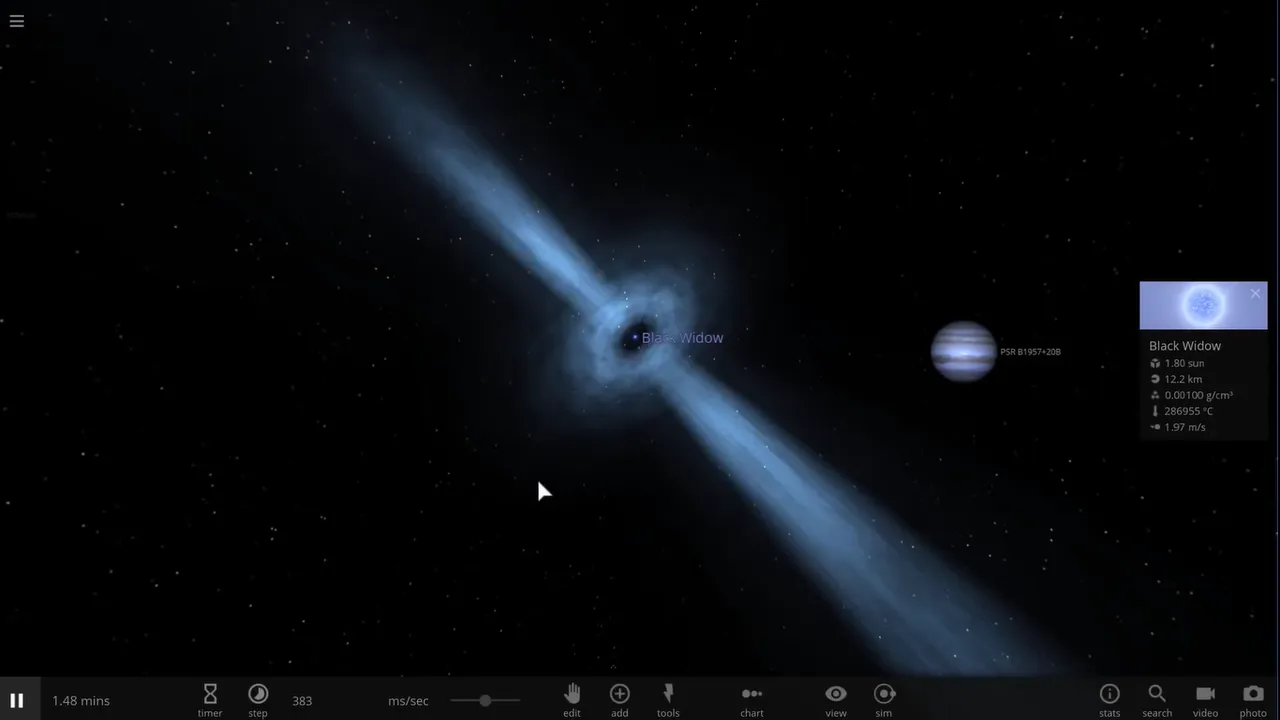
So, it's actually losing mass at all times. It's basically proofed up so much that there's a lot of gas here. So, let's go to Universe Sandbox just so that it kind of help you visualize this. So, let's take our own Jupiter here and place it around the Pulsar Black Widow. We're going to start with a slightly farther away distance. But we're going to basically make it more realistic and place it at a distance so that a single orbit takes approximately 9.2 hours. So, the orbital period here is going to be relatively short. So, there's that Jupiter. But we're actually going to need to rename it. Let's name it after the actual pulsar. It's known as PSR B1957+20B last one and this here is going to be the partners we are going to call it B.


So, this pulsar was actually discovered in 1988 and the university that studied this the most is University of Toronto and basically what's really interesting about this particular pulsar is that unlike other pulsars it's basically eating up its companion so much that it's creating a world of really crazy effects. First of all, we think that there is a huge gas cloud around this pulsar which I tried to recreate this as well. So, it may kind of look something like this as you can see in the picture. There's basically a tremendous amount of material in here and most of it or I guess all of it in some sense is from the companion. It's essentially stolen or taken away from the companion and deposited right here all over the star system. Now, the interesting thing about Black Widow is that because of the amount of stuff in the star system and because of the amount of stuff orbiting in here and there it’s pulsating thing now.


There is so much mass there that it actually has an effect on bending the light coming off the Black Widow and because this object is tidally locked it's always facing with the same direction or same phase toward the stars. So, the temperature is always super high. The other side might be a little bit cooler but not by much. Now, this is kind of what it looks like in this system possibly a lot more dust and a lot more cloud stuff. But I can't really place any more without causing the frame drops dramatically. But here's the interesting part. So, this pulsar as it pulsates releases the Jets that we can then detect back on Earth. But because of the amount of material here or because of the amount of stuff here we can actually detect those Jets a lot better since they actually gets bent by the mass that's within the star system.


In other words, we actually get what's known as the lensing effect. The lensing effect is caused by all of this dust here and this lensing effect is very unique and very unusual in because it's actually just a perfect alignment of dust. The other object the brown dwarf and the pulses coming off the black widow and because of all of this we can actually see all of these pulses magnified as if they were may be 80% or 90% closer to us and they really are and now as we develop this technique we'll be able to get even higher magnification. In other words we'll be able to actually discern these Jets with a lot more accuracy and be able to see them. Basically, what we can actually see is a much higher resolution of these two Jets or actually just one of the Jets because the other one is pointing in the opposite direction and we can actually now be able to create a much more detailed picture of what's coming off these pulsars and this of course means that once we find more and more of these and also once we find some of these pulsars that even have higher magnification; we'll be able to study them in a lot more detail and actually discover a few things about pulsar that we didn't really knew before.

Now, over the last few years we've discovered more similar objects and this actually has a type now and these types of binaries are now always called Black Widows because they're basically eating up their companion object and they're destroying its mass that's essentially absorbed by the pulsar and as you probably know or read from other sources in the references provided below that as the pulsars absorb the mass of the partner object they start pulsating and spinning even more and at some point once the spin is too high they might actually fall apart or if the object disappears with time the pulsar will actually slow down and most likely become just a quiet neutron star and so that's kind of the story of this unusual pulsar that's about 1,500 light-years away from us and what makes this even more interesting is that this might also be one of the most massive neutron stars we've discovered.

We currently think that it's mass is anywhere between 1.66 to possibly even 2.4 masses of our Sun which actually puts it the limit of pulsars. In other words, we think that it's at the point where it might actually get enough mass to change completely. Either turn into a black hole or go supernova. Well other than that; that's all we know about this unusual object and just the fact that it has such a cool name definitely makes it worth discussing about!
Thank you so much for reading this article guys and if you've enjoyed reading the information in this article, don't forget to just Resteem for those who enjoys reading space articles and wants to learn more through the information provided here!!


STEEMSTEM
SteemSTEM is a community-driven project that now runs on Steem for more than 1.5 year. We seek to build a community of science lovers and to make the Steem blockchain a better place for Science Technology Engineering and Mathematics (STEM).

More information can be found on the  blog, on the discord server and in the last project report. Please also have a look on this post for what concerns the building of our community.
blog, on the discord server and in the last project report. Please also have a look on this post for what concerns the building of our community.