
The impact of science fiction on technological development has long been recognized. From 1984 and a New World Order to Isaac Asimov to Gene Roddenberry's Star Trek to 2001: A Space Odyssey and on and on...
Give enough time to a creative human mind, and almost certainly what can be imagined can be wrought.
Along these lines, one of the most important scientific thought experiments of the twenty-first century, and one that all-too-often gets thrown into the "stoner fantasy" bin of modern philosophy is Nick Bostrom's "Simulation Argument."
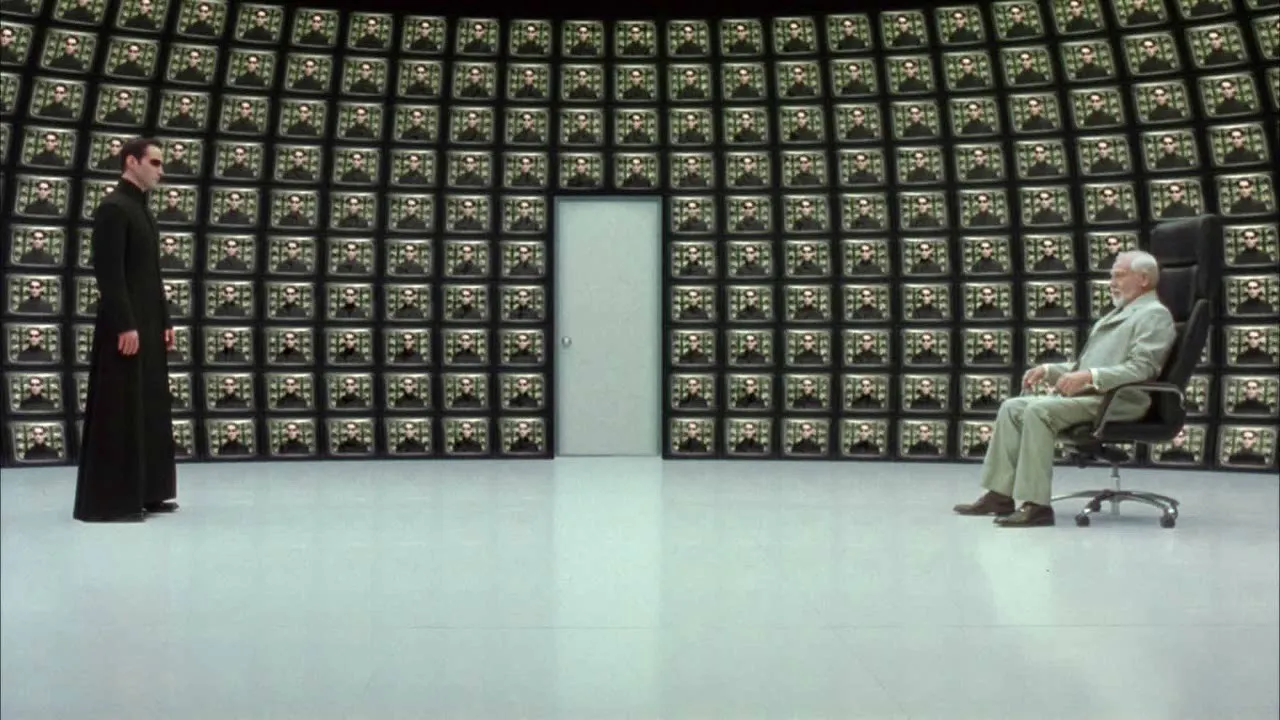
Quoting from the original Bostrom journal article on this subject:
The basic idea of this paper can be expressed roughly as follows: If there were a substantial chance that our civilization will ever get to the posthuman stage and run many ancestor‐simulations, then how come you are not living in such a
simulation?
Since I'm tagging this on weedcash.network, I must ask you to put down the pipe for a minute and follow this mind-bending Bostrom logic.
- It is likely that humans as a species will have copious amounts of computer processing power at their disposal in the very near future.
- Since homo sapiens tend to be a rather curious lot, we must assume that one of the use cases for such processing power (besides the most obvious use case of creating a bunch of crypto micro-economies like bitcoin) is the desire to run a series of "ancestor-simulations" to try and divine the great mysteries of humankind, prepare for all manner of potential disasters, and generally amass a large dataset of Monte Carlo simulations to feed into future AI models.
- Because we can all agree upon the likelihood of this near future, we must also agree that it is more than likely that we are already living in a computer simulation.
*hits blunt *
In other words, it is a tautological truth that if one can see the logic of running ancestor-simulations for the benefit of mankind (which seems like a fairly logical premise), then one also must agree that one cannot prove that we are not already those simulated minds.

One important caveat to the whole thesis relies on the substrate-independence of consciousness. As AI becomes increasingly complex and used in various implementations of so-called "smart" manufacturing, retail, or finance, it is increasingly obvious, at least to me, that at some point in the near-ish future, consciousness, or at least something resembling what we currently refer to as such, will be able to exist somewhere outside of the human mind. Our minds are not the only "substrate" where humanness can exist.
The inexorable exponential march of Moore's Law probably means that at some point in my daughter's lifetime (she is now just a little under 3 years old), humans will have access to the massive computational power required to conduct at least one of these "ancestor-simulations." A prerequisite for such an experiment would be the ability for human-level intelligence to exist and operate outside of the human mind.

We are on the cusp of the proliferation of mass VR human experiences. We sometimes take our daughter to play blissfully for an afternoon in an air-conditioned mall. There are bouncy huts, ball pits, bridges, slides, swings, and everything you'd expect for a playground.
Last time we went there, however, I noticed that across the hallway the same company had opened a VR experience hall to serve teenagers. Guess which one had more customers.
People are hungry for simulated experience. Could it be that they are already subconsciously predisposed to enjoying simulated experience because they themselves are already in a simulation? That logic is certainly not as far-fetched as it seems on the surface.
Quantum computing will push our civilization even closer to our theoretical limits. As Ray Kurzweil predicted in 2009, "By 2045, we'll have expanded the intelligence of our human-machine civilization a billion-fold."
Therefore, the question of when we as a species will start running ancestor-simulations is a question of when not if.
As Nick Bostrom posits in his seminal 2003 Philosophical Quarterly article titled "Are You Living In a Computer Simulation?" (click this link and go read it now!), "a posthuman simulator would have enough computing power to keep track of the detailed belief‐states in all human brains at all times."
Once AI has reached a human-level machine intelligence, the exponential nature of technological development dictates that it will continue to develop further and faster. There are no upper limits on the development of super intelligence. The size of our heads, the length of our lives, the myriad limitations of our physical body (i.e. the need to sleep, eat, drink water, biologically procreate, etc.) all impose severe limitations on human intelligence.

As Bostrom himself recently explained in a TED Talk titled What happens when our computers get smarter than we are?, "the train doesn't stop at Humanville Station, it's likely rather to swoosh right by."
Hence, the chances of us right now living in one of these so-called ancestor-simulations are pretty freaking high. And here's the kicker in Bogstrom's argument:
If we aren't living in a simulation, then humans MUST soon become extinct.
This reasoning follows from the fact that we all pretty much agree that 1) Moore's Law will continue marching on until we are capable of running ancestor-simulations, and 2) given that MMORPG's take up an increasingly disproportionate share of young people's time, humans have a natural proclivity for participating in and conducting realistic simulations, ergo there can be only one Bostrom hypothesis that can remain true, and one of the 3 hypotheses logically MUST be true. As a result, we must conclude that we are not likely to be living in what Elon Musk has called "base reality" and are most likely already living in a simulation. Sadly, if we are not already living in a simulation, we "must give a high credence to DOOM, the hypothesis that humankind will go extinct before reaching a posthuman level."
I don't know about you, but if given the choice between extinction and living in a Barbie World, well "you can brush my hair, undress me everywhere," and call me Barbie Girl!
