
I am fascinated by a lot of things. So I try to find answers. As a kid, I was a handful. I try to find out why the sky is blue. I was told the earth is spinning and I wanted to know why I am not dizzy when a small merry-go-round got me all giddy and ready to fall if I did not find something to hold on to.
Sometimes my curiosity got the better of me. I still have the mark of some of them. For instance, I had a scar on my chin for my efforts, when I tried to investigate why the upper burner glows red on top of our electric oven. I was about three at that time. I needed a stool for this investigation. Oh well, the burn mark is a gentle reminder that curiosity does kill the cat. But like the proverbial cat, there is still some lives left to live.
I watch the lady on the counter in the fast-food chain pop in some meatpie into the microwave. Moments later it came out piping hot. Oh sweet! Even though some health freaks may not be as enthusiastic to hear this as it may not be healthy for me, but I find it convenient.
What if we can reverse process the technology to get our food cold in that short time?
Who is up for ice cream in 5 minutes?
I know I will be interested.
Is it wishful thinking or can we pull it off?
A Series of Entropic Events
What happens to the food popped into the microwave oven as with the push of a power button? In simple terms, it is the agitation of the water molecules via a specific frequency of radio waves.
The same radio waves that harmlessly zips pass your ceramics, glass or plastics food containers.
Once the agitation progresses, at the atomic level, the water molecules will start to vibrate.
The group of molecule's activity or energy level is critically the measure of its heat.
The more excited the molecules become, the hotter it gets.
But Houston we may have a problem.

The water molecules are hot-headed. Calming it down is a challenge. No radio frequency can calm it down fast enough to get it colder.
The electromagnetic radiation or waves is a form of energy which is comprised of radio waves, x-rays, visible light, etc.
The molecules of matter get excited when it comes in contact with the energy. Unfortunately for us (the cold freaks) excited molecules blatantly refuse to cool when excited instead it gets hotter.
We should blame it on entropy. Yes, excited molecules are not only hotter, but they are in a higher entropy state.
Entropy is that thermodynamic quantity which shows the thermal (heat) energy which is unavailable for any useful work. In order words, it is known as the second law of thermodynamics which indicates the degree of randomness or disorder in a closed system.
The second law indicates that entropy always increases with time.
Cold things are at a lower entropy than hot things. This phenomenon explains why it is easier to heat up food faster than it takes to get it to cool down.
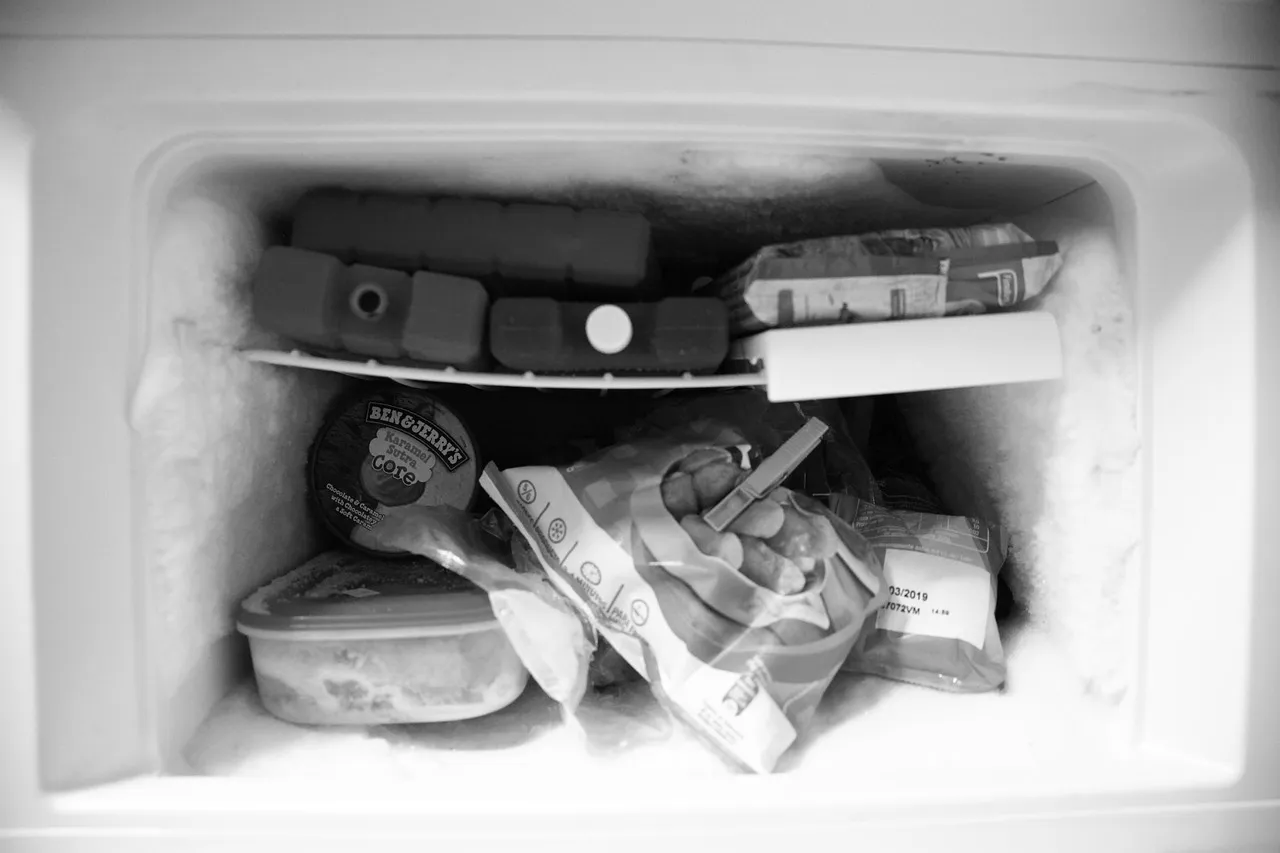
Imagine a scenario where you place a hot cup of coffee in the freezer. We are decreasing the entropy in other to get it cold. Right?
Well not entirely.
Consider the whole freezer unit. It is expending a lot of energy of transferring the heat inside to the outside.
Do you have doubts?
Oh, you can touch the back of the freezer or that air conditioner to see how warm or hot it could get. If you consider all that, that is an overall increase in entropy.
Also, the cold air is not a very efficient conductor, which increases the time taken to remove all the heat from the cup of coffee.
So you will have to wait longer than a few minutes, instead make it hours, to have that blocked ice coffee!
Not all that gloomy
If by chance, you like a gas diet such as a helium-diet, though I'd advise not to try this at home, there is a chance you may get it cold in no time. It will be a hilarious experience that will leave you sounding like a chipmunk.
Ever wonder why a freshly sprayed on aerosol appears cold to the skin? The gas cools rapidly by expansion.
So unless you are on the dangerous adventure of cooling your food with nitrogen, then we can only advise caution as nothing we can think of could cool your food as fast as a microwave warms food.
When we say, we cannot cool our food quickly does not mean we cannot cool other things.
All hopes are not lost yet as you can always cool your beer fast as illustrated in my post here.
REFERENCES
If you write STEM (Science, Technology, Engineering, and Mathematics) related posts, consider joining #steemSTEM on discord here. If you are from Nigeria, you may want to include the #stemng tag in your post. You can visit this blog by 

