
In this post you will discover:
- why do you want to have fast lens
- what was the historical background behind this lens
- and some practical application of this beauty
Fast lens, why should you care?
Aperture number, also known as f-number represents the ratio of the focal length to the diameter of the entrance pupil for the given optical system.
If you take a look at a typical lens, you will see that f-number is usually a bit weird, 1.4, 1.8, 2.8 or 5.6...
The reason is the square relation between the diameter of the aperture and its surface. For example, 1.4x squared = 2 times larger surface.
If you have one more "stop" for aperture, you will be able to compensate the amount of light by shortening the exposition twice or staying in more favourable ISO (for example 800 instead of 1600).
However, there is a problem... Or an advantage, it all depends what you want to achieve.
Smaller f-number means shallower depth of field. It also means that the background will be much less sharp.
The fastest practical lens ever produced was Zeiss Planar 50mm f/0.7!
In practice, this is the result:
- Your average 100$ CaNikon f/1.8 = 3.3x less light
- 500 $ f/1.4 = 2.0x less light
- 1.000+ $ f/1.2 = 1.4x less light
- Crazy 10.000 $ Noctilux-M 50mm f/0.95 = Reference
- Priceless Zeiss 0.7 = 2x MORE light than 10k Leica!
To be honest, f-stop denotes the theoretical amount of light that can vary from the real amount of transmitted light, but this is general rule (check t-number).

History and construction
The original Zeiss Planar was constructed in 1896 by Paul Rudolph. The same Rudolph that will design Tessar, Plasmat and continued his work in Mayer Optic.

As you can see from the Figure, the design was symmetrical. This is a common paradigm in optics, it this compensates aberrations and solves the problem of projecting naturally spherical image to a flat surface of the film (Petzval curvature).
Cosina-Voigtländer Nokton 50 mm f/1,1 (2009) for example is the original Planar + one additional element at the back.
During the interwar period, Zeiss started to produce optical devices for military. Beside the "sharpness" and precision, there was yet another imperative. To make the optics so bright that it will be possible to see the enemy first. WWII anecdotes are telling the story about Panzer III tanks able to aim in the dusk or fog, while T-34 crews were unable to see anything. Far superior gun at long range was limited by poor optics.
Back to the Planar 0.7...
In this case, the rear of the lens included the additional light condenser.
If you can read French, check This website
If you are better in Italian, this is the link for you.\
There are optical schemes on both websites but unfortunately... Copyrights...
Practical Usage
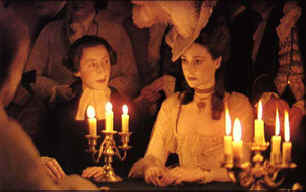
If you have 3 hours of spare time, I can highly recommend you to watch the movie Barry Lyndon, directed by Stanley Kubrick, awarded with 4 Oscars.
Camera is simply breathtaking and many scenes can be directly transferred to museums and galleries. Lighting is exceptional as only candles were used in some scenes!?


StemQ Notice: This post was originally submitted on StemQ.io, a Q&A application for STEM subjects powered by the Steem blockchain.