

Mona Lisa is one of the most-discussed works of art ever.

The picture is taken from the database of the Louvre (French)
Well, what do we know?
1. Smiling Mona Lisa
2. This is one of the most recognizable portraits in the world
3. The hidden portrait of Leonardo da Vinci (it is still unknown how Leonardo really looked - it is believed that he is hidden in this picture)
4. A trick with the optical illusion of a glance "following" you
5. One of the last three paintings, over which da Vinci worked for many years
Blah blah blah…
But we are not gathered for this. It would not be Steemit, if I told you stories that everyone has already heard. While experimenting with a picture in Photoshop, I discovered something interesting and share it with you, friends.
All right, let's get started
Leonardo liked to paint with a mirror, so I mirrored the picture, deciding to see what would happen.

Then came the thought of cloning Mona Lisa and extending the picture:

Hmm ... what is it, I thought, a spear, a pointer?

Then he noticed that the road looks good and from the bottom up and from top to bottom. It seems that the picture can be turned:

Which I did, and then cloned several times:

Then I applied a layer and turned it 90 °, with a transparency of 45%, and then interesting things began to happen! Mind games begin - in the picture you can see a man in the upper corner of Mona Lisa + man = heart in the corners, a girl with a scythe, a flying bird on the corner.

For those who do not see Mona Lisa with a braided braid:

The third eye of the Mona Lisa. Then I put a layer on the picture separately and turned and made a mirror image, with a transparency of 45%. Then Mona Lisa folded her arms and opened her third eye:

I was interested in the movements of the hands. The picture is so symmetrical that Mona Lisa performs many different actions with her hands. For example, corrects the hairstyle, puts on ... Of course, provided that if all of this is looked under the superimposed layers, the transparency is 45-85%.

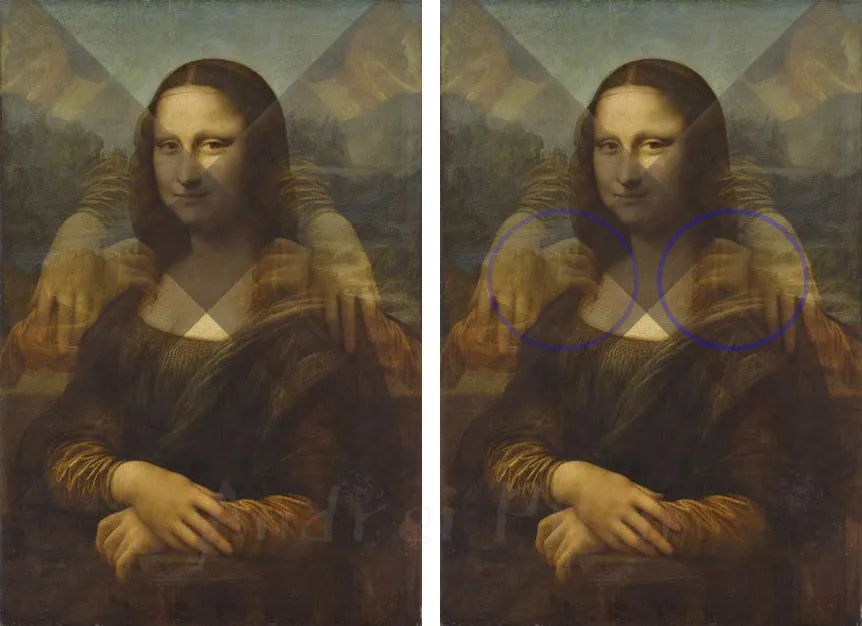


It is believed that the eyebrows were lost when the painting was restored. And what if it is a myth, but in fact the picture is conceived? After all, under a certain overlapping of the eyebrows again appear in the picture:
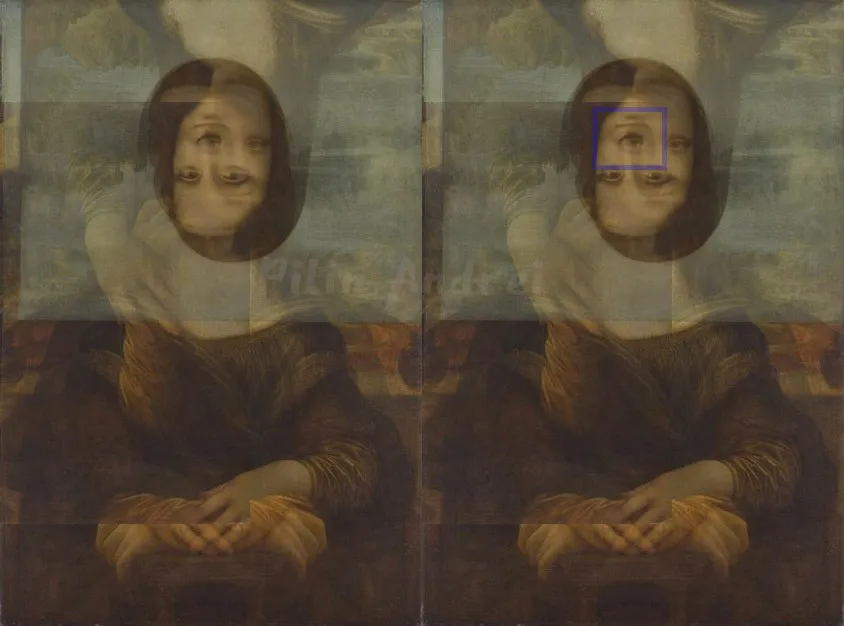

Each part of the face is marked with certain marks, some proportions. And if you connect them, you get an interesting thing. For example, lips and veil:

Then, applying a layer by layer, I got a portrait of a woman:


Besides this pretty woman there is also a bald man:

Everything you saw - I found ... Have you guessed where? No! But first I remind you that Leonardo da Vinci worked with light. Who knows how the camera or video camera works? Do you know how a kaleidoscope works? What links these things? Shine. Unfortunately, patents in the XV-XVI centuries on such things did not issue. The first kaleidoscope was opened in 1817 https://en.wikipedia.org/wiki/Kaleidoscope, and Leonardo lived 300 years before and yet he used it.

It's time for the Louvre to stock up with kaleidoscopes =)
Here's three videos about how it all was maded and finally - Kaleidoscope Mona Lisa - Motion Graphics
Part 1

Part 2

Part 3. Kaleidoscope Mona Lisa - Motion Graphics

We write this article together with my best friend Pilin Andrei.
Hope you enjoyed it!
&