
THE STONES OF PLOUHINEC
In the stable
Source

He was a beggar from Pluvigner who never entered churches, and of whom honest people were afraid. He was accused of casting spells on cattle, of turning wheat black, and of selling magic herbs to wrestlers. There were even some who suspected him of becoming a goblin at will.
However, as he wore the clothing of the poor, the farmer allowed him to approach the hearth; he even gave him a three-legged stool and a guest portion.
When the sorcerer had finished eating, he asked to go to bed, and Bernèz went to open the stable for him where there was only an old-skinned donkey and a skinny ox. The beggar lay down between them to keep warm, resting his head on a bag of crushed moor.
But, as he was about to fall asleep, midnight struck. The old donkey then shook his long ears and turned towards the skinny ox.
"Well, cousin, how have things been since last Christmas since I spoke to you?" he asked in a friendly tone.
Instead of answering, the horned animal glanced sideways at the beggar.
"It was well worth it that the Trinity gave us the floor on Christmas Eve," he said gruffly, "and thus rewarded us for the fact that our ancestors had witnessed the birth of Jesus if we had to have a scoundrel like this beggar as an auditor."
“You are very proud, Monsieur de Ker-Meuglant", replied the donkey cheerfully; "I would rather have the right to complain, I whose head of family once carried Christ to Jerusalem, as proven by the cross which has since been imprinted on us between the two shoulders; but I know how to be satisfied with what the three people are willing to give me. Don't you see, moreover, that the sorcerer is asleep?"
“All his spells have not yet been able to enrich him,” replied the ox, “and he damns himself for very little. The devil didn't even warn him of the good luck that there will be here, in a few days."
"What good luck?" asked the donkey.
"Well, replied the ox, don't you know that, every hundred years, the stones of the Plouhinec heath go to drink from the Étel river and that, during this time, the treasures they hide remain uncovered?"
"Ah! I remember now", interrupted the donkey, "but the stones return so quickly to their place that it is impossible to avoid them and they crush you if you do not have, to protect yourself from them, a branch of the common vervain surrounded by five-pointed clover leaves."
“And again,” added the ox, “the treasures you have taken away will fall into dust if you do not give in return a baptized soul; it takes the death of a Christian for the demon to let you enjoy the riches of Plouhinec in peace."
The beggar had listened to this entire conversation without daring to breathe.
"Ah! Dear animals', he thought to himself, 'you have just made me richer than all the bourgeois of Vannes and Lorient; rest assured, the sorcerer of Pluvigner will not damn himself for nothing from now on."
Source: Les Pierres de Plouhinec from the French book Contes et légendes de Basse-Bretagne published in 1891.
Hello, my name is Vincent Celier.

I am writing translations of folk tales that I found in public domain French books, so that people who do not understand French may enjoy them too.

The beggar, in the stable, hears the ox and the donkey speaking of treasures being under the stones of Plouhinec, and the time when these treasures are accessible.
So, now he knows how to get rich. But he will need the "death of a Christian" to be able to keep these treasures.
Who do you think will be this Christian?
In 1971-1972, my first post as a French Navy officer, fresh from the Naval Academy, was in Tahiti.
On the ship I was posted on, there was a mechanic petty officer whose hobby when we were onshore was painting. I made a command to him for a portrait from a photograph that I gave him. Of course, I paid whatever he asked me.
This portrait is in my office, in Coquitlam.

As can be seen from his signature, his last name was Warnsmann.

Warnsmann is a common last name in Alsace. Warnsmann was from Strasbourg.
Warnsmann's rank in the French Navy was "Maître" (Master), which is the equivalent of Petty Officer first class in the US Navy.
He often joked that he would never get the higher rank of "Premier Maître" (First Master).
However, I just looked for Warnsmann on the Internet, and I found that in 1976 he was indeed Premier Maître. Here is a drawing he made for the ship he was on at the time:
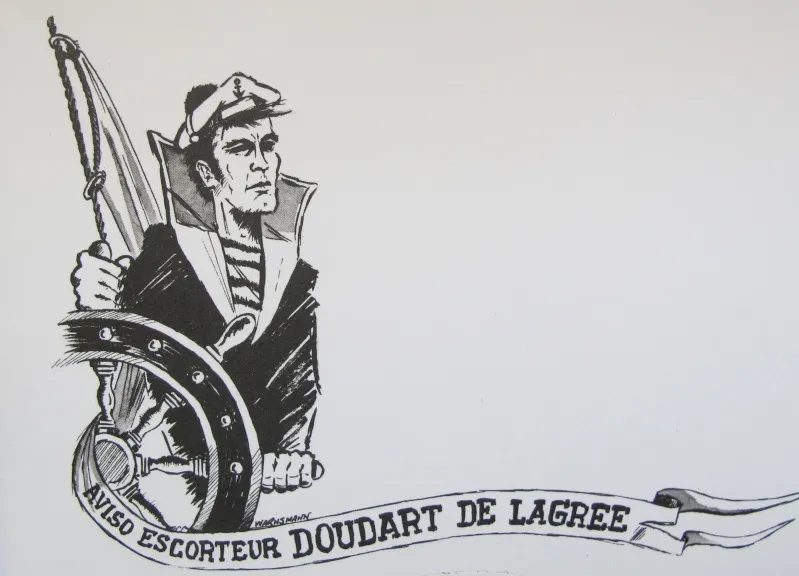
I was 22 years old in 1972. I think Warnsmann was at least 40 years old then. If he is still living, he is at least 92 years old. So, I think he probably passed away.
-- Vincent Celier