
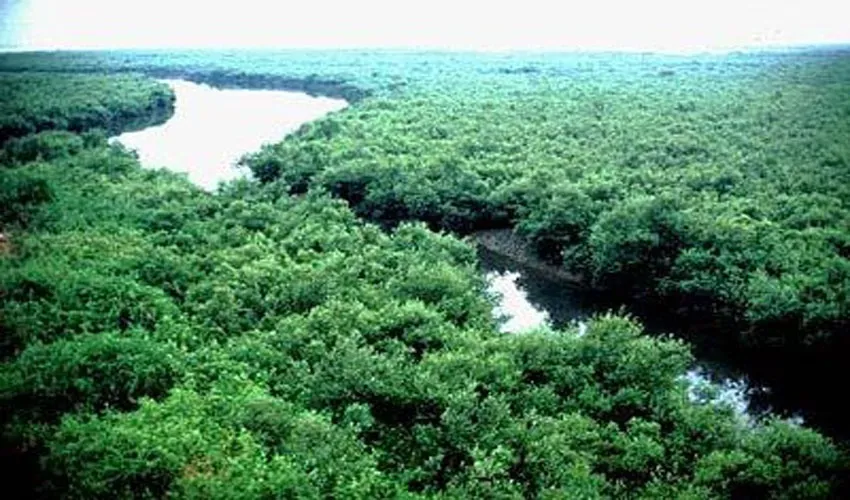
The Sundarbans, the world's largest mangrove forest, is under threat from plants and animals due to climate change and environmental pollution. Many forest animals are on the verge of extinction due to adverse weather and environmental disasters. Many animals have become extinct in the last few decades due to ignorance and neglect. Increased salinity of rivers flowing through the Sundarbans is having a detrimental effect on low-salt tolerant trees and wildlife. Therefore, the forest department has taken initiative to dig and re-excavate 6 ponds in the forest to reduce the amount of damage and protect the biodiversity. The excavation and re-excavation of the pond has been funded by the Meteorological Trust Fund at a cost of Tk 4 crore 96 lakh. The excavation is targeted to be completed by next June.
The United Nations has expressed concern that the existence of 30 species of wildlife in Bangladesh is currently under threat. Endangered species include Royal Bengal Tiger, Leopard, Elephant, Python, Crocodile, Crocodile etc. Besides, the beautiful trees of the beautiful forest are also under threat now. Apart from this, one species of wild buffalo, two species of deer, two species of rhinoceros and one species of freshwater crocodile have been lost from the Sundarbans due to natural calamities and human aggression.
Environment, Forests and Climate Change Minister Shahab Uddin told Inkilab that the present government is working to protect biodiversity. Bangladesh Forest Department is digging a pond inside the Sundarbans Protected Forest. In addition, initiatives are being taken to increase the area of freshwater inside the forest.
Bangladesh Environmental Movement (BAPA) is one of the leaders. Abdul Matin said, not only the project should be accepted, but also its proper implementation. Earlier, the project was taken up with the money of the Meteorological Fund to prevent air pollution in the capital. However, overbridges have been built in that project, sidewalks have been developed. Nothing real work was done. Therefore, it is a matter of seeing how much pond digging will be done in the project of digging ponds to protect the beautiful forest. In fact, if you want to protect the Sundarbans, you don't just have to dig ponds. All the harmful industries that are developing around it have to be stopped. In addition, indiscriminate cutting of trees inside the forest must be stopped. In order to do all this, the forest department must not be honest and sincere.
According to the Forest Department, the world's largest mangrove forest, the Sundarbans, is under increasing threat from nature and human aggression. The amount of salinity has increased in the rivers flowing through the forest. As a result, on the one hand, Sundari and low salt tolerant trees are being damaged. On the other hand, it is affecting wildlife. The Sundarbans is constantly being damaged due to siltation, river erosion and heavy navigation. The ponds will be dug and re-excavated to protect the biodiversity of the Sundarbans from various damages. According to the plan, a total of 6 ponds will be dug and re-excavated. Some ponds have been filled for a long time due to natural disasters. Besides, pucca ghats will be constructed in 70 ponds of saline forest lands flooded with tidal water. Once these ponds are dug, the demand for fresh water of about 400 species of wild animals including tigers and magic deer will be met. Besides, the demand for water will also be met by the officials and employees of the forest department in the Sundarbans and foresters and tourists. The ponds will be dug in the Sundarbans where there is an abundance of wildlife including Royal Bengal Tiger and magical deer.
Under this project, two new ponds will be dug in Dubla of Sharankhola Range in East Sundarbans Division of Bagerhat and three new ponds will be dug in Bagi. Besides, 24 ponds will be re-excavated in this range. There are four ponds in Kachikhali Sanctuary, three in Dubla area, two in Sharankhola Range Sadar and two in Dasherbharani. Besides, one pond each is being re-excavated in Dumuria, Charkhali, Terabeka, Chandeshwar, Shapla, Bhola, Shelarchar, Kokilmuni and Supati. 26 ponds are being re-excavated in Chapai range. Among them, three ponds will be re-excavated in Dhansagar area, two in Gulishakhali and two in Amurbunia area. Besides, Chapai, Dhangmari, Laudop, Chengra, Ghagramari, Nangli, Harintana, Kalamteji, Tambulbunia, Jiudhara, Baraitala, Katakhali, Shuarmara, Marapshur, Vaidyamari, Andharamanik, Harbaria, Nandabala will be a char.
It is to be noted that the area of Bangladesh part of the Sundarbans is 6,017 square kilometers. Which is 51 percent of the country's protected forest land. There are 334 species of plants in the Sundarbans including Sundari, Gewa, Garan and Pashur. There are 365 species of wildlife. These include 42 species of mammals including tigers and deer, 35 species of reptiles including crocodiles, guisaps, turtles, dolphins, pythons and king cobras and 315 species of birds.
On December 6, 1997, UNESCO declared the three protected areas of the forest as the 697th World Heritage Site, covering 30 percent of the entire Sundarbans. Twice a day, the amount of saline land inundated by the tidal waters of the sea is 4,142.6 square kilometers. The sea area of the Sundarbans is 1,603.2 sq km. There are 450 rivers and canals in the Sundarbans.