

This essay explores the details and the background of this iconic drawing, also exploring what led up to it, and its importance as a pivot point in my artistic development.
VINDOBONA ALTARPIECE III - SNAKES AND LADDERS - The recently made video on YouTube

Vindobona Altarpiece III - Snakes and Ladders

Graphite Drawing on Arches Etching Paper - 65cm x 48cm - 1994 - Private Collection, Austria

Vindobona Altarpiece I - Graphite Drawing on Paper - 76cm x 56cm - 1981 to 1993 - Private Collection Austria

the second half of this dyptich
Vindobona Altarpiece II - Graphite Drawing on Paper - 76cm x 56cm - 1980 - Private Collection Austria

Photo by David Rositter, Lethbridge Herald Newspaper
Some of my sources:
After a visit to the Maryhill Art Museum I was fascinated by this painting: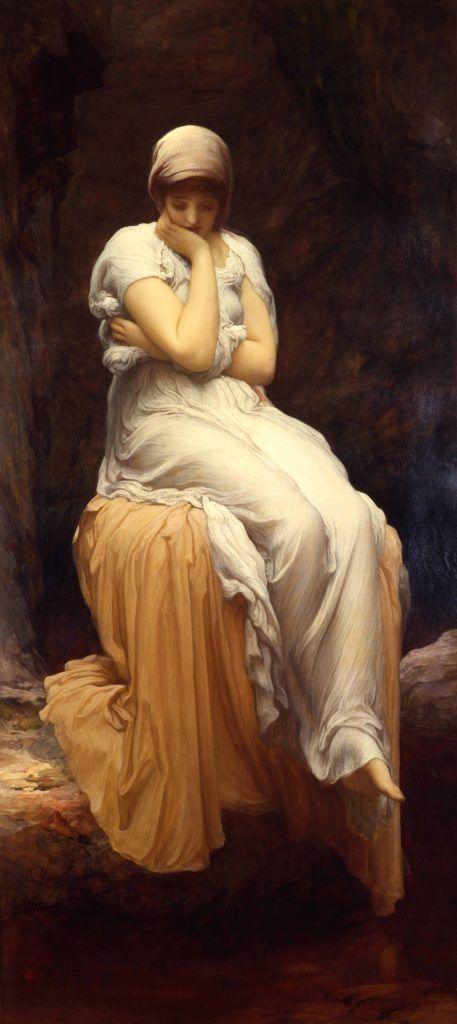 Frederic, 1st Baron Leighton of Stretton - (British, 1830–1896), Solitude, 1890, oil on canvas, 72" x 36"
 I made it a central figure in my drawing.

Graphite Drawing on Arches Etching Paper - Detail
I once read the book by Françoise Gilot, Life with Picasso, as well as many other books about Pablo Picasso, but this one made a particular impact on me and some funny stories in it had inspired another painting of mine some 4 years prior to this drawing, called Pablo’s Last Concert. So in this drawing, I ‘recycled’ the eye of Pablo again, watching over the scene:

Graphite Drawing on Arches Etching Paper- detail - Pablo's Eye
Exploring the History behind these drawings:
I left Austria, still a teenager, and moved to Sweden, and several years later to Canada. But I took my heritage with me, beginning to research in depth this fascinating Vienna School. I did not yet paint very well while I lived in Sweden, but I had always excelled in drawing. In Canada, my painting began to be more accomplished, and along with my drawing, I started to exhibit my work, which found many collectors already in the early seventies. A interest in printmaking led me to the University of Lethbridge Art Department in 1977, and while I only planned to audit some printmaking courses, I wound up taking the BFA program, eventually graduating in1982 with great distinction.
During the later years at University, I was working part time as a Gallery Assistant, and then for one year as Assistant Gallery Director in 1980. At that time, in conjunction with a new Fine Arts Building, it was proposed to open the building with an international show. Since I had already started to write a paper about the Vienna School of Fantastic Realism, I proposed to hold an exhibition. Travelling to Vienna, I contacted Prof. Rudolf Hausner, whom I met at his residence in Mödling in 1980.
It was a memorable visit, and he loaded me down with books, catalogs and brochures about the Vienna School. Based on this information I finished and submitted my paper. It was a disappointment that my proposal for a show was not accepted by committee, but the positive outcome was a exchange of letters with Prof. Hausner, who kept sending me new material from time to time. Eventually though, the connection faded.
When years later (1995) I found out he had passed away, I was devastated. His influence on my work (and also some influence of Ernst Fuchs) was already very strong, but perhaps best illustrated by my ‘signature piece’ called Selfportrait with the Critical Eye from 1978, which I had shown to him on my Vienna visit in 1980. At that time, I was rather anxious about being seen as ‘derivative’, but he jovially said to me that it was ‘very good brush work’, and about the theme and composition he said something to the effect of ‘this is no great state secret - we published this (to inspire)’. Hausner, and also Fuchs, along with my earlier fascination of the Surrealists such as Max Ernst and Salvador Dali, had a recurrent presence in some of my work.
Hausner’s Adam peeked into my paintings of that day, and in my drawing took on a dominant position in this, my ultimate tribute piece to the Vienna School, Vindobona Altarpiece III where he lords it over the central portion on a dark banner that stands above the scene like a sail.

Graphite Drawing on Arches Etching Paper
detail - Hausner's 'Adam'
Rudi Schreib Mal, 1994 - painted mailbox - private collection Canada
The Influence of Ernst Fuchs:
Particularly fascinating was the Unicorn series (Einhorn Zyklus) of his graphic work, particularly Die Versuchung des Einhorns. I admired his superior drawing skills above all and tried to emulate it the best I could.

Graphite Drawing on Arches Etching Paper
(Vindobona Altarpiece III, detail, bottom right)

Other Influences:

Graphite Drawing on Arches Etching Paper
Vindobona Altarpiece III - detail top right

Graphite Drawing on Arches Etching Paper
detail Vindobona Altarpiece III
What does it mean?
The question remains: What does it all mean? While I had set out to make this a tribute to the Vienna School, the subtitle "Snakes and Ladders" also alludes to the Game of Life, as in the words of Salman Rushdie (Midnight’s Children):

Please check out the Update in my comments HERE
Visit my website
▼

PRINTS OF MY ARTWORK AVAILABLE HERE:

Bonus Special: ANTIPODES AT THE FRIDGE GALLERY


should you not be on the blockchain, or have no upvote power, or this post is already older than 7 days, you can always just buy me a coffee.
Final Words of wisdom and a pet concern of mine, especially about art diplomas:
I had in years past come across quite a few 'fake diplomas' that pretend to be academic credentials. Next to 'Pay to Play Galleries' they are the scourge to be avoided. The summary of a paper about this spells it out
DEGREE MILLS - THE BILLION DOLLAR INDUSTRY
If you google the title you will find where this book is available, but also there are many videos on this subject.
