
North Korea's modern-day missile take a look at has brought simmering tensions the various notoriously reclusive u.S.A. And america to a head. But are fears of nuclear warfare premature? Are North Korean rockets able to accomplishing American shorelines?
It's feasible, regular with John Schilling, an American aerospace engineer and North Korea analyst.
Schilling, whose enjoy includes developing rockets for the U.S. Air Force, stated the present day North Korean missile is the number one with enough range and payload capacity to deliver a single nuclear warhead into United States territory.
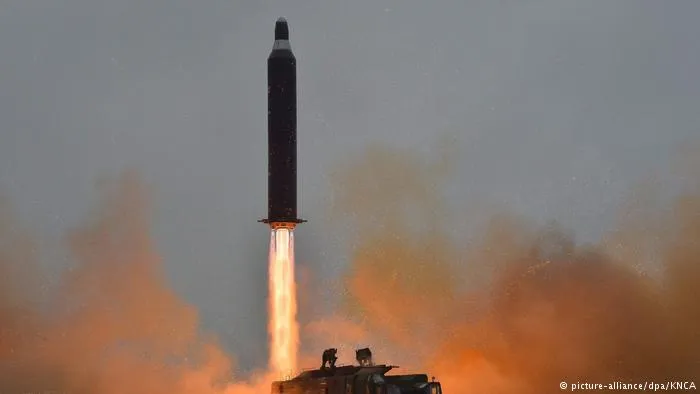
The July four take a look at release was "simply remarkable," Schilling told Live Science. "They've used bits of technology that they've been testing in smaller missiles, however this is the first time they have examined a missile of this scale."
Schilling is a consultant for 38 North, a internet site dedicated to professional analysis of North Korea, run with the aid of the US-Korea Institute on the Johns Hopkins School of Advanced International Studies in Washington, D.C.
The North Korean news enterprise KCNA broadcast a video of the launch and reported that the missile reached a most altitude of one,741 miles (2,802 kilometers) and flew for 39 minutes before it impacted inside the Sea of Japan "extra than 930 km" (580 miles) from its release website near Kusong, in the northwest of the united states of america.
In a blog post, David Wright, director of the Global Security Program for the Union of Concerned Scientists, expected that the new missile has a theoretical maximum variety of round four,a hundred and sixty miles (6,700 km) from release sites in North Korea.
"In its present form, it couldn't attain a good deal farther than Alaska or maybe Hawaii," Schilling said, "but we think it may be fairly effortlessly prolonged to cowl the West Coast of the US."
Nuclear danger
There may be little doubt about North Korea's meant targets for its missiles — the us of a's state media frequently issues dire warnings to South Korea, Japan and america, which it accuses of meddling in Korean affairs. [7 Technologies That Transformed Warfare]
"I expect they may sooner or later try and increase something larger to cover the entire United States, however would anticipate this one to enter carrier as a weapon, as a minimum inside the close to time period, over the next 12 months or ," Schilling said.
That approach North Korea is at the verge of making a clearly intercontinental nuclear risk: "Missiles of this scale are almost continually ready with nuclear warheads," he stated. "It's simply now not cost-effective with whatever much less."
Schilling envisioned that North Korea may want to have round 20 nuclear warheads that would be used on the sort of missile, "but there is big uncertainty on that," he said.
He also referred to that, unlike earlier North Korean missiles, the Hwasong-14 intercontinental ballistic missile (ICBM) that was examined in advance this month is fitted with a payload shroud, which hides the payload from external view.
"That form of design suggests that they're planning on incorporating decoys, similarly to just a unmarried warhead — but that would be several years down the road, requiring additional development and trying out," Schilling said.
Home grown
North Korea's nuclear missile application is made possible by way of a large dedication of cash and sources, pronounced the Washington Post, even though the u . S . Is idea to be one of the poorest within the international, and in which population bear common electricity outages and shortages of simple materials.
Schilling stated every rocket primarily based at the Hwasong-14 could in all likelihood fees tens of tens of millions of bucks to build, and the North Koreans are anticipated to position numerous such rockets into provider over the following couple of years.
The technologies used within the state-of-the-art rocket also confirmed how North Korea's missile generation has advanced due to the fact its earlier reliance on missile technology from submit-Soviet Russia, in addition to covert assistance in the past from Pakistan and Iran.
"We think this is a domestic-grown layout." Schilling said. "Getting to this level during the last two decades has worried a few overseas collaboration, but at this factor, we assume that they have got taken the schooling wheels off, and they're doing this on their very own, with simply an incredibly targeted attempt from a noticeably poor country."
Reliability chance
Schilling said North Korea still faces many engineering challenges before the Hwasong-14 may be an effective weapon, specially when it comes to ensuring that the missiles can characteristic beneath the haste and uncertainty of combat conditions.
"We are really surprised that this one worked at all — their missiles rarely work on the primary attempt," he said.
Developing precise guidance structures for the missiles might be any other challenge: "They've achieved launches which suggest they have got guidance era that might as a minimum be correct enough to hit town-sized targets," Schilling stated. "Anything greater specific than that might probable require a superb deal of trying out to calibrate the guidance systems."
The next tiers of North Korea's missile development will probable most effective be acknowledged while it assessments every other missile. And best North Korea knows when that may be.
"That's difficult to study," Schilling stated. "They may also simply consider this achievement to be sufficient for the instant, and now not chance embarrassing themselves with a failure."
source
1