
Introduction

Autonomous vehicles have become a very hot topic in the past few years and with many auto manufacturers and technology companies engaging in extensive research and development on the subject, each year we seems to get a little bit closer to this concept becoming a reality.
Overall, the technology opens up a world of possibilities when it comes to human transportation, and when driverless vehicles become the norm in society, they will certainly change the way human’s live and get around in their communities, in countless ways. This article discusses some of the ways that autonomous vehicles will change how people live and get around as well as some of the concepts that people and companies are envisioning when it comes to the future of transportation.
Getting Around

Nowadays it is quite common for each individual in a household to have their own vehicle. In fact, it is not uncommon in North America for single households to have 2 vehicles or more, depending on the age and employment status of any additional children living at home. However, since one autonomous vehicle could serve the needs of multiple individuals, households in the future may choose to own only a single autonomous vehicle - if they choose to own a vehicle at all.
When we think about coordinating the schedules of multiple people living in a single household, it seems a bit farfetched to think that one vehicle could be shared among all members of a family. However, when you consider the fact that autonomous vehicles do not need to remain parked after their passenger has been dropped off at their destination, this idea becomes a bit easier to fathom.

For instance, instead of waiting in the parking lot all day after dropping an adult off at work in the morning, an autonomous vehicle would be able to drive itself back home to pick up another individual who happens works at a different time. After dropping off both adults at their place of employment, the vehicle could then also return home to drop off the kids at school while their parents monitor their safety from their smartphones.

When autonomous vehicles hit the market many auto companies will sell rides instead of cars so a different scenario may be that households choose not to own their own autonomous vehicle but instead buy into a monthly service package that sends a driverless vehicle to their home to transport their household around the city. In this scenario the household could choose the service package and a schedule that suits their needs without having to worry about any sort of vehicle maintenance, insurance or fuel requirements. Instead of having their vehicles sit idle in their driveways during the day, some individuals may even choose to rent out their vehicles to others while they are at work. This could make ride sharing much more common and would also act as another source of income for the household.
Though these scenarios may still seem a bit far fetched, several auto manufacturers are currently in the process of making all of this happen.
Ford Motors

According to their website, Ford is the first automaker to begin testing fully autonomous cars and they claim that they will have a fully autonomous vehicle on the market by 2021. According to an article that you can find here the company has partnered and invested in several technology companies (Lyft being one of them) and is gearing up to mass produce a level 4 autonomous vehicle in only a few short years.

The company claims that the vehicle will be capable of completing all aspects of driving on its own without any sort of human intervention and that the vehicles will not be equipped with a steering wheel or gas or brake pedals, which means that humans will have no responsibilities in the driving process. Instead, passengers will be able to sit back and relax and let the vehicle do all of the work.
Mesh Networks

A mesh network is basically an electronic structure of connected nodes that arrange themselves dynamically and non-hierarchically in order to communicate and cooperate with one another. In the case of autonomous vehicles, each vehicle would operate as an individual node within the system which would be connected to every other node across the entire network.

Once connected to a mesh network, individual vehicles would be able to transmit information and communicate with other vehicles in order to determine what obstacles lay ahead as well as the traffic conditions on route. In this way, autonomous vehicles would be able to understand a much larger picture of what is happening on the roadways then their single scope, which in theory would make driving safer and much more efficient.
One limitation to the technology though is the amount of data these mesh networks would require, which unfortunately is probably beyond our current capabilities. Nonetheless, mesh networks will be vital to a society that uses autonomous vehicles.
Concepts

The technology and features within autonomous vehicles will likely progress somewhat slowly over time but eventually these vehicles could be equipped with any number of comforts and features. In the future, vehicles will likely be customized upon their purchase (or rental) to fit the needs of each individual and family.
For instance, some individuals will want their cars to be equipped with extensive entertainment systems with large screens for watching movies, browsing the internet or playing games. Others may want their vehicles to be suited for business or travel. As such, desktops, and seats that turn into beds may be among the features offered by auto manufacturers.

The Commute: Autonomous vehicles will change how people commute to work by essentially giving them more free time. Since people won’t have to worry about the responsibility of driving while they on their way to work, they will be able to spend their commute doing other things, such as catching up on some sleep, browsing the internet, watching videos or reading a book. Some individuals may even choose to log onto their laptops and begin work while on the road which would allow them to complete their work tasks on route and reduce the amount of time that they need to spend in the office.

Business: Business as well will certainly change with autonomous vehicles. Some individuals believe that the vehicles themselves will be like small businesses that travel the roadways to bring their goods and services directly to their customers. Fast food restaurants and coffee shops may operate within a vehicle in order to deliver food and beverages to customers immediately after they are made.
Autonomous vehicles would also be capable of allowing their passengers to hold meetings inside the vehicle or complete their everyday work tasks while they are on route to say a conference or travel flight.

Travel and Leisure: Autonomous vehicles will also certainly change how people travel. When couples and families go on road trips while in a driverless vehicle, they won’t necessarily need to pull over at night to sleep in a hotel. Vehicle could be equipped with seats that fold down into beds allowing them to sleep while driving. As such, people could fall asleep in their vehicles at night and wake up at their destinations in the morning, which would eliminate the extra expense of hotels stays and reduce their overall travel time. I’ve even seen some vehicle concepts featuring a toilet in the vehicle (like the above image) which seems a bit bazaar but nonetheless convenient.
Perhaps people will live in their vehicles??
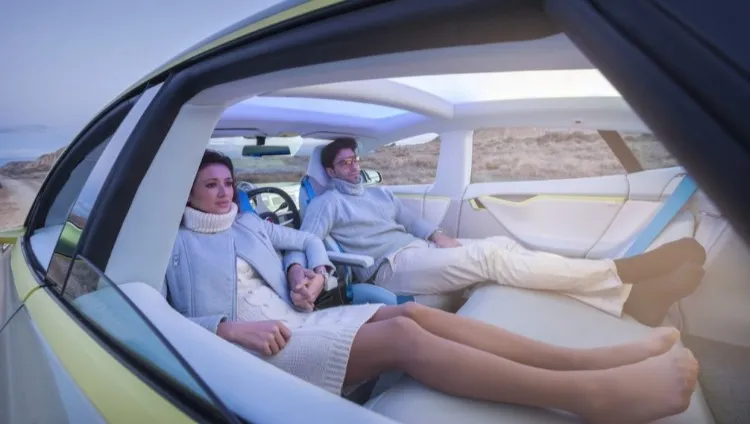
If people take a scenic road trip their vehicle may also be equipped with extra-large panoramic windows that will allow them to take in their surroundings as they drive through mountains or scenic landscapes. Some vehicles may even become moving party venues equipped with a music, a bar and even a dance floor. Bars, pubs and lounges could pick up their customers and allow them to party while they are on their way to the venue.
How the World will Change

Many people believe that society will change significantly with the introduction of driverless vehicles. Not only will they create a safer and more efficient roadways, with less accidents and traffic congestion, but they will also change the structure of how cities are designed and how they operate.
For instance, each individual store or business probably won’t need its own parking lot, which will free up more land for development. Instead of parking on the businesses property, vehicles may travel home when waiting for their passengers or they may wait in large designated parking hubs throughout the city until their passengers are ready to be picked up.
Autonomous vehicles will also provide another means of transportation (aside from public transit) for passengers who are normally unable to travel on their own, such as the elderly or individuals with a disability.
As mentioned previously, hotels will certainly be effected by driverless vehicles and they may even become obsolete entirely. If passengers begin sleeping in their vehicles instead of pulling over for the night, hotel chains will have to offer travelers more than just a clean bed and shower to entice them to stay at their establishments. They may need to highlight the experience of staying in a hotel by offering other sorts of entertainment.
Employment will change significantly as well since many professions will no longer be needed. Taxi drivers, truck drivers and package delivery personnel are just a few of the professions that will certainly become obsolete. Car manufacturing, dealerships, and supply chains will also be effected by the change as well as the auto maintenance and insurance industries. On the other hand, many new jobs will also be created.
The marketing strategies of restaurants and businesses may change as well. With passengers focused on the entertainment within their vehicles instead of the outer streets, the billboard advertisements and business signs that currently litter the streets will become obsolete. As such, businesses will need to entice passing customers with electronic advertisements. As such, our on-board screens and entertainment systems may become littered with ads.
Though I cannot stand advertisement pop-ups, I for one am in favor of cleaning up the streets and doing away with the unsightly billboards and street sign advertisements that currently litter our communities. I’d personally like to see more nature and more trees planted in our communities rather than restaurant and business signs.
Other Changes

Other changes to society will include things like:
Driver’s licenses will no longer be required, nor traffic lights and street signs. Traffic and parking tickets will no longer be a source of revenue for the police. People will no longer need a designated driver when drinking alcohol with friends or family. Similarly, DUI violations will not exist.
Since most autonomous vehicles will run on electricity, charging stations and quick battery swap outlets will replace gas stations. GPS and video recording within vehicles will be more common in order to track individual’s whereabouts and safety. Cities and communities themselves will probably be reconfigured to support more walking and biking, especially in downtown cores, parks and shopping centers.
Hacking vehicle computers will be an issue and driving itself will become extremely regulated and rare. Driving will probably even be seen as a luxury and a source of entertainment where people who want to drive a vehicle will have to pay to go to designated site. Much like we have shooting ranges in society, we may also have driving ranges (different from those of golf of course).
Conclusion

Though we are still a little ways away from autonomous vehicles hitting the streets, a lot of progress has been made in their development and many auto manufacturers and technology companies claim that they will have a working product in the next few years. When that happens, societies and our communities will change significantly. I for one am excited at the possibilities that autonomous vehicles offer. What do you think?