
Okay, imagine you’re driving along a three lane highway. You start to merge into the middle lane, but you don’t notice that a car in the far lane was merging too–and you hit each other.
Image Source
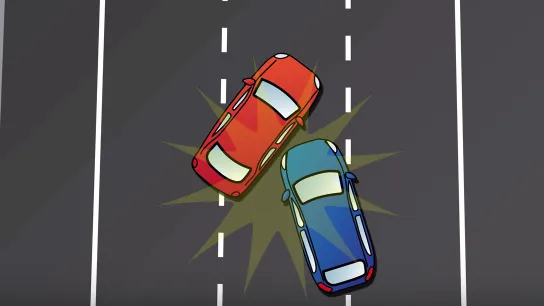
So here’s a question for you: Who’s at fault? Is it you, is the other driver, or is it a situation of equal blame?
You both pull over and it turns out that the other car was a self driving car. There’s no one inside.
Image Source

When you were both merging, the car’s algorithm predicted you would see it and allow it to merge before you. So, who’s at fault now? Did you fail the algorithm, or did the algorithm fail to allow for you? Or is it still a situation of equal blame?
This isn’t a purely hypothetical situation–earlier this year a Google self driving car hit a bus when it failed to adjust for the bus’s speed entering traffic. The vehicle’s automation system was partly to blame, but in that case there was a person sitting in the self driving car who did not override the system, because they trusted it would correct itself.
And, really, we have a lot of reasons to trust systems–automation is nothing new. In 1933, the first solo flight around the world was made possible thanks to “Mechanical Mike,
Image Source
” the plane’s automatic Sperry Gyroscope.
Image Source


Since then, flight has become more and more automated, a lot of that to make air travel safer. 1991 NASA memo stated “Human error is the dominant cause of aircraft accidents...The most important purpose automation can serve is to make the aviation system more error resistant.”
Image Source

And it DOES make air travel safer. For example, the Fly-by-Wire system helps monitor the plane to prevent stalling in mid-air. But, there have also been unintended consequences of this when automated systems fail.
Take the crash of Air France flight 477 in June 2009.
Image Source
At some point during the flight, the Fly-by-Wire system failed and the plane stalled. Neither the pilot or co-pilot recognized the warning alarm and the result was a tragic loss of life.

Some argue that pilots have become too dependent on automated systems and are unable to safely fly a plane if those automation's fail. And Air France flight 477 embodies The Automation enigma.
The Automation says that as systems become more automated, humans lose some of their skill with the system, resulting in more automation. And the paradox applies to any automated system–Including cars.
We started by replacing the crank start with an electric starter in 1896. Fully automatic transmissions were available by 1940.
Image Source

The ‘60s saw the adoption of power steering; and since then, ABS brakes,
Image Source
automatic headlights,
Image Source
reverse cameras,
Image Source
parking assist and a lot of automation has been added to vehicles.


Recently, Tesla released an Autopilot feature a semi-autonomous system where cars keep in a lane, adjust their speed, change lanes and self-park.
Image Source

But in the last few months, at least two accidents and one death have been attributed to Tesla’s autopilot feature. Which led to a lot of people and media to question if the idea of driverless cars.
Let’s look at the stats: For Tesla’s Autopilot, it’s the first fatality in 130 million miles driven. In the US, there’s one fatality every 94 million miles driven and globally, one every 60 million miles.
Image Source

In New York State, driver operated vehicles have an average of 2.4 accidents per one million miles driven, and for Google’s self-driving cars it’s 0.7 accidents per one million Miles.
Image Source

The numbers say that driverless and self driving cars are likely safe. But it’s questionable how close we are to a utopian vision of driverless cars as far as the eye can see. Think back to your crash at the beginning of this post.
When you were both merging, the self driving car’s algorithm predicted you would see it and allow the car to merge before you. But, you didn’t.
It raises a question where technology meets psychology: What happens when people don’t interact with technology in the way that developers expect?
Last month, Australian psychologist Narelle Haworth,
Image Source
an expert in road safety and psychology, said, “Technology isn’t the obstacle, psychology is, and the challenge is to understand if humans can trust autonomous machines. Will we be willing to entrust our children to self-driving machines? And will improvements in technology improve road safety in developing countries or just magnify the current inequities?”

The Automation is pretty logical: As systems become more automated, humans lose skill with that system, resulting in more Automation.
But when you think about it, the prospect of automated cars is really nuanced–cars are our personal possessions, and the trust and ethical considerations surrounding fully automated systems becomes personal, too.
Will we ever get to the point where, in the developed world, self driving cars are the norm? And we will allow ourselves to lose skills, driving skills, with that system?
Perhaps the real thing is in our own psychology.