

For my last day on Maui, I really wanted to explore the sea life a bit more. Ranked among the top 25 U.S. aquariums on TripAdvisor, choosing the Maui Ocean Center was a no-brainer.

Everything about this aquarium was beautiful - they even have this exquisitely done artwork for all visitors to see!

And check out the view from here! Isn't it in the perfect setting?
With the outside this beautiful, the inside must be spectacular. Let's dive in, shall we?
The Exhibits
The Maui Ocean Center has over 60 exhibits showcasing Hawaiian and tropical species. It is just incredible to be able to see many of these fish in one place, especially some of the more elusive ones. Since there was so much to see, I decided that I would like to share with you some things that I found particularly interesting. I hope you agree!

This is the unicorn tang, aptly named for what appears to be a horn growing from their forehead. What it is actually used for is not known at this time. Their name in Hawaiian is kala, which translates to "rough," probably because these fish have very rough skin - so much so that ancient Hawaiians would use their skin for drumheads!

Here we have the Hawaiian squirrelfish (I love that name!), also known as ‘ala‘ihi. This is a nocturnal fish, which is why they have such large eyes - all the better for feasting on unaware crustaceans! And you won't find them anywhere else but in Hawaii!

Eeeekkkk! It's a monster! Oh, wait....that's just a frogfish. These fish are the ultimate ambush predator! The bright coloration helps them to blend in with sea sponges, they use their fins for walking on the sand, and they also have a lure that projects in front of their mouth. If prey wanders too close, the frogfish will suck it down in a split second! Scary!

I really wish I knew what the name of this fish is, but unfortunately, I do not. I just thought it was so bizarre looking that it was worth showing you guys a picture of it. If anyone knows the name of this fish, please leave me a comment! I would love to find out.
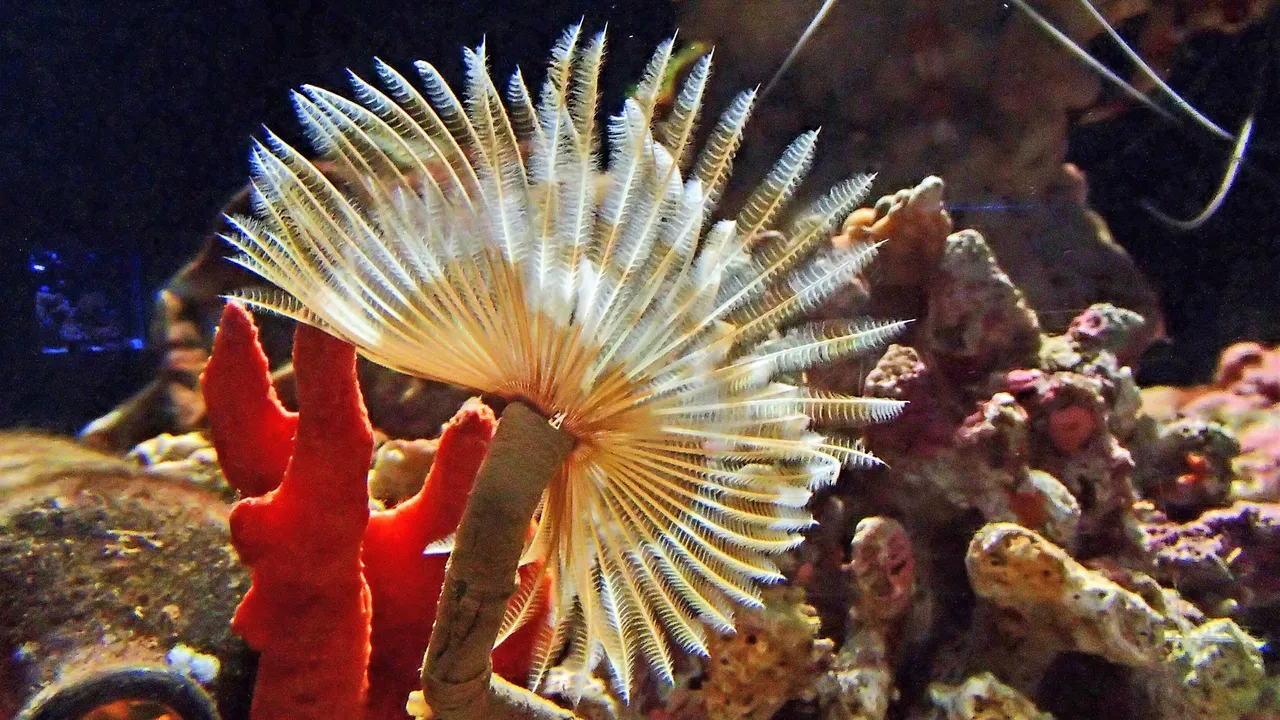
So, I will admit it - I thought this was a coral. It turns out that this is a worm! What we have here is a sedentary worm commonly referred to as fan or feather duster worm. The long tube that you see in the photo was constructed by the worm, and the fan part of it is actually tentacles (which are used for capturing prey). I still can't believe it's a worm!
The Tunnel & Open Ocean

The Maui Ocean Center also has this walk-through tunnel that is 54 feet in length and connects to the Open Ocean Exhibit. While walking through it, you really do feel like you are in this underwater world. I could just sit here and watch everything go by - and I did. For an hour!
Let's continue on to the open ocean.

Have you ever watched rays swimming? It looks like they are gracefully flying through the ocean. This ray in particular is the Hawaiian Broad Stingray, also known as lupe (kite). This species is found only in Hawaii and Tahiti, and can grow to be 5 feet across.

In this photo, we have 2 different sharks. On the left is the Sandbar Shark, and on the right is the Gray Reef Shark. In Hawaiian culture, many viewed sharks as ‘aumakua, a family deity, and believed their deceased family members would take the form of a shark. By taking care of the sharks, they believed they would receive protection in return.
The Sandbar Shark can be found worldwide and reach an average of 5 feet in length; however, in Hawaii the largest documented shark was 6.4 feet. This opportunistic feeder will dine on anything from bony fish, to crustaceans, to other sharks! Unfortunately, due to commercial hunting, this shark is considered Vulnerable and likely to become endangered.
Found throughout the Pacific and Indian Oceans, the Gray Reef Shark is a highly territorial and aggressive species that can reach lengths of up to 7 feet. Don't worry though - they prefer to eat bony fish or octopus/squid. Sadly, they are being over fished, which has led them to be listed as Near Threatened (meaning, they may eventually go extinct).

Here is a Blacktip Reef Shark, manō pā‘ele in Hawaiian. These sharks are very easy to identify, as the tips of their fins are all colored black - hence their name. Reaching a length of 5.5 feet, they are fairly small in comparison to other sharks. Because of this, they prefer to stay in shallower waters where larger sharks do not go.
Aquariums are a great place to go in order to learn about the world beneath the water's surface. And where else can you find all of these species in one place? The Maui Ocean Center does a wonderful job of both creating a place to see, explore, and learn about tropical and Hawaiian species.
I would highly recommend this aquarium to everyone, and I can't wait to visit again. Their exhibits, especially the Open Ocean Exhibit, are constantly changing, meaning every time you go is a new experience (and one that you will treasure)!
Thank you for taking the time to join me in my adventure! Like always, if you enjoyed this post, please feel free to comment, upvote, resteem, and/or follow me. All are greatly appreciated! I look forward to seeing you in the next one!