
Hello there!
This is my fourth post reviewing museums and zoos in the Boston and Greater Boston area:
D2: New Bedford Whaling Museum
D4. Museum of Science (Boston) (this post)
This time we're in downtown Boston visiting the Museum of Science which is part science museum, part natural history museum, part zoo.
All of the pictures in this post were taken by me except for the map of the museum.
MUSEUM OF SCIENCE
1 Science Park
Boston, MA 02114
Website: https://www.mos.org/
Hours: Open Daily, 9 AM - 5 PM
On Friday and Saturday evenings, the Planetarium and Mugar Omni Theaters are open until 10 PM (last show).
Cost (as of 2025):
Adult: $33
Senior (Ages 60+): $29
Child (Ages 3-11): $28
Child (Under 3): FREE
Members: FREE
Add-ons:
Planetarium Shows: $6
Omni Films: $6
4-D Films: $6
Special Add-On Price for Members: $5
Active duty military get free admission upon showing their military ID.
Veterans receive complimentary admission on November 11th, to celebrate Veterans Day.
Between Armed Forces Day and Labor Day (3rd week in May through Labor Day), free admission to active duty US military personnel and up to 5 family members. This includes Reservists, National Guardsmen, and certain other categories.
The Museum of Science also participates in the AZA reciprocity at the 100% level. That means Museum of Science members get 100% (free) admission when visiting other AZA institutes participating at the 100% level and members of those other 100% institutes get free admission to the Museum of Science. Museum of Science members get 50% discounted admission when visiting AZA institutes participating at the 50% level and members of those 50% institutes get 50% off when visiting the Museum of Science.
LIFE HACK: Since one adult admission to the Museum of Science costs $33, it is actually cheaper to spend $30 and buy a year-long non-resident membership to Buttonwood Park Zoo which gives you free access to the Museum of Science (due to 100% reciprocity). The membership also has various other benefits throughout the year at a variety of AZA institutions. This is what I did!
Parking: This being downtown Boston, there are notable parking fees. For nonmembers using the museum garage:
30 minutes or less: FREE
30-60 minutes: $15
1-2 hours: $18
An additional $3 for each additional hour up to the 7-8 hour mark which is $36 total.
Over 8 hours: Jumps to $60
Estimated Time: 2-4 hours, depending on your interest and whether you are bringing kids. There's enough kid-friendly content to keep children occupied for hours.
I only spent 1.5 hours because most of the science sections were too elementary for me so I just breezed through them.
SUMMARY

The Museum of Science is a hybrid science museum + natural history museum + zoo in downtown Boston. It seems to be quite popular among Bostonians, especially for families with children. However, I'm going to go against the grain and say that it's merely an average 2 stars.
The museum is replete with hands-on activities that teach basic scientific principles to kids so for those with children this can provide hours of entertainment for their little ones. Casual adults without much scientific training might find it fun too. However, I personally found the majority of the science displays to lack sufficient depth - I learned a lot more from my high school science classes. I've also seen science exhibits done better at other science museums, such as the Museum of Science and Industry in Chicago. Thus the science half of the museum wasn't particularly interesting at all for me.
I was more intrigued by the natural history half, which was reasonable. It did feel like most of the natural history exhibits were tucked into the basement or in other corners because the curators felt that the science exhibits drew bigger "oohs and aahs." The Museum of Science had a respectable collection of animal specimens though it can't really compare to the Field Museum of Natural History in Chicago.
The Museum of Science has a limited selection of live animals, which explains its membership with the AZA. However, if you are expecting to see a large assortment like at a normal zoo, you will likely be disappointed. If I were to rate the Museum of Boston compared to actual zoos, it would be 1 star, but I won't do that because I'm just thankful that the AZA affiliation allowed me to get free reciprocal admission! I would characterize the Museum of Science as a museum with some live animals and not really a museum + bona fide zoo.
The hybrid approach (science museum + natural history museum + live animals + planetarium) reminds me of the California Academy of Sciences (natural history museum + aquarium + planetarium) and Six Flags Discovery Kingdom (amusement park + zoo). I guess this might be convenient for locals who see it as a one-stop shop and who haven't traveled sufficiently to see the depths that specialized museums can offer. But my personal perspective is that by trying to do too much by appealing to so many interest groups, you do a poorer job than if you had simply focused on one area.
Furthermore, admission is pricey ($33) plus you have to pay for expensive downtown parking (likely to be $20+), though you can at least get the admission price waived with certain AZA reciprocal membership.
Here is how I rate comparable museums:
5 stars:
- Field Museum (Chicago, IL)
- Castello Sforzesco (Milan, Italy)
4 stars:
- The Ringling (Sarasota, FL)
- Museum of Science and Industry (Chicago, IL)
- Museum d'Histoire Naturelle (Nice, France) (2 stars without the Lego special exhibit)
- Musée Masséna (Nice, France)
- Galata Museo del Mare (Genoa, Italy)
- Museo del Duomo (Milan, Italy)
- CDC Museum (Atlanta, GA, Free)
- Mardi Gras World (New Orleans, LA)
- World War 2 Museum (New Orleans, LA)
3 stars:
- Chicago Fed Money Museum (Chicago, IL, Free)
- Medieval Torture Museum (Chicago, IL)
- Musée d'Archéologie de Nice-Cimiez (Nice, France)
- Civico Museo Archeologico (Milan, Italy)
- Museo Nazionale della Scienza e della Tecnologia Leonardo da Vinci (Milan, Italy)
- Museo di Storia Naturale (Milan, Italy)
- California Academy of Sciences (San Francisco, CA)
- Michael C Carlos Museum (Atlanta, GA)
- Center for Puppetry Arts (Atlanta, GA)
- World of Coca-Cola (Atlanta, GA)
- Fernbank Museum of Natural History (Atlanta, GA)
2 stars:
- Musée d'Archéologie d'Antibes (Antibes, France)
- Museo Civico di Storia Naturale Giacomo Doria (Genoa, Italy)
- Museo del Tesoro di San Lorenzo (Genoa, Italy)
- Museo Biblioteca dell'Attore (Genoa, Italy, Free)
- Holcomb Observatory and Planetarium (Indianapolis, IN)
- San Jose History Park (San Jose, CA, Free)
- Museum of Illusions (Atlanta, GA)
- Atlanta History Center (Atlanta, GA)
- New Bedford Whaling Museum (New Bedford, MA)
- Museum of Science (Boston, MA)
- Cape Cod Maritime Museum (Hyannis, MA)
- Cape Cod Museum of Natural History (Brewster, MA)
- French Cable Museum (Orleans, MA, Free)
- Pilgrim Monument and Museum (Provincetown, MA)
1 star:
- National Center for Civil and Human Rights (Atlanta, GA)
- Attleboro Industrial Museum (Attleboro, MA, Free)
- Whydah Pirate Museum (West Yarmouth, MA)
SCIENCE MUSEUM
Exploring AI: Making the Invisible Visible
Atlas
Created by Boston Dynamics
Historic humanoid
Known for its athleticism and acrobatic moves, Atlas was developed to explore how robots could move around the world like people. Atlas could run, jump, pick up objects, dance, and even do backflips! Now retired, this hydraulic version of Atlas advanced research in areas of robotics such as mobility and perception.

Spot
Created by Boston Dynamics

MIT Cheetah II

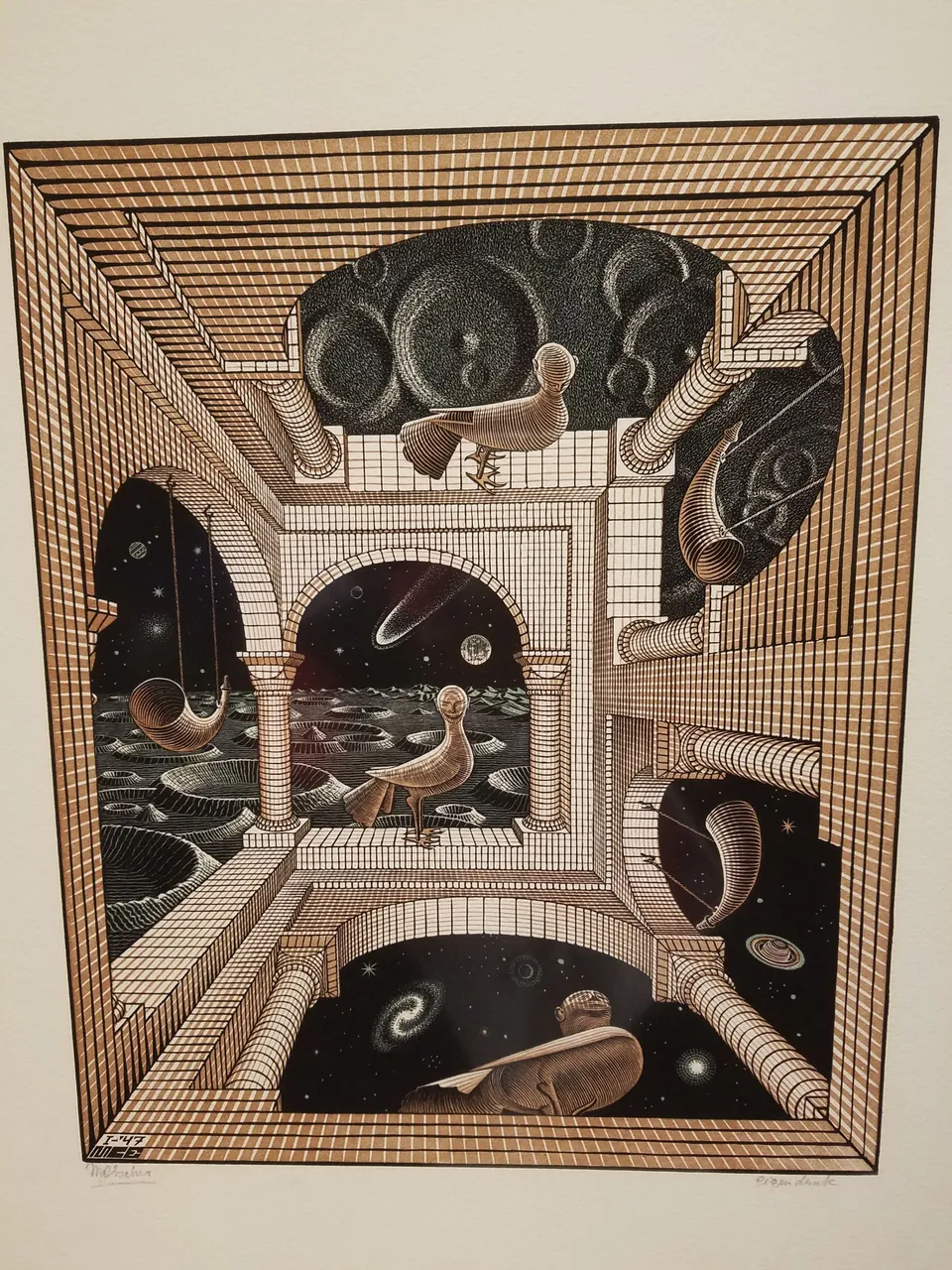
The Art of Illusion
Waterfall, 1961
Lithograph reproduction

Three Worlds, 1955
Lithograph reproduction

Ascending and Descending, 1960
Lithograph reproduction

Other World, 1943
Wood engraving and woodcut in black, reddish brown, and green, printed from three blocks
Reproduction
Up and Down, 1947
Lithograph in brown
Reproduction

Castrovalva (Abruzzi), 1930
Lithograph
Reproduction

Sky and Water I, 1938
Woodcut
Reproduction

Self Reflected, 2014-2017
Microetched print on aluminized polymer
Greg Dunn and Brian Edwards
Self Reflected is an artistic representation of a brain slice, inspired by the way neurons transmit and receive signals within the brain. More than 86 billion neurons allow humans to think, move, and sense the world.

The Cosmic Light exhibit is in the corner of the museum near the planetarium. There were several beautiful images that I appreciated for their artistic majesty:
When Two Galaxies Pass
The gravitational tug of the smaller galaxy creates ripples in the Whirlpool Galaxy. These gravity ripples cause the interstellar dust to clump together and gradually condense into new stars. In this image those areas are shown in pink.

Star Formation
Towers of gas and dust in the Carina Nebula are the raw material for creating stars. Hidden inside, new stars spew out jets of gas that create streamers of dust.

Interstellar Dust
The heat from the hundreds of stars in the Pleiades cluster is warming up the dust cloud they are passing through. The hot dust glows with the infrared light in this image.

A Dying Star
When a mid-sized star runs out of fuel, its core collapses in on itself, creating tremendous heat. In the Butterfly Nebula, the matter ejected from the star formed two glowing plumes that resemble wings.

Archimedean Excogitation, 1987
George Rhoads


Foucault Pendulum & Aztec Calendar Stone mosaic:

Gaia Globe
Luke Jerram
In Greek mythology, Gaia is the personification of Earth. Gaia, the piece created by UK artist Luke Jerram, is a touring artwork measuring over twenty feet in diameter and featuring 120dpi detailed NASA imagery of the Earth's surface. Installed in the Museum's iconic Blue Wing, visitors can see our planet at this impressive scale, floating in three dimensions.
The installation creates a sense of the "overview" effect, first described by author Frank White in 1987. Common features of the experience for astronauts are a feeling of awe for the planet, a profound understanding of the interconnectedness of all life, and a renewed sense of responsibility for taking care of the environment. This exhibit was part of the Museum’s Year of the Earthshot, in which the Museum of Science explored the most innovative climate solutions of our times.

Perception Playground, a limited time (through October 26th, 2025) exhibit on the senses:


Science in the Park, a hands-on experience oriented towards kids:

Hands-Only CPR training kiosk sponsored by the American Heart Association and Johnson & Johnson MedTech:


Guess how many beanie babies?

World's largest air-insulated Van de Graaff generator at the Theater of Electricity:

Apollo Command Module:

A Lego model of the Museum of Science:

Yorkshire 1843
Model scale: 1 inch equals 4 feet
Length: 167 feet
Width: 35 feet, 4 inches
In 1846, the Yorkshire crossed the Atlantic in just 15 days - the fastest westbound voyage by a commercial sailing vessel.
Model built by Peter Ness, East Boston, Massachusetts
Gift of Joseph E. Nunes, Quincy, Massachusetts

Charles W. Morgan 1841
Model scale: 1 inch equals 4 feet
Length: 105 feet, 6 inches
Width: 27 feet, 7 inches
The Charles W. Morgan is the most famous of the old New Bedford, Massachusetts whaling ships that traveled the world and hunted whales. The real ship is on exhibit at the Mystic Seaport in Mystic, Connecticut.
Model built by Peter Ness, East Boston, Massachusetts
Gift of Mr. and Mrs. Leopold Peavy, Jr.

Mayflower
Halve Maen 1609
Santa Maria 1492

LIVE ANIMALS
There are supposed to be live axolotls but they were not on display when I visited. I was initially looking forward to the "Live Animal Care Center" near the planetarium but it was underwhelming. Just a handful of animals in cages being taken care of - there wasn't even anything worth taking a picture of.
Here are the other live animals that I saw:
Cotton-top tamarins
Saguinus oedipus

Honey bee
Apis mellifera


Poison dart frog

NATURAL HISTORY MUSEUM
Lion
Panthera leo

Tiger

A collection of kitties:

Polar Bear
Ursus maritimus

A particularly ferocious polar bear!

Grizzly Bear
Ursus arctos horribilis

Red Fox
Vulpes vulpes
Frolicking foxes:


Raccoon
Procyon lotor

Striped skunk
Mephitis mephitis
A surfeit of skunks:

Great Horned Owl
Bubo virginianus
Vermont In June
The Great Horned Owl is the only North American animal that regularly preys on skunks. However, if this owl has been sprayed by a skunk before, it may hesitate to tackle all five at once. Here it has discovered a mother skunk with her family searching for grubs in a rotten log. Will the owl dine on skunk tonight?

North American Opossum
Didelphis virginiana

Nine-banded Armadillo
Dasypus novemcinctus
2004.6

Fisher
Pekania pennanti
Porcupine
The fisher moves in four-footed bounds, hunts mostly after dark, and is active year round. Once hunted to rarity for its beautiful coat, it is making a comeback in New England.

New England Habitats


Grizzly Bear
Ursus arctos horribilis

Wardsboro Panther
Shot November 20th, 1975, this was the second-to-last panther killed in New England.

Collection of birds:

The Colby Room
The objects in this room represent stories and cultures of people and places from around the world.
Colonel Francis Thompson Colby (1882-1953) was a soldier, outdoorsman, and one of the Museum's greatest benefactors in its nearly 200-year history. He traveled extensively in the early to mid-20th century, during a period when colonialism inflicted significant harm on indigenous communities globally, the effects of which are still felt today. Colby maintained homes in Hamilton, Massachusetts and Nairobi, Kenya, and decorated both residences with objects he collected in his travels.
In the 1950s, Colonel Colby gifted the Museum this room from his home, along with a generous endowment, which has supported the Museum's educational activities for decades. But the stories told by the artifacts in this room, particularly the stories of the Indigenous cultures reflected here, are missing. The Museum is dedicated to learning more about this collection, and has undertaken research to reveal the diverse histories represented.


Full-size Tyrannosaurus rex model:


Triceratops:


Ichthyosaur fossil:

WEEMS SCULPTURES
Hidden away on Level 3 is an impressive gallery of sculptures by Katharine Lane Weems (1899 - 1989).
The bronze sculptures and drawings displayed throughout this library are the work of the Boston artist, Katharine Lane Weems.
During her 70-year career, Katharine Weems broke away from the 20th century social standards for women to become one of the most recognized animal sculptors of her time. Specializing in bronze, her works reflect her careful observation of the anatomy and personalities of the aniamls she studied.
In 1965, Mrs. Weems donated her collection to the Museum of Science to demonstrate the many connections between science and art.
Grey Fox, 1971
Bronze with green patina, bronze base

Lion Cub Licking Paw, 1936?
Bronze with brown patina, marble base

Rabbit, 1945?
Bronze with green patina
Domestic Rabbit, n.d.
Bronze with brown patina
Domestic Rabbit, n.d.
Bronze with brown patina

April, 1929
Bronze with green patina, marble base

Dark Warrior1929
Bronze
Grey Fox, 1971
Bronze with green patina, bronze base
Bee Sting, 1950
Bronze with brown patina, wood base
Awarded the Ellin P. Speyer Memorial Prize by the National Academy of Design in 1963

Greyhounds Unleashed, 1928
Bronze with green patina, bronze base
Head of Gino, 1950
Bronze with brown patina, Bakelite base
Narcisse Noir, 1926
Bronze with black patina, marble base
Awarded the George D. Widener Memorial Gold Medal for Sculpture at the Pennsylvania Academy of the Fine Arts in 1927

Cat Sleeping, 1950s
Pen and ink, on scratchboard

OTHER ART
Mrs. Fiske Warren (Gretchen Osgood) and Her Daughter Rachel, 1903
Reproduction with wooden frame
John Singer Sargent
American, 1856 - 1925
Given to the Museum by Mr. And Mrs. Robert C. Barton, in memory of Mrs. Barton's mother, Mrs. Gretchen Osgood Warren

North American River Otter Sculpture
Lontra canadensis

Beaver Sculpture

Muskrat Sculpture
Ondatra zibethica

Mobiles above the Yawkey Gallery on the Charles River:

OTHER CUTE THINGS
An adorable out-of-order sign:

Cute image of an arctic fox from the Arctic Adventure exhibit:

A beary interesting caution sign:

Cute critters from a kid's activity:

GIFTSHOP
Note that I am not compensated in any way for promoting any of these products. I just like to take note of cute things!
Assorted Eco Pals plushes:

Assorted Wild Republic plushes:
$28

Small Eco Pals penguins
They had the same Eco Pals penguins at the Shedd Aquarium in Chicago.

Gumball Plush
$29
Sun
https://shop.mos.org/plush-gumball-sun
Moon
https://shop.mos.org/plush-gumball-moon
They had similar space-themed plushes at the Museum of Science and Industry in Chicago.

Axolotl paraphernalia
Squish Axolotl Plush
$20
https://shop.mos.org/squish-axolotl-plush
Axolotl Onesie
$26

Sloth Branch Youth Tee
$24
