

Repository
https://github.com/feekayo/dbooksEOS
DBooks is Moving to EOS
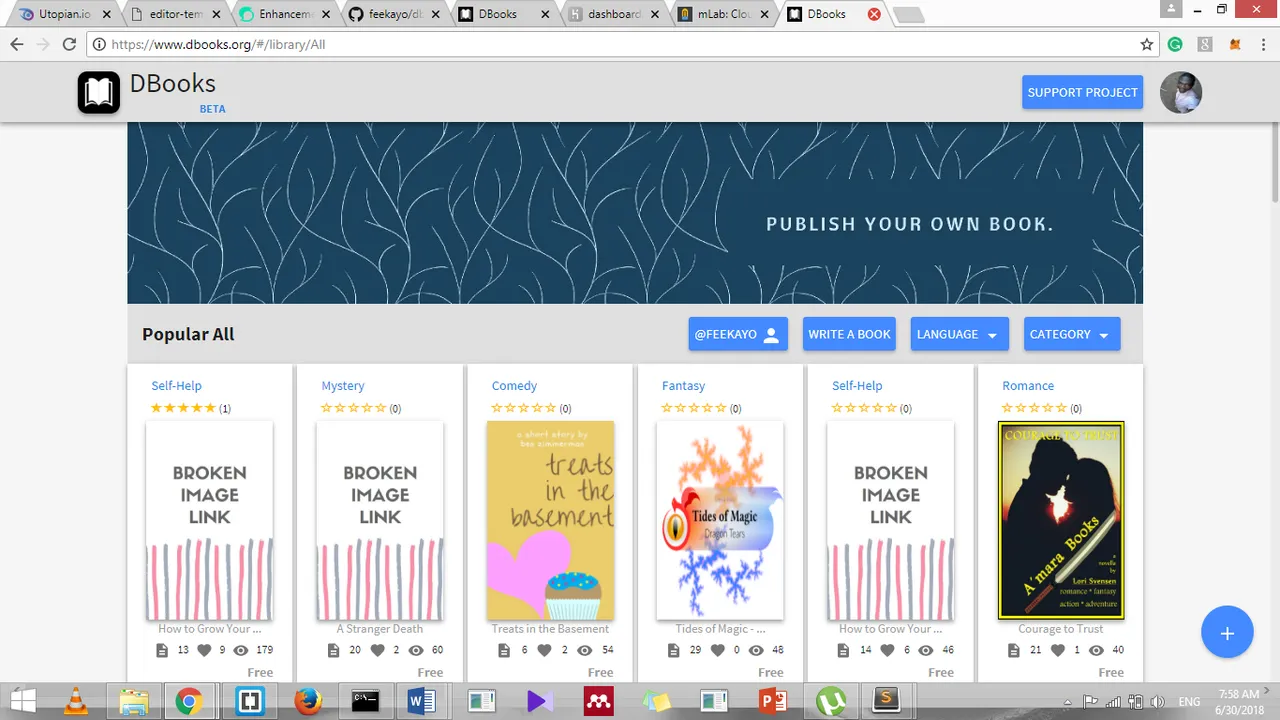
This is a corollary to the initial announcement made here. Steemit's premier book publishing platform DBooks.org would be porting to the EOS blockchain. This decision was made as a result of consultations and intense pondering on how best to make this a successful and sustainanble project.
The DBooks platform was designed to extend the capabilities of regular steem functions and provided a thin layer of functionalities that made it possible for authors and publishers of books of fiction and non-ficition on the Steem Blockchain while getting rewards in the form of Steem and SBD.
Switching over to EOS has not been an easy decision as most members of the team have an almost tribal attachment to the Steem blockchain. However certain realities have made it totally illogical to not switch. These realities stem from Steem's strict use case which cannot offer the flexibility required by DBooks.
In the following sections I would try to expantiate on the issues.
Extending The Steem Blockchain.

Source
Steemit's current use-case is centered around the Article. It is the central entity around which everything forms. On DBooks the central entity is the Book which really is a group of related articles chronologically ordered and given the look and feel of a book.
Most functionalities that exist on DBooks are not available on the Steemit Blockchain. Amongst these are the abilities to favorite books, keep track of number of reads a book has had, number of unique users of the application, review a book and assign a rating, collaborate on books amongst a myriad of other functionalities currently existing/planned for future versions of the application.
These functionalities are data intensive, and these data needs to be kept track of, inspite of the fact that they are a very big departure from the Steem use case. But we managed to do something about that.
To implement these features and make sure to know what articles belong to what books, we had a simple solution, we created a RESTful API which is hosted on https://dbooks-api.herokuapp.com and all the data and metadata involved is stored on a Distributed MongoDB database.
This means that the D in DBooks is more ornamental than functional
The Issue With Rewards.
Rewards on the Steem blockchain are very strict. They are generated from the upvotes an article gets during the course of the week after it was published. This has led to kind of publish or die phenomenon occuring on Steemit, if you don't keep writing, you can't keep earning.
This is not a bad thing for the average steemit user as Steemit & Steem based apps are designed for content creators on the go. But this is a terrible thing for book publishers who deserve to be compensated in perpetuity for the work they've done as long as said works are still being interacted with.
To achieve the ability to improve the reward shelf life of books, we came up with a few possible solutions, which I would paraphrase from our last post.
The immediate need to extend the reward shelf life of books for novelists and other book writers have made us have to make some pretty interesting choices.Those choices include the introduction of certain fees meant to serve as Royalties and a general reward pool for the writer community.These fees include
Book Purchase Fees:- Set by the writer for each book he wants to monetize. 75% of this fee goes to the writer, while the remainder goes to the community.
Writer Subscription Fees:- Also set by the Writer, allows users access to all his books for 1 month; 75% of each payment goes to the Writer. 25% to the community
Liquid Rewards:- 75-25 ratio once again. For the same purposes
These fees are set by the writers; and are expected to be a token value (could even be set as free). The 25% community fees would be used for community developments projects (Bounties & Contests) and Monthly Royalties payments.
This approach tries to pass the buck to the consumers/users of our application. And whilst this is not a bad idea, it has a lot of what if's that make come hand in hand with it. These include
- What if users do not accept the concept of fees? Everything on Steemit is free? Why should we pay writers for articles we can find (regardless of how inconvenient it might prove) for free on steemit?
- What if the number of writers/novels and general activities increase at a rate not consumerate with the reward pool being generated by our best efforts? The writers would find themseleves in a choked room fighting for very limited resources.
There needs to be a better way to provide rewards to users... and SMTs are still some way from arriving.
With our own EOS tokens we can be in total control of rewards and won't need to charge users for use of the application. Everything would be totally free and we'll be able to create our own reward pool for writers and users
So Why EOS?

If you've been on Steemit within the past year or so and have never heard of EOS... Then well...
Simply put, The EOS platform is an emerging blockchain for developing purely decentralized apps dApps and it gives greater freedom and autonomy to developers than the Steem Blockchain, essentialy allowing us define our core functionalities within our smart contracts.
This would eliminate the need for a 3rd party RESTful API for managing our core functionality. Everything would be done on the EOS blockchain, we would be able to dictate our fates as we can interact directly with the blockchain without having to make use of too many layers of abstraction like the Steem Blockchain.
Using EOS we would also have the ability to clearly define our rewards system. Using our own tokens to reward Writers and eliminating the publish or die traps of Steemit. As a corollary to this announcement in the coming weeks, a whitepaper would be released to provide more details about all these
Core Team Expansion
With the expanded scope of our project, we have expanded our team. With three new developers added to the team. They include

This team would be on ground to work on developing the smart contracts and most of the frontend functionality of the Web Application. However, we would still be releasing lots of task-requests and bounties and we're still asking the Utopian community to come and join in our development. The EOS testnet and mainnets are very new technologies and we would be needing as much help as we could possibly get
We are also on the lookout for developers who are good at ReactNative to join in the development as we aim to expand our services to mobile devices.
We have also added the following people as advisors to the DBooks project.


This is in addition to the existing team members which include


How To Contribute
The entire development process would be open source. Task-requests would be released from this handle to guide the development process. All submissions are expected to be done through pull requests and are expected to be submitted via the appropriate utopian-io tags
Right now, only the web frontend repository has been published
The repositories for the smart-contract and mobile development would be released soon. As part of the development process, extensive documentation is expected to be carried out, and this documentation would be published intermittently between development phases, so as to make easy onboarding to project possible for interested participants.
Technology Stack
To properly contribute to this application; you are expected to be proficient in one or more of the following
- ReactJS
- EOS-Testnet
- EOSJS
- ReactNative
- Bootstrap
Roadmap
Over the next couple of months we are aiming to complete the development of the platform and provide extensive documentation and task requests to meet these aims and objectives. Over the next 3-4 months, our core aims in development include
- Smart Contract Development and Deployment
- Mordern web design and development with extensive community features
- Development of IOS and Android Applications using ReactNative
- Token development and distribution
- Elimination of Bugs and Release of a stable beta on all the aforementioned platforms
Contact Information
We have a development workspace on slack. To enquire about joining our development workspace, send a mail to
Interested participants are expected to be proficient in one or more of the above stated Technology Stack.
We also have a dedicated community server hosted on discord.
You could drop in complaints, contributions and general merriment