

If meat-eaters are held responsible for murdering animals, shouldn’t vegetarians take responsibility for slaughtering plants?
When confronted with this statement, most vegans & animal rights activists will ridicule you by proclaiming that plants don’t feel pain. Plants are not sentient beings because they do not have any nervous system or neurons or a brain. Hence no pain signals can be transmitted. Thus there is no suffering in plants. They will immediately add that since plants can’t run away from pain, they don’t have any reason to feel pain.
All these thinking are too anthropomorphic, in my opinion. These are the people who have too much faith in Science and only believe in what has been proven by Science but are closed to the possibilities of what scientists couldn’t discover or prove thus far. They can’t imagine different forms of lives in this Nature. Have you ever seen any image depicting an alien who haven’t got two legs, two hands or two eyes? How limited are we with our creativity!
A sentient life can exists entirely differently as compared to a human physiology. But most people are so anthropomorphic in their thinking and perception that they can’t imagine anything else.
What's sentience?
It is defined as the capacity to feel, perceive or experience subjectively. On this ground, vegans differentiate between beings that can feel pain and suffer vs. those who can’t. Thus plants are categorized as insentient while most animals are said to be sentient. But how can you tell about the intensity of pain and suffering felt by an other being?
For this too we resort to Argument By Analogy, which can’t be said to be the ultimate truth with any certainty. There is still no concrete evidence that plants don’t feel pain.
So how can you insult plants by categorizing them as insentient beings? Just for the sake of saving animal lives, plants don’t deserve such mislabelling.
So how can you tell someone is in pain?
Let’s try to understand pain. There are basically two components of pain:
(i) Nociception: This is the ability to detect noxious stimuli which generates a reflex response in the body of the being to escape from the source of that stimuli. Let me clarify here that the concept of nociception does not imply or associate any “feeling” with it. It’s just a reflex action in response to a stimulus.
(ii) Suffering: Suffering is the actual subjective experience of pain, which is the result of emotional interpretation of nociceptive experience. This experience can be an internalized one or a one-off experience.
Now there is no known way to verify the existence of subjective suffering. So here we use Argument By Analogy to compare our own physiological and behavioral reactions with those of other beings like animals. And we look for similar physiological and behavioral responses in plants too. But we often forget that plants have completely different physiology than us. So anthropomorphism comes into play again and we conclude that plants can’t feel!
What do religions say about it?
For thousands of years, religious doctrines have dominated our thinking and perception. Many religions explicitly say that plants are sentient beings just like us.
Hinduism:
In the Hindu epic Mahabharata (Shanti Parva, Section – 184), in an answer to Bhardwaj, Bhrigu elaborately describes:
'Without doubt, though possessed of density, trees have space within them. The putting forth of flowers and fruits is always taking place in them. They have heat within them in consequence of which leaf, bark, fruit, and flower, are seen to droop. They sicken and dry up. That shows they have perception of touch. Through sound of wind and fire and thunder, their fruits and flowers drop down. Sound is perceived through the ear. Trees have, therefore, ears and do hear. A creeper winds round a tree and goes about all its sides. A blind thing cannot find its way. For this reason it is evident that trees have vision.
Jainism:
Jainism not only describes plants as conscious and sentient beings but it laid a detailed guidelines for which plant should not be consumed or which part of the plants should be consumed to cause the least violence to them. E.g. All root-plants like onion, potato, ginger, garlic, carrot, radish, beetroot etc. were forbidden.
Jainism categorize all living beings from one-sensed organism to five-sensed organism to map them on an evolutionary map. These five senses of touch, taste, smell, sight and sound are based on the five sensory organs and all living being attain these senses with their evolution in this respective order. They classify plants as lower beings with only one sensory organ for touch. So yes, they can feel the touch and hence can feel the pain. So they are sentient being.
Buddhism:
Buddhism has five aggregates concept to completely explain a sentient being’s mental and physical existence.
The five aggregates or heaps are:
form (or matter or body) (rupa), sensations (or feelings, received from form) (vedana), perceptions (samjna), mental activity or formations (sankhara), and consciousness (vijnana)
So yes, plants are sentient beings.
...And What does Science says?
You would be surprised to learn that scientific community had never been unanimous on this issue. But of late, scientists have scaled up their research to learn the deeper secrets of a plant’s life. Gradually through their efforts, new startling facts about the sentience of plants are being revealed to the humanity with each passing day.
Even Charles Darwin in the later years of his life became passionate about the sensory capabilities of the plant roots. He along with his some Francis demonstrated through their several experiments that root of a young plant could sense light, moisture, gravity, pressure and several other environmental aspects and then accordingly chose the optimum trajectory for its roots.
So far we only used to talk about 5 senses but it seems that plants have extra senses …err, I don’t mean ESP here, but having a perception of gravity, pressure and a sense of direction & distance to reach water is something unheard of in humans and animals.
In his book “The Power of Movement in Plants”, Charles Darwin stated:
“It is hardly an exaggeration to say that the tip of the radicle . . . having the power of directing the movements of the adjoining parts, acts like the brain of one of the lower animals; the brain being seated within the anterior end of the body, receiving impressions from the sense organs and directing the several movements.”
Michael Pollan, the author of popular books, “The Omnivore’s Dilemma” & “The Botany of Desire” says plants have all the same senses as humans, and then some. In addition to hearing, taste, for example, they can sense gravity, the presence of water, or even feel that an obstruction is in the way of its roots, before coming into contact with it. Plant roots will shift direction to avoid obstacles.
Plant Neurobiology is now an emerging field of research. Now you may say that this term “neurobiology” is a misnomer as plants don’t have any neuron or brains. But there are possible homologies between neurobiology and phytobiology. Michael Pollan explains this beautifully. In his own words,
"They have analagous structures. They have ways of taking all the sensory data they gather in their everyday lives ... integrate it and then behave in an appropriate way in response. And they do this without brains, which, in a way, is what's incredible about it, because we automatically assume you need a brain to process information."
Plants don't have nerve cells like humans, but they do have a system for sending electrical signals and even produce neurotransmitters, like dopamine, serotonin and other chemicals the human brain uses to send signals.
Animal biologist Monica Gagliano’s experiment goes as far as to suggest that plants can learn. She set up a contraption to drop a mimosa plant (a.k.a. touch-me-not plant) without hurting it. Plant’s leaves collapsed after every drop. But after 5-6 drops, plant stopped responding in this way as if it understood that it’s futile to respond this stimulus as it was not unsafe for it. And what’s more interesting is that she retested this upto a month to check that plant could remember this in its memory for as long as a whole month. Compare this to bees who forget similar dishabituation test results in just 48 hours.
So do plants actually feel pain?
To this question, Pollan gives out an interesting fact that plants do respond to anesthetics.
"You can put a plant out with a human anesthetic. ... And not only that, plants produce their own compounds that are anesthetic to us."
According to Pollan, our perception of plant intelligence is hindered by our own sense of time. He explained this with a time-lapsed video of a bean plants trying to climb a metal pole. Even before reaching the pole, plant seems to know where the pole is located. One plant even ceded a pole when it found that another plant was first to discover it.
Yes, trees are social beings too. You will find a collection of published articles for several recent developments and observations related to plant neurobiology at the Society of Plant Signaling and Behavior’s website.
Have a glance at some of the interesting articles linked from this website:
German Forest Ranger Finds That Trees Have Social Networks, Too
Theory of ‘smart’ plants may explain the evolution of global ecosystems
So Why Should We Not Kill Animals Instead Of Plants?
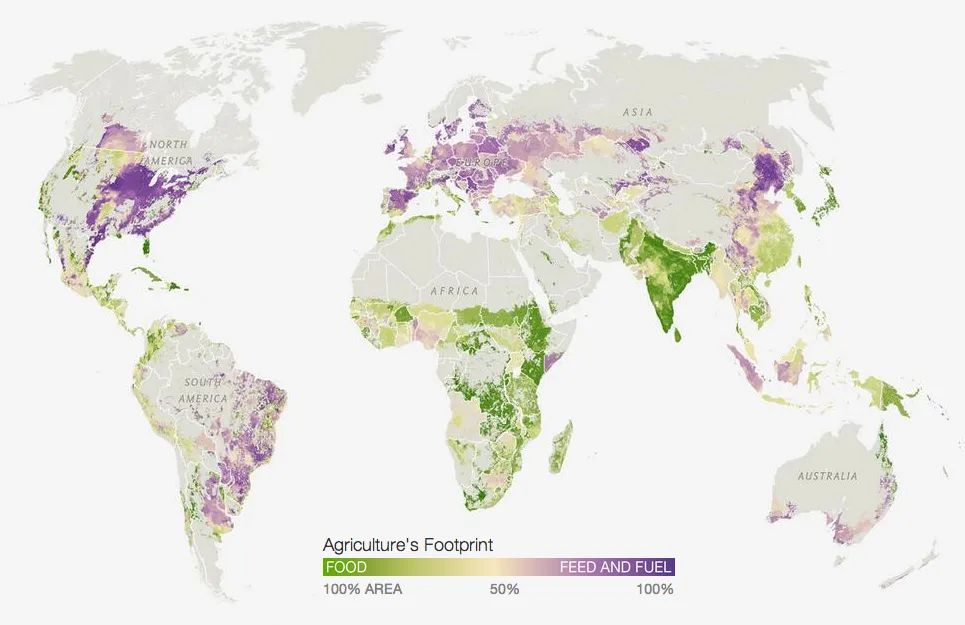
Irrespective of the sentience, we need to understand that animals are not the primary source of our food. Since all the farmed animals are fed plants throughout their lives, consumption of one animal means indirectly consuming all those plants which were fed to those animals all their lives.
It takes about 100 calories of grain to produce just 12 calories of chicken or 3 calories worth of beef. So consuming animals is not efficient in any-which way. Just 55 percent of the world's crop calories are actually eaten directly by people. In the United States, where just 27 percent of crop calories are consumed directly. more than 67 percent of crops goes to animal feed. On a global scale, about 40% of the global crop calories are used as livestock feed. This proportion is set to rise to 48–55% by 2050. Livestock systems occupy 45% of the global surface area with a value of at least $1.4 trillion.
Therefore by consuming animals, we kill many more plants in comparison to directly feeding on them. So eating plants is in the best interest for plants as well as animals (humans included).
Animal farming is not a sustainable practice. It is responsible for major share of climate change & global warming, water scarcity, rain forest destruction, species extinction, ocean dead-zones, desertification, land & water pollution, top-soil depletion, food insecurity and many more critical problems looming on our very existence.
Animals are much more evolved and complex organism than plants and hence can be said to be more sentient than plants according to our present knowledge.
Taking nutrition directly from plants is physiologically more desirable and is naturally a healthier option.
By sparing animal lives and by not inflicting avoidable pain & suffering to innocent beings, positively impact our mental & spiritual health too.
So does it really matter whether plants are sentient or not?
You are wise to make better choices for yourself irrespective of this fact. Ain’t you?
*******
References:
Skandha
Plants too have Feelings and Responses
Argument By Analogy
The Intelligent Plant
New research on plant intelligence may forever change how you think about plants
Video: Do Bean Plants Show Intelligence?
Society of Plant Signaling and Behavior’s website
How much of the world's cropland is actually used to grow food?
http://www.cowspiracy.com/facts/
Livestock and Climate Change by Philip Thornton, Herrero and Polly Ericksen
Agriculture: Food vs. Feed
By 2050 crops will feed more animals than humans
