
Venezuela is currently experiencing hyperinflation. Since we expect that most fiat currencies (with centrally-managed unbounded supplies) will eventually hyperinflate, Venezuela is an important case study. In fact, I consider Venezuela one of the most interesting and informative pieces of global news in 2018.
First, check out how quickly the Venezuelan currency called the bolívar fuerte is losing value, just in the last year. Below is the price of a cup of coffee at Cafe Con Leche, a bakery in Caracas, according to Bloomberg:
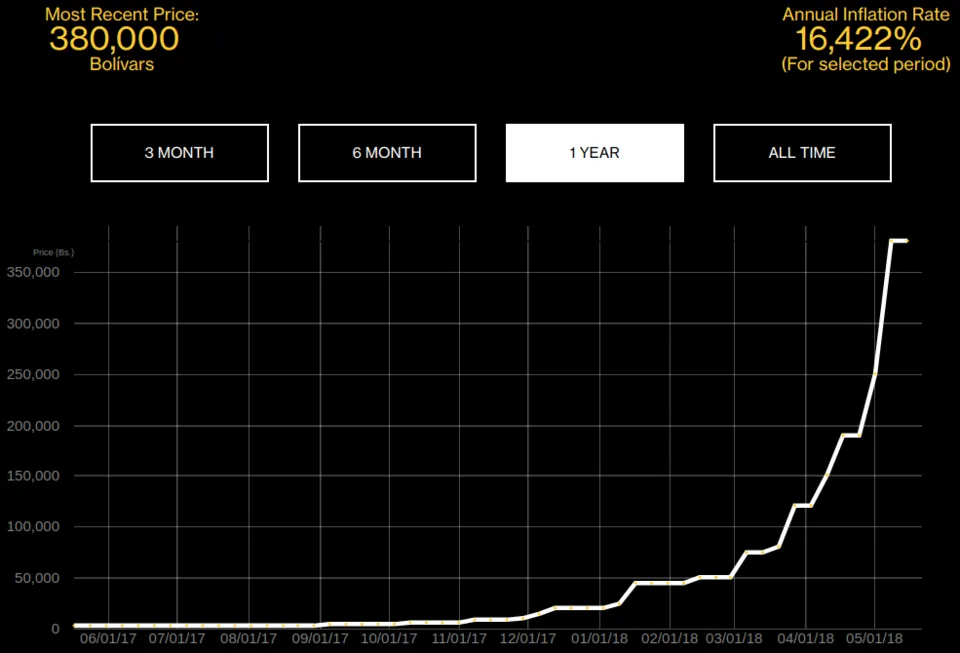
You might ask, why is the purchasing power of a whole currency being measured by a single item rather than a basket of goods? Well this underscores the difficulty of obtaining reliable financial metrics in a country where the value of money is changing so quickly and the government suppresses the free flow of economic data.
By the way, fuerte means strong and it's only in the name of the currency because in 2008, the bolívar was redenominated 1000:1. However, fuertes will not be the unit for much longer, as another devaluation is needed and another 1000:1 redenomination will occur on June 4 to the bolívares soberanos (meaning sovereign).
I've read several mainstream media articles on the situation in Venezuela. They tend to capture the international aspects of the situation, such as increasing sanctions and international corporations pulling out from the country. However, these articles seem to overlook the most noteworthy aspects: what is the situation like on the inside? Why is this happening in Venezuela as opposed to some other socialist country with shaky finances. To answer these questions, I've found nothing better than two recent Let's Talk Bitcoin episodes.
The first is Episode #365 titled "El Petro and Money That Doesn't Work". In this episode, the LTB hosts speak with Alejandro Machado, who used to live in Venezuela and is not shy about blaming government corruption in causing the crisis. However, you get the sense that Alejandro's gripes are not just political. The government is widely despised by the populace and the elections are a charade. The episode also talks about the El Petro crypto-token the ruling party is releasing and determines it's essentially an ICO where the deadbeat government makes a future promise to develop an oil field, e.g. scam.

The second podcast is Episode #366 titled "Outside Perspectives". Starting at 15:27, Christian Garcia reports a segment from within Venezuela discussing how difficult the previously simple act of buying eggs has become. This is such an incredible segment and includes authentic Venezuelan street noise. Give it a listen:
It's fantastic to see Venezuelans using bitcoin to escape the financial repression and mismanagement of the ruling party.
This episode provides some important lessons regarding hyperinflation. Foremost, the first thing you do when you get the hyperinflating currency is to spend it. If you dilly-dally, then the money may lose half its value or more before you spend it. Ironically, this lack of faith in the currency accelerates the hyperinflation as there is very little demand to store wealth in the currency. Essentially, you've got to store wealth in hard assets, like physical goods. Or cryptocurrency if you're woke.