
Sure, forest fires can make for pretty sunsets. But when the smoke got so thick I couldn't breathe, I had to make a break for it -- to clean Pacific Ocean air pushing inland from the the Oregon coast.

The summer of 2017 was a tough one for forest fires, smoke, and lousy air quality all over the Pacific Northwest. Many folks had it worse than me, for sure. Whenever I think this winter has been cold, cloudy and wet - and I'm ready for spring -- I remind myself that at least I can breathe easy! The trees and mushrooms like this weather a lot better, too!
My escape to the marine layer of air was the start of many trips, all during the autumn, to parts of Oregon that I hadn't been to. I hope you will join me for the whole series -- especially if you like mushrooms! I'm posting this for SundayScentExperience, hosted by 
So Many Fires and So Much Smoke!
While the forest were burning, I kept track of them with NASA's WorldView tools. And I tracked my local air quality with the US Forest Service's Airfire tool.
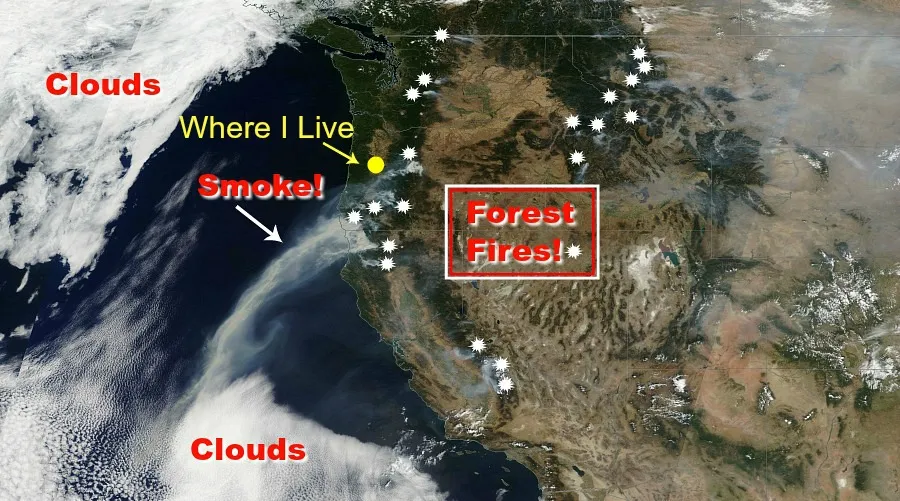


Hot, Dry and Dusty!
But then, the fresh air from the Pacific Ocean didn't blow in. The air got stagnant. Every bit of automobile exhaust and dust stirred up by local agriculture just mixed with the smoke. It had been so long since we had rain. So dust and ash covered everything. The plants were not happy. They just hunkered down.


It Gets Worse!
Folks were complaining for weeks. And then it got worse! The Willamette Valley filled with smoke for days. Every day was worse. I watched my local air quality get worse and worse - until it went above the most hazardous levels. I could check the numbers, but I didn't need need those numbers to tell me that things were bad! My lungs were screaming that message!


Wildfire smoke is so much worse than smoke from a campfire or fireplace. Why? Because all that green wood is full of oils -- volatile organic compounds. When green wood burns, there is a lot of incomplete burning, so there's carbon monoxide that combines with nitrogen in the air to make nitrous oxides that are like automobile pollution. And then that combines with the smoke to make smog.


I went to bed that night, hoping things would be better in the morning. I don't have air conditioning, because the weather in Oregon's Willamette Valley usually isn't very hot. Whether my windows were open or closed, the air was bad. At 3 am, I woke up and said, "I have got to go. I am headed toward the coast. I'm driving until I reach some fresh air." And then I was gone!

Thanks for Walking With Me - and Breathing All That Wildfire Smoke!
In Part 2 of my escape to marine layer, you won't be able to see the clean, fresh air I found. But you will see a lot of other great things -- even a mushroom! I hope you will join me!
I hope none of you were threatened by the wildfires in the western U.S. last fall. So many people lost homes - and even their lives - in some of the fires. Wildfire smoke is bad enough! My experience sure helps me appreciate the challenges facing people with respiratory illnesses, too.
Thanks to  for the #walkwithme tag! And to everyone using that tag! Enjoy your walks!
What Do You Think?
- Have you been around forest fire smoke?
- Did you breathe any of the forest fire smoke in the 2017 fires in the Western U.S.?
- What would you do if wildfire smoke was bad around you?
- What would you do if wildfires were close by?
Haphazard Homestead
foraging, gardening, nature, simple living close to the land