
“I’m not bad. I’m just drawn that way.”
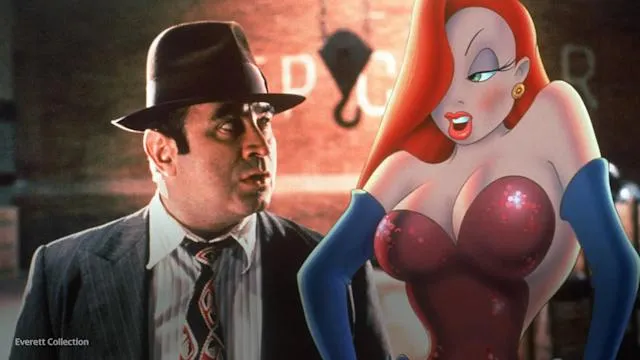
These are the lines seductively spoken by Jessica Rabbit (voiced by Kathleen Turner with singing vocals by Amy Irving) in the 1988 live action animated film “Who Framed Roger Rabbit”. Seeing as it’s Noirvember this month, I decided to take a little trip down memory lane and revisit this 80s classic. At 33 years old, “Who Framed Roger Rabbit” well and truly stands the test of time. Blending together the bright family friendly animated cinema of the 1940s and 50s with the slick coolness of the Noir genre, the film manages to entertain both adults and children alike. Not only is the film a visual delight, it’s also incredibly well-written, full of genuine laugh out loud gags, and is well-acted with Bob Hoskins smoothly holding the film together.
Directed by Robert Zemeckis (who is probably best known for being the writer of “The Back to the Future'' films and being the director for Part 2 and 3 of the franchise, as well as being the director of “Death Becomes Her”, “Forrest Gump” and “Cast Away”), the film had a production cost of $70 million, making it the most expensive film produced in the 1980s. The film was based on Gary K. Wolf's novel: “Who Censored Roger Rabbit?” and Walt Disney studios had obtained the rights to the novel in 1981. Before Steven Spielberg and Amblin Entertainment came on board to help finance the film, writers Jeffrey Price and Peter S. Seaman had composed two drafts of the script. One of the most notable changes was the word ‘censored’ to ‘framed’. However this wasn't the only change that occurred, the question mark at the end of the title was also dropped as it’s considered bad luck in the film industry to have a question mark contained in a film’s title.

Zemeckis was keen to direct and in 1982 approached Disney to offer his services However, the studio were quite reluctant to assign him the role, as his previous films (“I Wanna Hold Your Hand” and “Used Cars”) had been box office bombs, so they kindly let him go. From the years of 1981 to 1983 Disney developed test footage with Darrell Van Citters as animation director. Pee Wee Herman star Paul Reubens was set to provide the voice of Roger Rabbit, with Peter Renaday as Eddie Valiant, and Russi Taylor as Jessica Rabbit. However, the project went through a major change when Michael Eisner became the new Disney president in 1985.
Amblin Entertainment were approached to produce the film alongside Disney. And originally the film was assigned a budget of $50 million, which Disney felt was too expensive. Somehow, the film was green lit, and the producers managed to get the budget down to $29.9 million. It sounds like peanuts in today’s standards, but at the time it was still considered the most expensive animated film to have ever been greenlit.
Terry Gilliam (best known for his work with the Monty Python team and for directing “Brazil”, “Twelve Monkeys” and “Fear and Loathing in Las Vegas”) was actually approached to direct the film but turned it down, something that he has stated that he regrets upon reflection.
Finally, Robert Zemeckis was hired to direct in 1985, which was based on the success of “Romancing the Stone” and “Back to the Future”. Richard Williams was hired to direct the animation sequences.

The film is set in 1947 Hollywood, in a strange alternate universe, where Toons commonly interact with the studio system of Classical Hollywood cinema. It tells the story of private investigator Eddie Valiant (Hoskins) caught in a mystery that involves Roger Rabbit (voiced by actor Charles Fleischer) an A-list Toon who is framed for murder. In terms of story, it’s your run-of-the-mill typical noir detective yarn but what makes the film so memorable is its world building. At no point do we not believe that a world where human beings and Toons can’t exist. The human cast manage to do such an impressive job of convincing us that they are well and truly interacting with their cartoon co-stars.
Watching “Who Framed Roger Rabbit” in 2021, you can’t help but be shocked at how daring and bold the film is. The character of Jessica Rabbit oozes sex appeal, and is sight for the the sore eyes of the male gaze. She’s well and truly devoted to her husband and the film doesn’t bat an eyelid at this. Jessica Rabbit knows that she’s lusted after and uses her attractiveness to her advantage in order to get what she wants. But she makes a bold statement, she’s not to blame...she was simply drawn that way.

Jessica Rabbit isn’t the only character who would be determined to be ‘politically incorrect’ by today’s standards. Eddie Valiant is a drunk who has a mean and quick temper towards others (especially the Toons). He’s not exactly your clean-cut hero. Instead, he’s a typical representation of the classic noir anti-hero, a great man who has lost his way and has become haunted by his demons. Hoskins manages to give the character so much depth and there are some really tender moments where he gets to show off his emotional range as an actor. It’s hard to imagine anyone else in this role, but there were some very big names originally attached to the project including Harrison Ford and Eddie Murphy.
In terms of casting for the film’s villain Judge Doom, names such as Tim Curry and Christopher Lee were thrown around. Curry was deemed too sinister for the role and Lee turned down the role. Gilliam’s fellow Python, John Cleese, was also considered for the role but Spielberg felt that audiences wouldn’t find Cleese believable as a villain.

Despite it’s troubled beginning and long road to the big screen, the film was finally released on 22nd June 1988. It went on to gross $156.45 million in North America and $173.35 million internationally, coming to a worldwide total of $329.8 million. In fact, it was such a hit that it was the year’s second highest grossing film after “Rain Man”.
Despite all of it’s risqué dialogue and sexual innuendos, the film managed to connect with viewers of all ages. It also managed to help rescue the struggling animation industry of Hollywood, ensuring that the great animated films of the late 80s and 1990s were able to get made and find an audience. Without the success of “Who Framed Roger Rabbit” then it’s more than likely that we probably wouldn’t have ended up with the likes of “The Little Mermaid”, “Beauty and the Beast”, and “The Lion King”.
So, this Noirvember, why not go back and revisit an unlikely icon of the film noir genre. And remember, they certainly don’t draw films this way nowadays.