

PARENTHETICALS (New York Accent) PARENTHETICALS? What are they in a screenplay? Well, they are used often in dialogue. They can be used to give instructions to the actors in order to say their lines in a certain way. They can be used to indicate information in regards to the dialogue being spoken and how it is spoken. Let me give you an example.

The PARENTHETICALS are showing that the lines being read are in a mocking manner, or a manner of mockery.
Let's take a look and see what other ways we can them.

This is being used in terms of how "loud" the actors lines are to be spoken. Let's use a different instance of it. It is accurate to write (loud) or (loudly), but it would be incorrect to put it (LOUDLY) or (Loudly.) We can use it to also address other actors with their lines. Take a look at the "to Arnold" below. There is a CPR instructor character and the line is being said to someone else. So, who is he addressing?

You can also see it used as "whispering." The character ARNOLD is whispering his lines to his fellow actor. We can also use it to show a mannerism or tiny behavior.

We can use it for emotions when speaking the actors lines, or how the dialogue is spoken.

It can be used with better instruction toward languages.
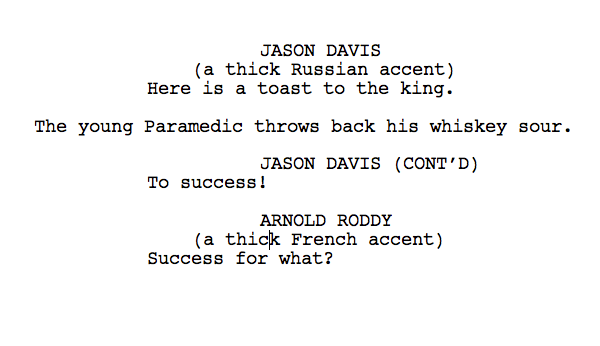
Let's talk about how we can use this more wisely in an entirely different scenario. There are three unique cases that you would use them.
1. beat 2. interrupting 3. pause (common with phone calls)
First let's understand (beat). I rarely use this, yet it is has its place in the screenwriting world. Beat can be used in few ways. It can show us indecisive moments, dramatic moments that have pauses, or a change of mind. I often see (beat) right before a big explosion for dramatic effect. Watch this for more explanation!

Let's take a look as to how its written. Notice we also see (V.O.) this is referred to as voice over. That is when the audio of the actor is recorded separately and laid over the film later on. Below is an example video of that from the film "Limitless."


You can see how the audio of Eddie's voice was pre-recorded and placed over the footage, so glance at how it is written below.

Interrupting! Let's take a look how this can be used. It can also be expressed with double dashes. I think that's a great way to to do it, yet you could do it this way.

The questions I get often enough is whether you should use (beat) or (pause). They can be interchangeable, yet they can be applied very differently. The (pause) can be used to indicate a "listening moment" during a phone conversation with no change of any tonality. The (beat) refers the emotional pause or emotional moment, or context of the dialogue. Put a fork in it. I am done. There you have it. It is all there in a nutshell. I invite you to do research. No answers are easy and all things take hard work.
I may want to add.. Use PARENTHETICALS sparingly. Control them and avoid over usage.