
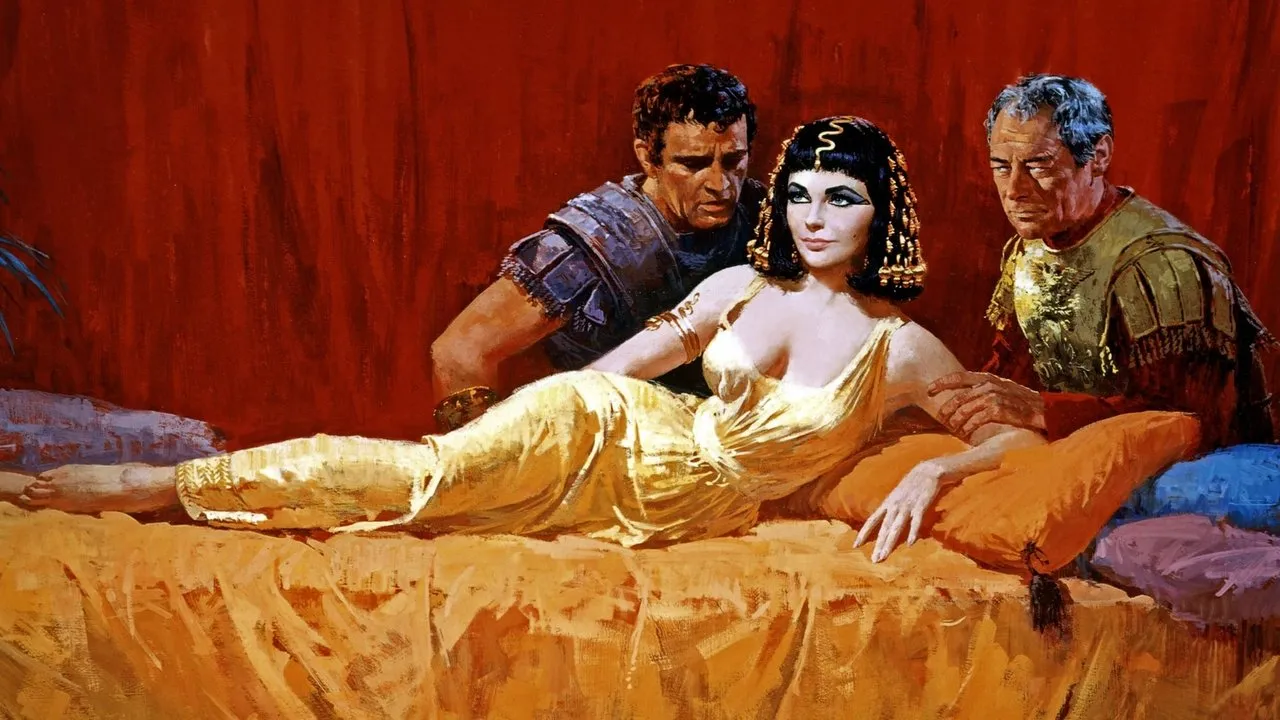
One of the greatest ironies of filmmaking is that quality doesn’t seem to be the only or the most important reason why films are remembered decades after their premiere. More often than not, popularity is much more important than artistic merit or influence on future filmmakers. In some cases, films become cultural icons of their time even without being popular. Such was the case with Cleopatra, the 1963 historical spectacle directed by Joseph L. Mankiewicz. Today this film is remembered for many reasons – its budget, which remains unsurpassed even by present‑day Hollywood megalomaniacs; the romance between its principal stars; and last but not least, the commercial failure that brought 20th Century Fox near bankruptcy and in many ways marked the end of Old Hollywood.
Unlike the majority of films that deal with the life and times of the legendary Egyptian queen, the 1963 version of Cleopatra has a plot based on the works of Plutarch and other prominent historians instead of Shakespeare’s plays and similar works of fiction. The story begins in 48 BC, during the civil wars that brought down the old Roman Republic. After scoring a decisive victory in the Battle of Pharsalus, Roman general and statesman Gaius Julius Caesar (played by Rex Harrison) sails to Egypt in order to capture his fleeing arch‑rival Pompey. In Alexandria he finds Pompey murdered and Egypt embroiled in its own civil war between young King Ptolemy (played by Richard O’Sullivan) and his banished sister and co‑ruler Cleopatra (played by Elizabeth Taylor). Motivated by a desire to provide cheap Egyptian grain for Roman citizens and thus secure his political base, Caesar at first wants to mediate in the conflict, but Cleopatra uses her charm, intelligence and diplomatic ability to bring him and his legions to her side. Their political alliance becomes intertwined with a romantic liaison that results in the birth of Caesar’s son Caesarion. The child is supposed to unite the military might of Rome and the wealth of Egypt and thus bring total domination over the entire known world. But Caesar’s fellow Romans feel uncomfortable about this dynastic scheme, fearing that their Caesar might sacrifice republican ideals and Roman freedom for the sake of Egyptian despotism. A band of conspirators assassinates Caesar and causes another civil war that shatters Cleopatra’s ambitions of a global empire. Among the victors is Caesar’s most trusted lieutenant Mark Antony (played by Richard Burton), and years later he would become a member of the governing triumvirate in charge of Rome’s eastern provinces. When Antony, who lacks Caesar’s governing and political skills, gets into financial trouble, Cleopatra is more than able to seize this opportunity and seduce Antony both by her own charm and Egypt’s resources. This romantic and political alliance, however, provides an excellent opportunity for Caesar’s nephew and designated heir Octavian (played by Roddy McDowall). Seeing Antony as the only remaining obstacle to his absolute rule over the Roman Empire, he manipulates the Senate into declaring war on Egypt and Antony, thus setting the stage for a great conflict between East and West.
Like many other “larger than life” films from the 1950s and 1960s, Cleopatra represented Hollywood’s attempt to beat the emerging competition of television with spectacle, colour and images that audiences couldn’t enjoy on their little black‑and‑white screens. However, unlike some other such instances, the makers of Cleopatra decided to sacrifice quality for the sake of quantity, and that decision had serious consequences for the concept and execution of the project. The producers, somehow convinced that the big budget would do the trick by itself, seemed to construct the film around on‑screen displays of their financial resources – whether in the form of spectacular scenes, a single character’s costume changes, or by hiring the most expensive actors or actresses available. In doing so, the producers weren’t discouraged by various incidents that plagued or delayed production until those resources began to dry up, forcing filmmakers to compromise the last trace of the original artistic vision.
As a result, Cleopatra, despite its enormous budget, looks unfinished. The reason might be found in the source material – Cleopatra’s life was more suitable for a mini‑series than a feature film. Joseph L. Mankiewicz, one of the directors involved in this project, was aware of this, so he planned to turn six hours of filmed material into two separate three‑hour movies – one dealing with Cleopatra’s relationship with Caesar, and another dealing with her doomed romance with Antony. Unfortunately, studio heads were against this idea and forced him to cut the filmed material in half, resulting in a single three‑hour version (expanded to four hours in the 1995 special edition). Because of that, Cleopatra looks like two two‑hour films loosely patched together and varying in quality. The first part is much better, mostly because Caesar is a more intriguing protagonist than the weak Antony, and the regal Rex Harrison delivers a much better performance than the often uninspired Richard Burton. The role of Cleopatra is, of course, the best‑known in Elizabeth Taylor’s career, and the great actress (here undoubtedly looking at her best) does more than a decent job, but all her efforts are in vain due to terribly wooden dialogue. Apart from Harrison, the best role was undoubtedly played by Roddy McDowall, who manages to outshine everyone by portraying a Machiavellian villain. Hume Cronyn is fine as Cleopatra’s advisor Sosigenes, Martin Landau is also very good as Antony’s lieutenant Rufio, as is Andrew Keir as Octavian’s admiral Agrippa. Other actors, some of them fine, are wasted in roles that serve no other purpose but to show that Cleopatra has as diverse and stellar a cast as possible.
However, the worst problem of Cleopatra is its pace, which is slow even by the standards of those accustomed to pre‑MTV filmmaking. Much of the three‑ or four‑hour running time is spent on scenes that should have been left on the cutting‑room floor. This is especially true of Cleopatra’s triumphal entries into Rome and Tarsus, which seem to go on forever. Although even a contemporary audience might be awed by the millions of dollars spent on sets and costumes, the hundreds of professional dancers, or the tens of thousands of extras, those scenes often create unnecessary pauses in the plot. Like anything else in Cleopatra, the pacing is much better in the first than in the second part. While Caesar’s segment looks like a coherent whole, Antony’s story is often a disorganised (and not particularly well‑edited) mess. For example, the audience has to wait a whole hour before the climactic Battle of Actium brings its final, rather predictable consequences for the protagonists.
In one aspect Cleopatra nevertheless manages to be superior to the majority of other historical spectacles. The script, written by three (plus one uncredited) authors, takes history very seriously and is much more faithful to real‑life events than some other, better‑acclaimed films like Spartacus. The authors also made sure to explain the complex political situation of the 1st‑century‑BC Mediterranean to the average audience, so Cleopatra could be understood even by viewers who didn’t enjoy the benefits of a classical education. Unfortunately, due to budget cuts, the most important event of Cleopatra’s era – the Battle of Actium – is displayed in an unsatisfactory manner. Although Waterworld taught us that the difficulties of shooting mass scenes on water can never be overestimated, the filmmakers could have shown that Antony lost the battle due to Agrippa’s superior tactics and ship designs.
Nevertheless, despite rightfully deserving its reputation as a legendary failure, Cleopatra looks like a stunning achievement compared to its present‑day counterparts, and those who endure watching it are going to be left with a great experience. In the decades to come, Cleopatra, just as now, is going to be viewed in the same way tourists watch ancient monuments – old, abandoned, partially ruined, yet still able to create awe among new generations.
RATING: 5/10 (++)
(Note: The text in its original form was posted in Usenet newsgroup rec.arts.movies.reviews on November 26th 2001)

==
Blog in Croatian https://draxblog.com
Blog in English https://draxreview.wordpress.com/
Cent profile https://beta.cent.co/@drax
Minds profile https://www.minds.com/drax_rp_nc
Brave browser: https://brave.com/dra011
BTC donations: 1EWxiMiP6iiG9rger3NuUSd6HByaxQWafG
ETH donations: 0xB305F144323b99e6f8b1d66f5D7DE78B498C32A7
Movie URL: https://www.themoviedb.org/movie/8095-cleopatra?language=en-US
Critic: AA