
 Voy a iniciar este Boletín con la aclaratoria que en varios países de América del Sur se les llama comúnmente escarabajo o gorgojo a este tipo de insecto volador que posee un par de alas primarias duras y firmes que les sirve de carcasa protectora a los coleópteros. Dicho esto, veremos a continuación una seguidilla de fotografías de un artrópodo de la Familia Scarabaeidae que se caracteriza por su color amarillo (ámbar) en el 98% a excepción de sus ojos compuestos que son de color negro.
I am going to start this Newsletter with the clarification that in several South American countries this type of flying insect is easily called beetle or weevil that has a pair of hard and firm primary wings that serve as a protective casing to the coleoptera. That said, we will see below a series of photographs of an arthropod of the Family Scarabaeidae that is characterized by its yellow color (amber) in 98% except for his compound eyes which are black.


🤔 Tal vez se trata de un escarabajo de la Especie Pelidnota virescens
Las especies del Género Pelidnota constituyen una amplia diversidad taxonómica alrededor del mundo y su diferenciación resulta difícil al momento de identificar la especie correspondiente. Sin embargo, existen reportes fotográficos que me hacen presumir que en esta oportunidad me he encontrado con un espécimen de Pelidnota virescens que habita en varios países de América, desde México hasta Colombia, pasando por América Central.🤔 Perhaps it is a beetle of the Species Pelidnota virescens
The species of the Genus Pelidnota constitute a wide taxonomic diversity around the world and their differentiation is difficult when identifying the corresponding species. However, there are photographic reports that make me presume that this time I have found a specimen of Pelidnota virescens that lives in various countries of America, from Mexico to Colombia, passing through Central America.Al medir a este visitante del estanque de agua, pude estimar que tenía una longitud de 25 milímetros aproximadamente, pues en ocasiones se movía para alejarse de la regla de medición. Su color es amarillo más anaranjado, sin iridiscencia notable al enfocar mi cámara fotográfica desde diversos ángulos y bajo la iluminación solar.
By measuring this visitor to the water pond, I was able to estimate that it was approximately 25 millimeters long, as it sometimes moved away from the measuring ruler. Its color is more orange yellow, without noticeable iridescence when focusing my camera from different angles and under sunlight.

I didn't see him flying, he just walked aimlessly, always in a straight line. He kept his elytra closed, while he showed his secondary wings (hindwings used for flight) displayed on the extreme part of his body. He possibly had problems coordinating the opening of his elytra (without venation) and the deployment of his hindwings (membranous), so he was limited to using his 6 legs to move at ground level.
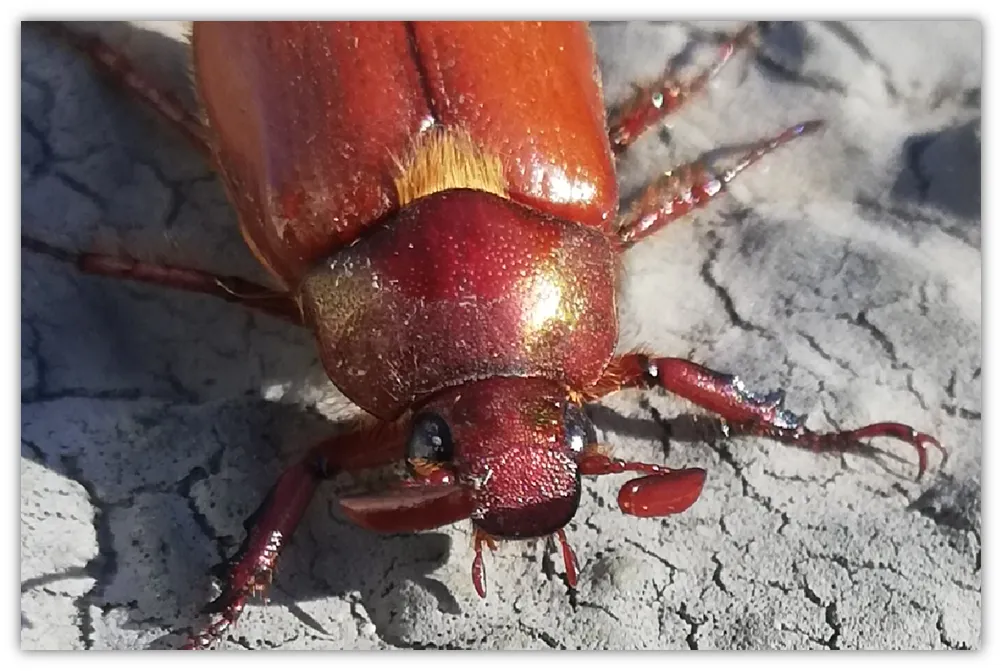
It presents a very pronounced prognathism, where the well-developed oral apparatus stands out with the strong and robust jaws that are characteristic of chewing insects, guarded laterally by the articulated appendages that serve it with olfactory sensors (maxillary palps that extend towards the front of the mouth). his head, see previous image).
También se destacan las antenas lameladas ubicadas hacia los extremos laterales de su cabeza, que a diferencia de la bifurcación observada en el Escarabajo del Género Pelidnota que presenté en otro Boletín, estas antenas constituyen una terminación única y gruesa.
Also noteworthy are the lamellate antennae located towards the lateral ends of its head, which unlike the bifurcation observed in the Beetle of the Genus Pelidnota that I presented in another Bulletin, these antennas constitute a unique and thick termination.

It is commented that this type of arthropod constitutes a pest during its larval stage, affecting the roots of the plants and later their leaves, due to its preference for feeding of the type phytophagous, although most beetles are polyphagous and can feed on the animal and plant kingdoms.
Me gusta la lectura y buscar información audiovisual de todo lo relacionado con el AQUA y su entorno más cercano, así que procuro que el texto publicado por @aqua.nano sea 100% original, proporcionando un pequeño análisis de la especie marina o animal terrestre que les presento en mi blog.
I like reading and looking for audiovisual information on everything related to AQUA and its closest environment, so I try to make sure that the text published by @aqua.nano is 100% original, providing a small analysis of the marine or terrestrial animal species that I present to you on my blog.

·) Especies del Género Pelidnota
·) Pelidnota virescens
Las imágenes y vídeos que son CC0 Public Domain están indicadas con sus enlaces correspondientes para respetar los derechos de autor. El texto presentado en el Blog de @AQUA.nano es 100% original


Las referencias están incluidas en el mismo texto, así que puedes darle clic y llegar a ellas, pero también puedes buscar más información sobre el escarabajo del Género Pelidnota en los siguientes enlaces:
·) Coleóptera·) Especies del Género Pelidnota
·) Pelidnota virescens