

Apart from 木, 瓜 and a few hundred other drawings of real things (pictograms), most Chinese characters are meaning-sound compounds.
Meaning & Sound Compounds
These account for most Chinese characters: one part provides a general meaning (“female, plant, fish” etc.) and the other part is a rough guide to the pronunciation (the fancy technical term is "Semanto-phonetic compounds"). Some characters date from thousands of years ago, so their pronunciation has changed a great deal since their initial creation.
Graphic Evolution of 木 and 瓜 (pictograms)
The character 木 mù / muh started out 3000+ years ago as a simplified picture of a tree. The Bronze Script form (from about 1500 BC) shows the trunk, the leaves at the top and the roots at the bottom. A thousand or so years later, this picture had evolved into a more artistic but less recognizable shape with two ovals standing in for the leaves and the roots.

The character 瓜 guā / gua started out in Bronze Script as a simplified but more easily recognizable picture of a gourd/melon hanging in the middle of a vine. The Seal Script form is an elegant, but highly stylized picture; the Regular Script form dating from ~2000 years ago is completely unrecognizable.
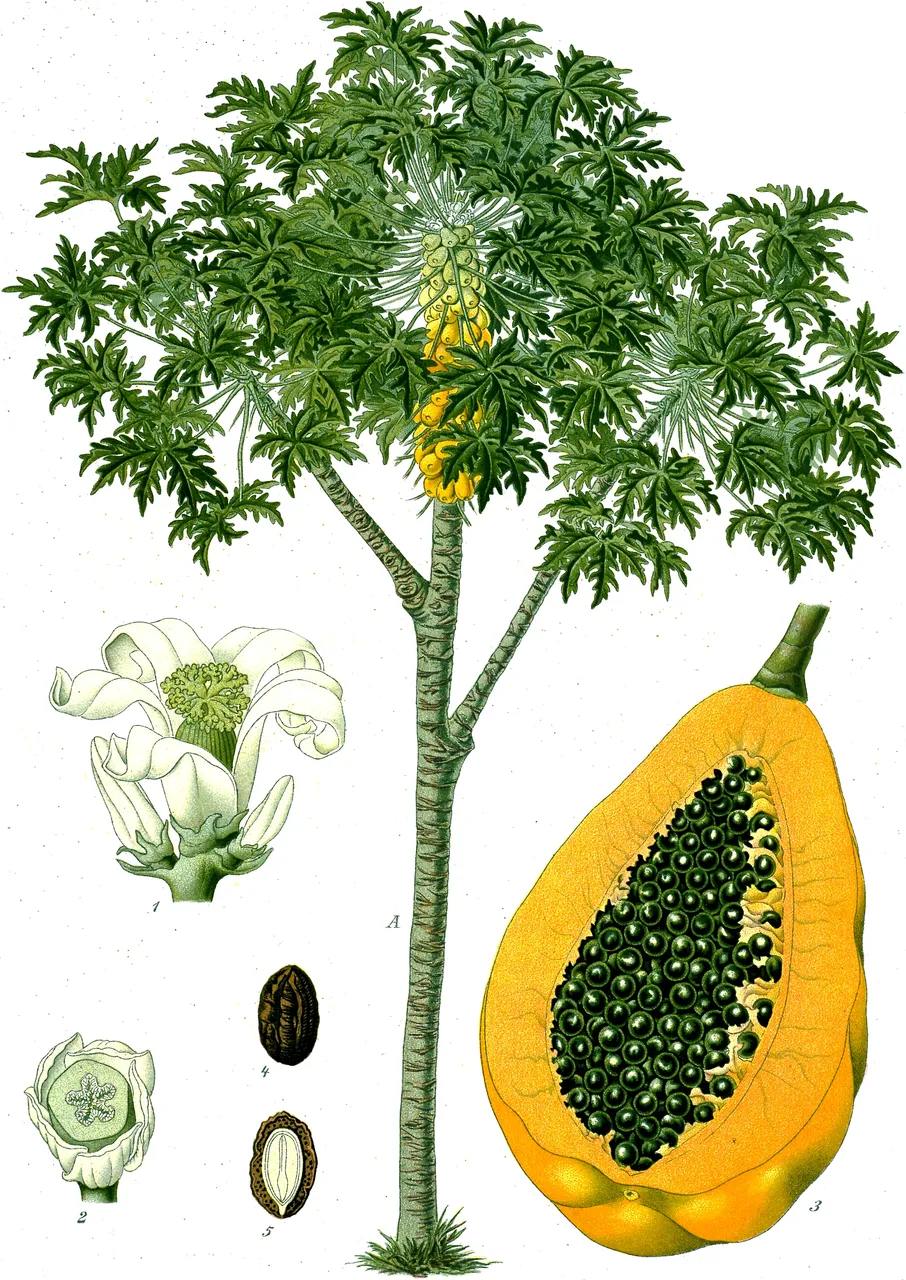
These two characters put together, 木瓜 mùguā / muhgua, mean papaya. In Modern Chinese, 木 means wood, but in Classical Chinese it means tree. The two-character compound 木瓜 means “papaya” ([literally] “tree melon”) because it grows on a type of tree
[Public Domain Image]
Romanization Notes
Notice that this posting provides two different spellings for Mandarin Chinese words:
(1) Hanyu Pinyin (the 1958 Chinese government standard with hard-to-type tone, hard-to-remember tone diacritics): āēīōūǖ, áéíóúǘ, ǎěǐǒǔǚ, àèìòùǜ
(2) Gwoyeu Romatzyh (the 1928 Chinese government standard with intuitive, easy-to-remember mnemonic tone spellings; after the slash)
Most red letters in GR do double duty: they stand for consonants and vowels simultaneously. The hollow portion is a mnemonic that helps foreign students remember either the pitch change or the vowel length.
If you liked this post, you might also like these:
https://steemit.com/cn/@wentong-syhhae/chinese-for-false-beginners-a-thinker-s-approach
https://steemit.com/cn/@wentong-syhhae/the-tyranny-of-chinese-spelling-the-passionfruit-case
https://steemit.com/cn/@wentong-syhhae/chinese-easy-to-learn-but-a-good-foundation-is-needed
Who I Am
https://steemit.com/introduceyourself/@wentong-syhhae/enthusiastic-intp-polyglot