
As I mentioned in one of my previous reviews, from time to time I encounter an interesting film-watching phenomenon, quite the opposite of a “guilty pleasure”. There are filmmakers who are great and who are supposed to be worshipped, but sometimes I just can’t help it — I don’t like their work, and later I feel guilty about it. The films are technically all right, they have all the necessary ingredients, but they simply don’t feel the way a true masterpiece should. I often encounter this phenomenon when I watch films by John Ford, but there are other cases. Among them are also the classic thrillers by Alfred Hitchcock, the great master of suspense. More often than not, those alleged masterpieces failed to meet the expectations created by established critics and film scholars. Of course, that doesn’t mean they are bad or substandard; actually, many of them are very good, but their flaws are often overlooked, mostly out of irrational respect for the great Hitchcock.
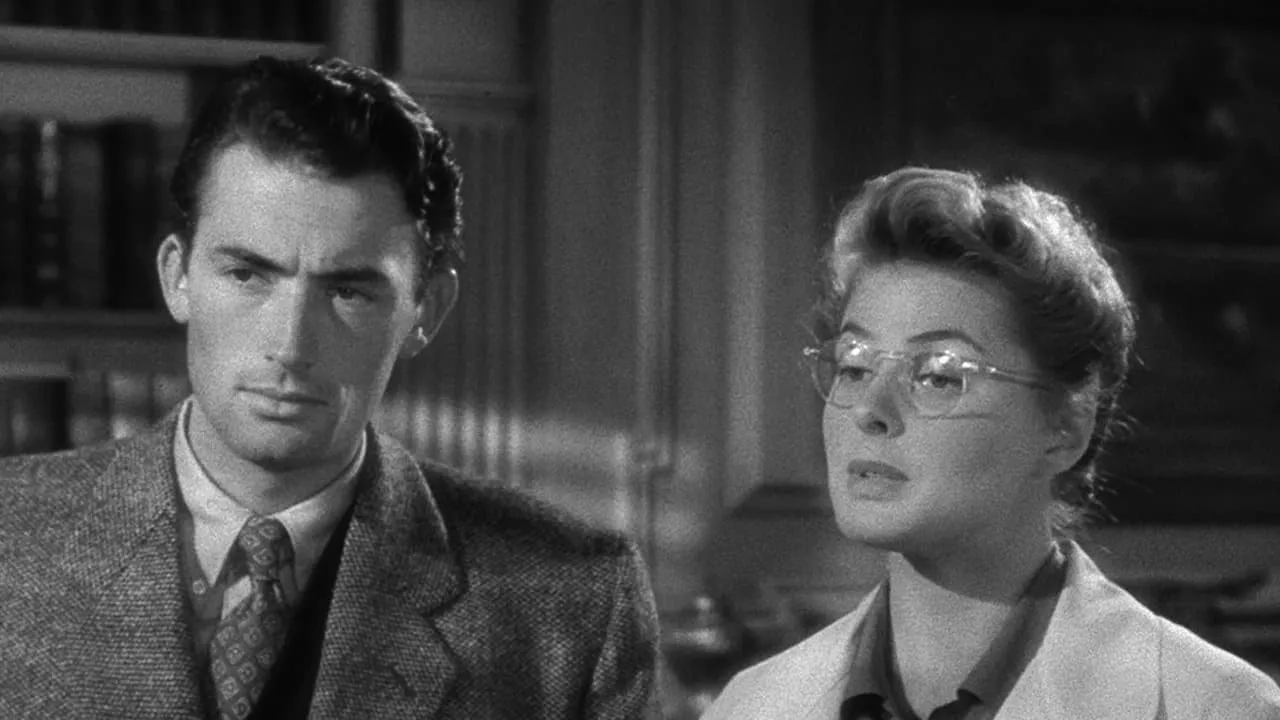
One illustration of this phenomenon is Spellbound, his 1945 thriller, often hailed as the first major Hollywood film to deal with psychoanalysis. The plot begins at Green Manors, a psychiatric institution dedicated to the treatment of mental disorders via psychoanalysis. Among the staff is Dr. Constance Petersen (played by Ingrid Bergman), a beautiful but emotionally cold psychiatrist. Her barren love life is about to improve thanks to Dr. Edwards (played by Gregory Peck), a young psychiatrist who is going to become the new head of the institution. The two fall madly in love, but Constance and her colleagues soon discover some oddities in Dr. Edwards’ behaviour. Constance confronts him and discovers that her lover is actually an impostor, a mentally disturbed amnesiac who used to be Dr. Edwards’ patient and later took his identity after being involved in some mysterious and traumatic incident which, presumably, left the real Dr. Edwards dead. Against her better and professional judgement, guided only by her feelings towards a stranger whose initials “J.B.” are the only trace of his identity, Constance decides not to report him to the police. Instead, she tries to treat his condition by helping him remember his true identity and what really happened.
Hitchcock, sometimes accused of creating films solely around a single scene, had a very good script here, written by Ben Hecht and based on a novel by Francis Beeding. The plot of Spellbound revolves around a genuine and very intriguing crime mystery, and its originality was due to the use of someone’s mental condition as the main element of the plot. Hitchcock also used that mental condition in order to create some really effective and suspenseful scenes. On the other hand, the scenes most remembered from this film — the dream sequence by Salvador Dalí and the showdown at the end — had nothing to do with that mental condition. The bravery with which Hitchcock used psychoanalysis for the first time in Hollywood was compromised by a rather simplistic approach to the subject. According to Hitchcock, psychological problems that require professional help could be cured simply if the person acknowledges their existence. Of course, we know this is not the case, and even Hitchcock in his later films used a much more complex approach when dealing with psychoanalysis.
The acting in this film is good. Ingrid Bergman is very believable, both as an emotionally detached professional and as a woman blinded by love. Unfortunately, her character is done a great disservice by the script, which failed to properly explain her transformation from the former to the latter; Hitchcock as director didn’t help either, since he didn’t make that change gradual. Also, many feminists would probably be up in arms because this film implicitly treats professional women as inherently unstable and therefore inferior to their male colleagues. Gregory Peck as her partner has a somewhat better role, one that inspired many similar characters in psychological thrillers — good-looking men who hide sinister secrets behind an attractive surface. But those in supporting roles did the most impressive acting job in Spellbound. Michael Chekhov was excellent as Dr. Brulov, Constance’s old mentor and friend. Leo G. Carroll was also very good as Dr. Murchison, and Bill Goodwin had a brief but very good appearance as a sympathetic house detective.
All in all, Spellbound is more than solid, although still overrated, as a psychological thriller. Its true importance lies not in its quality, but in the roads Hitchcock paved for future filmmakers with it.
RATING: 7/10 (+++)
(Note: The text in its original form was posted in Usenet newsgroup rec.arts.movies.reviews on November 26th 1999)

Blog in Croatian https://draxblog.com
Blog in English https://draxreview.wordpress.com/
Cent profile https://beta.cent.co/@drax
Minds profile https://www.minds.com/drax_rp_nc
Brave browser: https://brave.com/dra011
BTC donations: 1EWxiMiP6iiG9rger3NuUSd6HByaxQWafG
ETH donations: 0xB305F144323b99e6f8b1d66f5D7DE78B498C32A7
Movie URL: https://www.themoviedb.org/movie/4174-spellbound
Critic: AA