

Autumn is here in the Northern Hemisphere. It’s sad to say goodbye to summer, but fall brings the taste of great apples. As I posted a few weeks ago, one of my favorite apple varieties ripens in late summer, but the vast majority of good apples do not arrive here until late September, October, or even later. Over the last week, I’ve bought some various apples at markets and even picked a few myself.
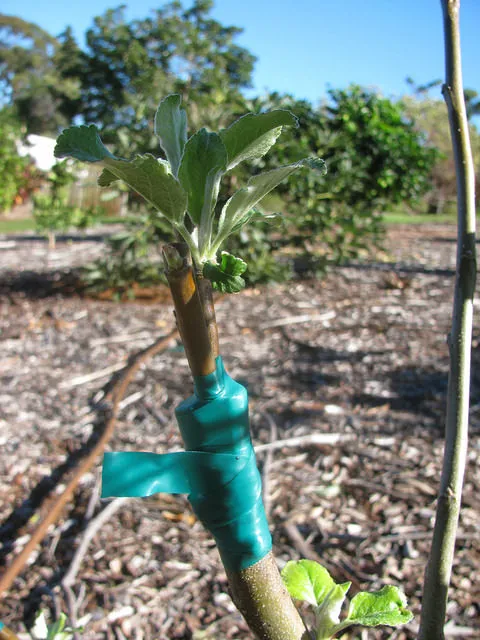
Each variety of apple has a flavor as unique as its history. For me, biting into an apple evokes its rich heritage. Apple trees do not grow true to seed, so planting seeds does not guarantee you will get the same kind of apple. Instead, these apples came from grafted trees, grown from scionwood taken from an earlier tree. Each of them traces its lineage directly to that variety’s original parent tree.
Grafting an apple scion onto rootstock. Source: Creative Commons via Flickr by starr-environmental.

Most are heirlooms, old varieties handed down from one generation to another, which have been joined by some great modern creations. Some varieties were created naturally when a chance seedling produced a new fruit that caught someone’s attention, while other apple varieties came from careful breeding of other apple types. In some cases, an old heirloom fruit or vegetable variety from the past has nearly died out, saved only by one valley or town (or even a single family) of people who have kept it alive by continuing to grow it.
As tastes have changed, some old apple varieties have died out or become endangered. Apples of the past were not as sweet. Many of them were grown primarily for cider (mostly the alcoholic kind, when cider was safer to drink than water). Generally, people were accustomed to eating apples that were much more sour or bitter than the ones we know today. I don’t mourn the loss of sour or bitter ones, but unfortunately, a few of the perfectly balanced sweet-tart apples have become harder to find in recent years. This is primarily because relatively plain, sweet tasting apples have gained more real estate in supermarkets aisles.
Let me introduce you to some of my September finds. Here are some apples that I have discovered in local markets or picked myself, all within the last week.

1. McIntosh Apple, Dundela, Ontario, Canada, 1811
For many years, the McIntosh has been the most popular apple in Canada and the northeastern United States. Somewhat tart and thick-skinned enough to last in storage, it’s had an important place in the lives of many generations of North American families. Its name was further etched in lore when Apple Computer decided to name its line of personal computers Macintoshes (Macs for short).
Source: MacWorld Magazine.

In 1811, James McIntosh discovered a seedling growing on his farm, which was not far from modern day Ottawa, Canada. Realizing that this apple was good for fresh eating and for cooking, McIntosh and his wife grafted more trees and began cultivating it. Macs became so widespread that they were the most widely grown apple of the 20th century in Canada and New England.
Ask many people from these regions and they’ll tell you that there is no finer apple than the McIntosh. Ask anyone from my region, the West Coast, and you’ll get mostly “meh”. Macs are good apples, and they get the job done, but they wouldn’t make a Top 5 list for anyone who was born on the West Coast. That’s not a judgment on their quality, simply a difference in peoples’ tastes and expectations when one bites into an apple. I mean no disrespect to the mighty Mac, which is Canada’s national apple and one of the most important apples in American history.
2. Cortland Apple, Geneva, New York, United States, 1898
This was an unusual, but welcome, find at my local health food store. Cortlands are quite popular in some other parts of the United States and Canada, namely McIntosh country. But here on the West Coast, we do not see many of them. This is a beautiful apple with heavy red stripes over green, a large calyx at the base, and bright white flesh.


Anytime you see the location “Geneva, New York” next to a piece of fruit, it signifies that the variety was developed at the New York State Agricultural Experiment Station there, which is now affiliated with Cornell University. In 1887, the Station expanded from its early focus on dairy and vegetable farming to include fruit development. A decade later, its scientists and fruit breeders created an enduring classic by crossing the McIntosh with the Ben Davis apple.
Cortlands are cold-hardy, they are both sweet and tart, and they do not brown easily when cut. For this reason, they often are used in fresh salads. If you get a fresh one, it is crisp, but the texture softens with age. Because they are cold-hardy, they are planted in Canada as well as the U.S. with most commercial production occurring in New York state and the Great Lakes region.
I’ve had McIntoshes. I’ve had other Mac crosses like Empires and Macouns. And I think Cortland ranks as the best of this bunch.
3. Hudson’s Golden Gem, Oregon, United States, 1931
Russet apples have a long tradition in England, France, and elsewhere. The terms russet refers to the thick brown skin which covers some apples and pears, fully or partially (think of a russet potato). Classic old varieties like the Egremont Russet, Golden Russet, and Reinette Russet all have some common features. They tend to be very sweet, nutty, and quite enjoyable to eat, though you might need to peel them before digging in.
Hudson's Golden Gem Apple Tree. Source: Trees of Antiquity.

In 1931, someone in southern Oregon saw a tree growing in a stand of other bushes and trees. It was a random seedling that may have been part of a hedgerow planting. The tree produced a remarkable fruit that first was marketed as a pear.
The Hudson’s Golden Gem turned out to be an apple, but it does look and taste a lot like a pear. With all due respect to the Brits and the French, this New World variety might be the best russet of them all. It is very sweet and juicy with a nutty flavor. If you’ve never eaten a good russet apple before, then the closest thing might be a ripe Asian pear.

I only had one Hudson’s Golden Gem left at picture time and it did not look that good, so I used the outside photo above of a Hudson's tree showing the apples growing on it. The image directly above shows some Warren pears which I also found this week and you can see the similarities between these pears and a Hudson's Golden Gem apple. The shape and russeting of the Hudson’s Golden Gem looks much more like a pear than like most apples.
4. Gala Apple, Greytown, Wairarapa, New Zealand, 1930s
The Gala apple was developed by a fruit grower in New Zealand named James Hutton Kidd in the 1930s. He used a Golden Delicious and Kidd’s Orange Red to make the cross. The Kidd’s Orange Red, in turn, had been created from a cross of Red Delicious and the famous Cox Orange Pippin, which some believe to be the world’s best tasting apple. The Royal Gala is a sport (mutation) which has more redness than the original cross. Kidd died before the Gala became popular, but his legacy outlived him.
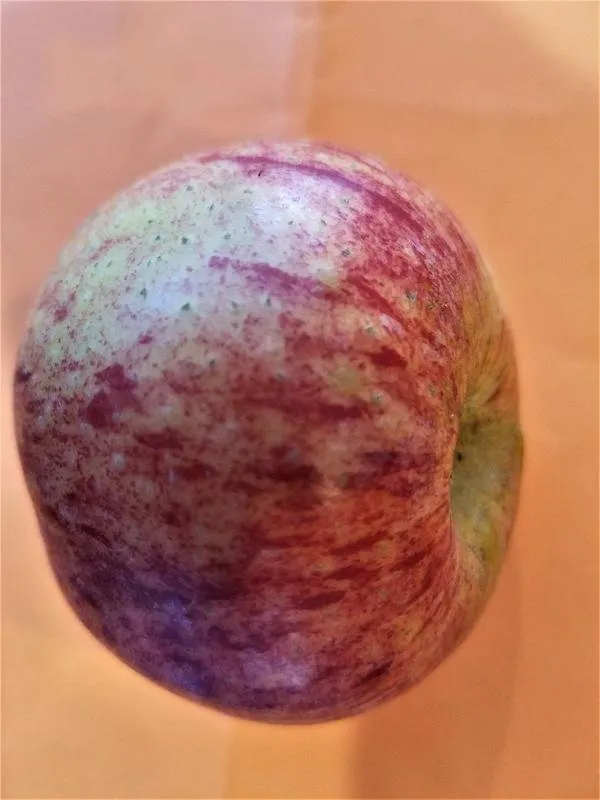

Some purists would say the Gala should not be on my list. This is a plain, sweet apple that is quickly becoming the most popular variety in the U.S., Britain, and elsewhere. When I see this on the supermarket shelves in January or in April, I groan, because it is just plain sweet with very little flavor. Usually, those apples have been sitting in refrigerated, low oxygen storage for many months. It’s an easy apple for people to eat, it’s sweet and usually crisp, but it doesn’t have much flavor or much soul.
Until you eat a fresh Gala that has just been harvested at peak ripeness. Then you understand that this is a very high quality apple with a hint of that Cox Orange Pippin aroma to complement the sweet crispiness. It ripens near the beginning of the fall apple season. California Galas are perfect just about now. But a month from now, I wouldn’t bother with them, and I routinely ignore them in the stores for most of the year when they become insipidly plain.
5. Fuji Apple, Fujisaki, Aomori, Japan, late 1930s
What, another mainstream apple on this list? Fuji has rapidly become the most widely consumed variety in my state and its popularity has grown elsewhere also. With good flavor, crispness, intense sweetness, and an ability to hold up well in storage, Fuji’s popularity is well-deserved. Aside from that, some of the same criticisms of Gala also apply here, since this apple is overgrown and we are oversupplied with it for far too many months of the fruit year.
There’s another reason this apple should not be on my list. It’s a late apple and it is not ready for picking yet. Because of the sweetness of Fuji and the fact that many of the fruits will be stored for a long period, growers tend to pick them much too early. This fruit should be allowed to remain on the tree for at least a few more weeks. That’s when you can taste the real magic of a Fuji.

September is too early for Fujis in California or elsewhere. The ones that are commercially grown in Washington state (which is the largest source of apples in the U.S.) are generally poor quality because most are picked long before the apple ripens on the tree. I don’t like to buy Washington Fujis if I can help it, but later in the year, there isn’t much other choice.
Here, I prefer California-grown Fujis, but I only start looking for them in October. If I find some truly tree-ripe California Fujis, I buy a box of them and store it somewhere cool for the next couple of months. But this week, I jumped the gun and bought these ones too soon. These Fujis are not ready yet and thus they disappoint.
6. Crispin (Mutsu) Apple, Mutsu Province, Japan, 1948

What’s this? Apples do not grow well in my yard. It gets too hot there in the summer and is a better spot to grow stone fruits such as plums and peaches. But I snuck in one apple tree in the corner a couple of years ago. This year, it produced two fruits, one for the raccoons and one more that’s still there. I snapped a picture of the apple on this little tree before picking it.
I planted a 4-in-1 multi-grafted tree and the only branch that has produced anything yet is this Crispin (Mutsu) variety. It’s sweet and juicy and my kids love it. We knew that before planting it because we’ve found this variety and bought some before at a local farmers market.
This was called the Mutsu originally, because as far as anyone knows, it came from that region of Japan. Golden Delicious and Indo Apples are its two parents. Some Crispins look a lot like Golden Delicious Apples, but they have either more green than gold or a light splash of pink striping. Whatever it looks like, the taste is dependable. This is a sweet, juicy, flavorful apple that anyone will like. You can’t go wrong with a Crispin.
Until the late apples come in, I have plenty to keep my jaws busy.
References:
McIntosh: https://en.wikipedia.org/wiki/McIntosh_(apple)
Cortland: https://www.orangepippin.com/apples/cortland
Geneva NY Station: https://nysaes.cals.cornell.edu/about/history-station
Gala: https://en.wikipedia.org/wiki/Gala_(apple)
Mr. Kidd: https://teara.govt.nz/en/biographies/4k11/kidd-james-hutton
Hudson’s: http://www.treesofantiquity.com/index.php?main_page=product_info&products_id=61
Fuji: https://en.wikipedia.org/wiki/Fuji_%28apple%29
Crispin (Mutsu): http://petalsfromthepast.com/catalog/fruit-plants/apple-trees/apple-mutsu.html
All images are by the author unless otherwise noted.