
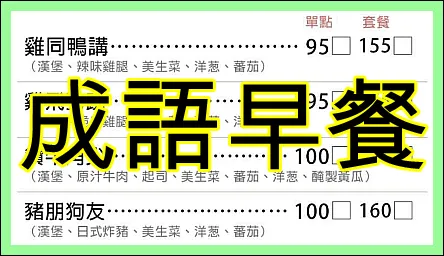
This breakfast shop menu made me break out laughing. Entries are 成語 chéngyǔ / cherngyeu or 四字格 sìzìgé / syhtzyhger, idioms and four-character expressions, both of which are very popular in Chinese culture. The amusing thing about this menu is that its creators managed to turn menu reading into a very entertaining riddle guessing exercise: “I wonder which dish this idiom indirectly refers to?”
Any foreigner who can read and understand the literal and figurative meanings of all the entries on this menu deserves a pat on the back: your Chinese level is quite respectable.
Examples from the title graphic:

Notes
- 豬 zhū / ju (traditional Chinese character) uses the “pig” radical 豕 shǐ, but the simplified form is assigned to the “dog” radical 犬 quǎn / cheuan, 猪 zhū / ju (saves four strokes).
- 雞同鴨講 jī tóng yā jiǎng / ji torng ia jeang is mostly in southern China (Guangdong and Taiwan, for example). 同 tóng / torng “with” in southern dialects is usually 跟 gēn / gen “with” in standard Mandarin, 講 jiǎng / jeang is usually shuō / shuo “say” in standard Mandarin.
雞同鴨講 is the title of a 1988 Hong Kong comedy (simplified Chinese captions only) about a restaurant that has repeated trouble with the health department.
alternate version (less clear)


Previous Food-Related Posts:
https://steemit.com/cn/@wentong-syhhae/papaya-plantation-curiosities
https://steemit.com/cn/@wentong-syhhae/papaya-mugua-muhgua-in-chinese-literally-means-tree-melon
https://steemit.com/cn/@wentong-syhhae/passionfruit-in-taiwan
Self Introduction: Enthusiastic INTP Polyglot
https://steemit.com/introduceyourself/@wentong-syhhae/enthusiastic-intp-polyglot
Image Credits:
Unless specifically marked, all images are Public Domain (copyright free), but modifications (colors, text etc.) are mine. Most tables (green and yellow columns) are designed by me and are CC--BY-SA
