
So I’m here in Brazil studying wild food plants, and it really opens your eyes to the potential of everyday spaces. So take for example my back yard, which until recently was used to keep chickens and is also used by the land lady to store old glass bottles from her restaurant. On the surface, it might look like a bit of a weedy mess. But let me take you on a mystical magical journey of discovery of its deepest darkest vegetal recesses! (well, some of the more obvious species…I could be here all day writing otherwise!).

João-Ricardo: 'Natureba' extraordinaire
Let me introduce João-Ricardo, he’s a friend and takes clean eating to another level. He’ll only eat something if he knows where it comes from and knows it to be clean – not so satisfying to cook for, on the other hand, just cook him a big pot of manioc or give him a bunch of bananas and he is truly happy as Larry (it's quite sweet). He’s picking a papaya for breakfast and is also happy to have just found bertalha-coração (Anredera cordifolia) in the backyard.


Bertalha-coração
Here is the bertalha-coração (in english: madeira vine), it’s leaves and aerial and underground tubers are edible and delicious. It’s a native to South America and is very much regarded as an invasive weed in many places. In many other countries where it has been introduced as an ornamental and/or food plant, it often escapes to the wild and as it climbs and scrambles over other species it may dominate the native vegetation. However, it’s extremely nutritious, containing a high amount of iron, zinc and calcium as well as various other nutrients (N, P, K, Mg, S, Na, Cu, Mn, B). The leaves can be eaten raw, or cooked in various forms, and the “little potatoes” are cooked and eaten also. It has a suave taste, very eatable.
It scrambles and climbs over fences.


Peperômia
Peperômia or jabuti-caá (Scientific name: Piper pellucidum; English names include: greenhouse tea plant / pepper elder / rat ear), is a fairly low herb is a frequent “weed” growing abundantly in human spaces in the Atlantic forest. Can be eaten raw or cooked, and also prepared as medicinal tea (to treat cholesterol and high-blood pressure). It is a great source of potassium, calcium, iron, sodium, zinc and copper. It’s very tasty, a true functional food.

Capiçoba
This is my absolute favourite wild edible herb so far in Brazil! Very tasty!!!! Capiçoba (scientific name: Senecio hieraciifolius), an erect annual herb that grows to nearly a metre in height, it is a pioneer species in that it rapidly colonises freshy disturbed ground. You can eat the branch tips and leaves, they say you should cook it but I’m forever eating it in salads (official line: only eat in moderation until further lab work has been concluded). It’s aromatic with a very particular and delicious flavour. Apparently, there’s all sorts of folk medicinal use of this plant, however I’ve only ever just gobbled it up thinking how yummy it is (it’s one of the plants I’m gobbling in my profile pic).

Major-gomes
Major-gomes (has MANY other common names; scientific name: Talinum paniculatum) is a much-loved favourite among the wild-foodies of Brazil. It is a hairless and somewhat mucilaginous annual herb that only gets to about half a metre at the most, as you can see it has quite distinct-looking simple leaves and it also have very attractive sprays of little pink flowers. Regarding the latter, a friend (‘Helena Amora Terra’ on Facebook) who studies the energetics of food theorises that due to these cheery little inflorescences that it should serve to lift the spirit when eaten (I love this stuff!). Another frequently abundant ‘weed’, this little beauty can be gobbled up raw or cooked. I always think it has a somewhat zingy lemony taste, very delicious. It’s a very hardy species so this is handy in times of drought as it will still persevere when all your faint-hearted lettuces have long since wilted and died. Nutritionally it is a power house for iron, magnesium, calcium, zinc and potassium. It also has 21.85% content of protein (in dry form) which is pretty handy for a veg. Unsurprisingly a lot of vegetarians have become fans of wild foods as important contributions to a well-rounded diet.
So I heard a nice story about how this plant got its name. Antônio Ernesto Gomes Carneiro (1846-1894) was a Brazilian army officer who fought in the in the Riograndense Federalist Revolution. Apparently on one of his campaigns (when he was a Major) he and his troops were stuck and starving to death. He recognised an abundant local herb as being an edible plant that his gran showed him when he was younger, and it ended up saving the battalion from starvation. It was named Major-gomes in his honour. I am trying to find a proper source for this story, I was told it whilst on a course, I think it's a pretty cool tale!

Taioba
Taioba (Xanthosoma taioba). A pretty popular veggie in Minas Gerais and Rio de Janeiro. These things can grow to be enormous! To be honest it warrants an entire blog spot all to itself, so I shall keep this brief! The leaves and rhizomes are both edible, but need to be cooked due to the presence of calcium oxalate (for this reason best to collect young leaves growing in the shade). There’s actually various varieties, including one which can be fatally toxic, eek! So people get themselves in a tizz trying to remember the various key identification features that differentiate the edible and non-edible forms (I shall not compromise myself here with any such hints and tips – do your research before picking this yourself!). The rhizomes offer a calorific punch which differentiates this as an important food plant. The leaves also offer a lot of calcium, magnesium, manganese, potassium, iron, sodium, potassium, copper, zinc and vitamin C. It’s also a good source of alpha carotene, beta carotene, lutein and violaxanthin. It follows people around like a bad smell, sometimes being planted, but very often simply appearing in fields and gardens of its own accord.

**Caruru-de-espinho **
Caruru-de-espinho / carurur caiçara (Amaranthus spinosus) is another erect annual herb, often forming quite significant bushes on disturbed grouds (the vacant lots in the neighbourood here are full of it). Best when picked young because later on it grows stout thorns that show no mercy (however not impossible to get around with some care and a pair of scissors). A good source of vegetal protein, iron, calcium, magnesium (among others). I love this herb! I always eat it simply cooked like spinach, usually when the cupboards have gone empty and I’m too lazy to go to the shops (true story!! he he).

Almeirao-roxo
Almeirao-roxo (scientific name: Lactuca canadensis; english names include: horse-weed, wild lettuce). Grown in home gardens all over Brazil, this wee plant actually gets sold in supermarkets sometimes as well (a true sign of ‘reach’ in this day and age!). Think a slightly bitter lettuce, hardy as f@*! It’s a bit like the taioba in that it seems to pop up of its own accord almost more than it gets planted on purpose and can look a good drought in the eye without blinking. It’s very tasty and versatile in the kitchen, it can be eaten raw or also cooked like a spinach.

Cidreira de arbusto
Cidreira de arbusto (Lippia alba). Always ends up in my tea, especially around the time of my period, it has somatic, sedative, antidepressant, and analgesic properties. Very aromatic and soothing.


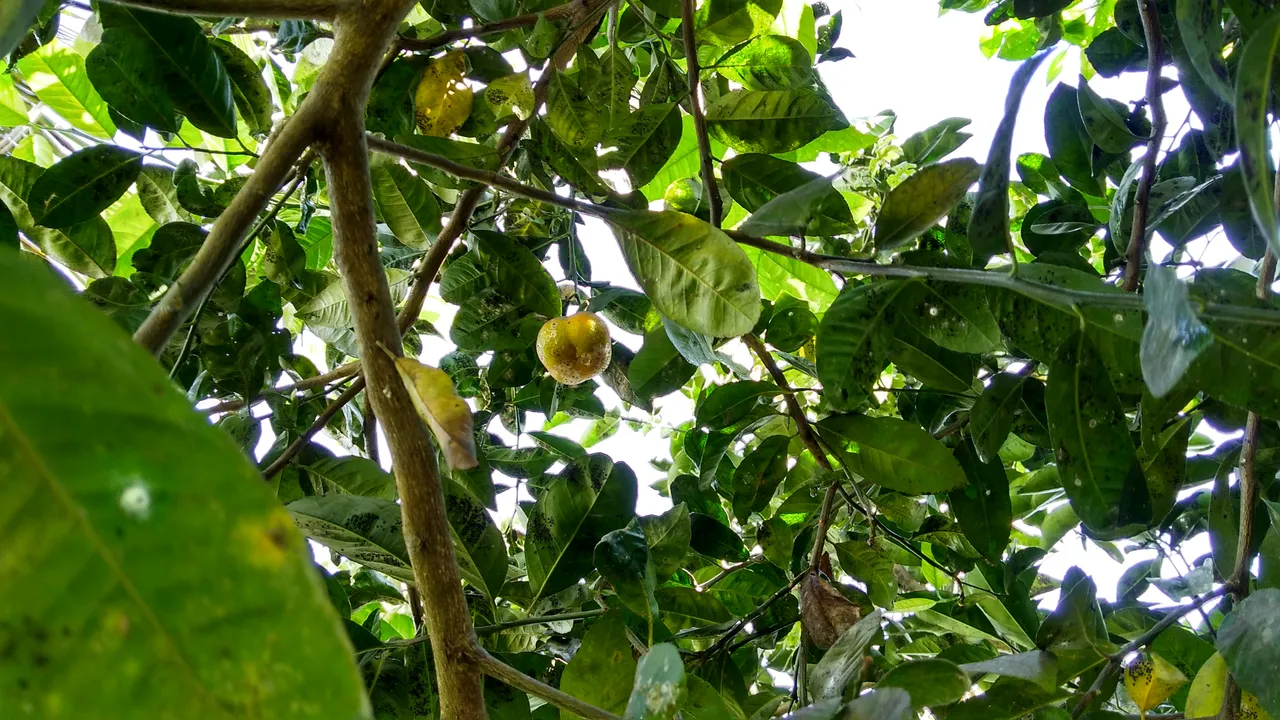
Limão-cravo
A ‘foot’ of rangpur (um pé de limão-cravo; scientific name: Citrus × limonia). These crazy lemons are more like oranges in comparison to the tart sicilian lemons that I’m used to back in Europe. The season has just passed but I managed to get a photo of one lemon just clinging on.

Coconut
And a coconut! (I don’t think it needs any special introduction).


Melão-de-são-caetano
And last but not in any way least, we have Melão-de-são-caetano (scientific name: Momordica charantia; English name: bitter melon). The leaves and funky little warty fruit are traditionally eaten in many Asiatic countries, I’m still trying to figure out the nuances of preparation as food. I have however been drinking away at its tea as it is highly medicinal and acclaimed for use in treating diabetes, skin problems, insect bites, constipation, generally an all-organism clean-out detoxification and maybe even has potential in treating cancer. Please do your own research regarding possible side-effects before consuming as it is a medicinal power-house, always treat such plants with respect.


And that’s it, the back-yard hasn’t run out plants, I’ve just run out of steem to keep on writing!!! I didn’t even get to tell you about the jurubeba, wild tomatoes, urtiga-mansa, pitanga or the jabuticaba. Ah well – maybe another time!
Back-yards: worlds of wonder
But I guess in brief, the point I’m trying to make is that back-yards are amazing places!! They are filled with plants that are useful to humans, and often highly nutritious or medicinal. Sometimes they’ll seem an anarchic mess, but oft times people will have been planting in all sorts of useful species in there through the years, and other wild species will be popping up shouting out for your attention. There’s an entire academic field within ethnobotany dedicated just to studying them. They always tell a story about human’s relationship to nature, you just need to know how to read it.
Peace out Steemonians!!! <3
Credits:
All the photos are my own.
Many thanks to João-Ricardo for modelling with the plants as he foraged his breakfast!
I referred to :
Kinupp, V.F. and Lorenzi, H. (2014). Non-Conventional Food Plants (PANC) of Brazil [Plantas Alimentícias Não Convencionais (PANC) No Brasil]. Nova Odessa, SP: Instituto Plantarum. (this is a keystone book - started a veritable movement regarding wild food plants in Brazil!)
AND
http://www.plantasquecuram.com.br