
You'll see plenty of leafhoppers in this post.

They all belong to one species.

I can't tell you the name of that species but the family is definitively Cicadellidae and the genus is certainly Macrosteles.

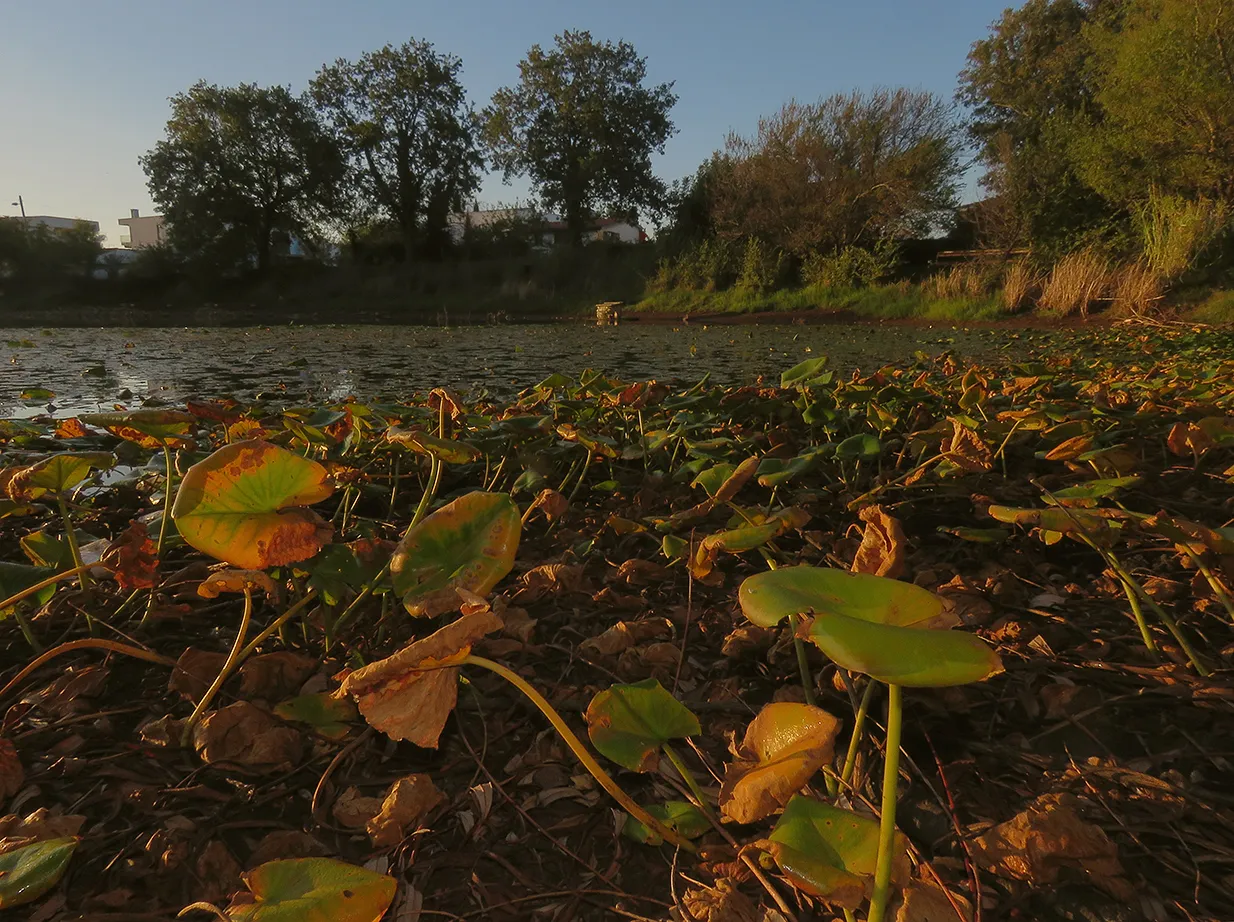
In this photograph, you can take a look at the wider setting. The dense growth of stranded waterlily leaves around the pond behind the last houses in my neighborhood, only about hundred - hundred fifty meters from where I live. Three days ago I published, in Liketu, a post about a morning walk to the grocery store. Today's post starts exactly where that post ended, so I'll put the link to that morning walk that has nothing to do with insects but has a strong connection to this leafhopper story. It's a prequel, although in a completely different genre.
@borjan/early-morning-in-medulin
Here's the link, and now, let's continue.

Some waterlilies were in the water, but since this summer was extremely dry, many plants were out of their ideal environment, stranded in the mud even after the rain and humidity that came with the autumn.

Some of those large stranded leaves were covered with leafhoppers. On this one, you can see only adults. In the following photograph ...

... you can take a more up-close look at another leaf that hosted a mix of adults and nymphs.

Here you can see an interaction between two nymphs. I don't know what exactly is going on, but it looks that the leafhopper with the spread and elevated hind legs is trying to impress or chase away the other one. In the following photograph ...

... you can take a look at the same kind of interaction between an adult and the nymph. In this case, the slightly bigger adult successfully chased the nymph away.

The leaves are very large. There was plenty of free space on them. But some leafhoppers were chasing each other from time to time.

Many were harmoniously resting together in small groups of three insects.

Here you can see two groups of three, a pair underneath them, and a single leafhopper in the top part of the picture.

At one point a fly with feathery antennae landed in the center of one of the leaves so the leafhoppers moved toward the edges. I was able to take only one photograph with the fly on the upper surface ...

... before the insect moved to the underside and found a nice place on the brown, rotting patch of that lower surface. Not only was the fly better sheltered on that side of the leaf, but the insect also chose a place that makes it less visible than on the green or vivid yellow surfaces. The mosquito-like fly shown in these two photographs is the Chironomus plumosus, a midge from the Chironomidae family. Only males have lovely, fluffy antennae that help them detect female feromones at long distances.

When I took a look at the water, to get a break from the macro view, I noticed what looked like a dorsal fin of an orange shark. It was only a leaf of course.

While exploring the Internet pages that show some or all of the leafhoppers from the Macrosteles genus of the Cicadellidae, I found quite a few species that look more or less like the leafhoppers shown in this post.

I'll say that the most likely candidates are the Macrosteles variatus, the Macrosteles sardus, the Macrosteles lividus, and the Macrosteles frontalis.

About half of the photographs shown in the post were taken with the flash of my camera on. That additional light worked great when it comes to showing all the small details of the insect anatomy, but ...

... but the overall atmosphere looked much better in the gorgeous ambient light provided by the early morning sun.
I had plenty of fun with the morning light. The world was fresh and colorful.

Here you can see an inspired portrait of the leafhopper in the desert-like macro landscape on the dried-out leaf of the Nymphaea alba plant.

Yes, Nymphaea alba is the scientific name of the waterlilies shown in this post.

Here you can see another small fly that landed on one of the leaves. Unlike the one shown earlier in the post, this one doesn't look like a mosquito. Chlorops interruptus is the name of this species from the Chloropidae family.

After taking the photographs that form the previous triptych, I got out of the macro view and zoomed in on the birdhouse for ducks across the water.

Here you can see the same scene photographed in two different ways. With and without the flash.

Most (practically all) adult leafhoppers looked like the one shown in this portrait.

I found only a couple of paler ones.

Right in the center of this picture, among adults and youngsters, you can see an empty exoskeleton left after the molting of one of the nymphs.

And that's it. With these two leafhoppers in different stages of their existence, the post is ready to end.
The following links will take you to the sites with more information about some of the protagonists of this post. I found some stuff about them there.
https://www.naturespot.org.uk/node/122176
https://truehopperswp.com/genus/macrosteles
https://www.commanster.eu/Commanster/Insects/Flies/Chloropidae.html
https://en.wikipedia.org/wiki/Chloropidae
https://www.naturespot.org.uk/species/chironomus-plumosus
https://en.wikipedia.org/wiki/Nymphaea_alba
AS ALWAYS HERE ON HIVE, THE PHOTOGRAPHS ARE MY WORK.