


Hola querido hiver.
Después de mis visitas al Museo del Foro y al Museo del Puerto Fluvial, sigo con mi ruta romana de Zaragoza y hoy le toca el turno al Museo del Teatro de Caesaraugusta.
Este museo es muy particular, pues se pueden ver los restos de lo que fue el teatro desde la calle y están protegidos de las inclemencias del tiempo por una enorme cubierta. En la imagen de la portada puedes ver todos esos elementos sin atravesar sus puertas.


Cuando damos la vuelta a la manzana llegamos a la entrada del museo, situada en la planta calle. Esta solo alberga el mostrador de información y venta de entradas, una vitrina con objetos a la venta relacionados con la temática romana y una cafetería. La visita al museo se realiza en las plantas sótano y primera.
Para respetar el orden cronológico, comenzamos en el sótano, donde están los restos antiguos. Allí proyectan un audiovisual que nos ayuda a situarnos en el lugar y nos prepara para lo que vamos a descubrir. Al terminar, accedemos a la sala de exposición y nos recibe esta maqueta que nos permite considerar las dimensiones y forma del teatro. Una construcción que se utilizó durante un par de siglos y que fue el de mayor capacidad de espectadores de Hispania, como llamaban a España los romanos. Seis mil almas podían disfrutar al tiempo de los que aquí se representaba.


En esta sala comparten espacio elementos de gran tamaño recuperados entre las ruinas. Restos de estatuas, que no sé por qué, siempre terminan decapitadas... también partes de las cornisas del frente escénico, colocadas en la posición aproximada que tuvieron.


Se exponen restos del sistema que permitía la movilidad del telón, así como se explica que este teatro disponía de un velum, una lona que cubría a modo de visera parte del graderío y lo protegía del sol o de la lluvia. Es gracioso pensar que ahora también está cubierto como en sus viejos tiempos.
Hablando de las gradas, vemos una reproducción de cómo eran aquellos cómodos asientos, ejem...


Salimos al exterior y recorremos unas pasarelas gracias a las cuales pasearemos entre las piedras sin estropearlas. Aunque no pisemos las mismas piedras, sí transitamos a la misma altura por la que caminaron los romanos de inicios de nuestra era. En ese transcurso, los carteles informativos nos sirven de guía para interpretar lo que se ha mantenido.
Ese acceso al foso de la orchestra me recuerda a las películas de gladiadores... ¡ay, perdón, que eso se hacía en el circo! Por cierto, se tiene una idea de dónde pudo situarse el circo de Caesaraugusta, pero no se ha descubierto hasta el momento. Si te apetece pasar a la posteridad y te gusta excavar, aquí te lanzo el guante, jeje.


En fin, que para variar me desvío del tema. Sigamos por la pasarela, que parece que ahí hay algo que curiosear... el único acceso a la planta superior que se conserva con el arco completo. Te muestro la imagen desde la parte de afuera.


Casi al terminar el arco del graderío se aprecia parte de lo que queda de la superposición de ocupaciones sucesivas. Gran parte de lo que recubría este teatro fue a parar a las murallas que circundaron la ciudad y los huecos de hormigón albergaron alcobas o se utilizaron de sótanos en viviendas construidas sobre los escombros.
Conociendo esto, parece un milagro que se conserve parte del suelo original de la orchestra. Cada losa procedía de un rincón diferente del imperio romano, de dentro y fuera de la Península Ibérica.


Regresamos al interior y subimos hasta la primera planta. Un gran panel recorre una línea de tiempo con los eventos más importantes que afectaron al solar donde se ubicó el teatro. Por él pasaron las tres culturas que han morado en Zaragoza: fue donde se asentaron los musulmanes cuando llegaron poco después del año 700, pasando a albergar a los judíos cuando los anteriores fueron expulsados y hasta su propia expulsión en tiempos de los Reyes Católicos.
Las tres religiones del libro están presentes por medio de una reproducción de lo que sería su estancia principal, y desde la que se proyecta un audiovisual que nos pone en situación de lo que podían vivir aquellos habitantes. Además, en varias vitrinas se exponen objetos de su vida cotidiana.
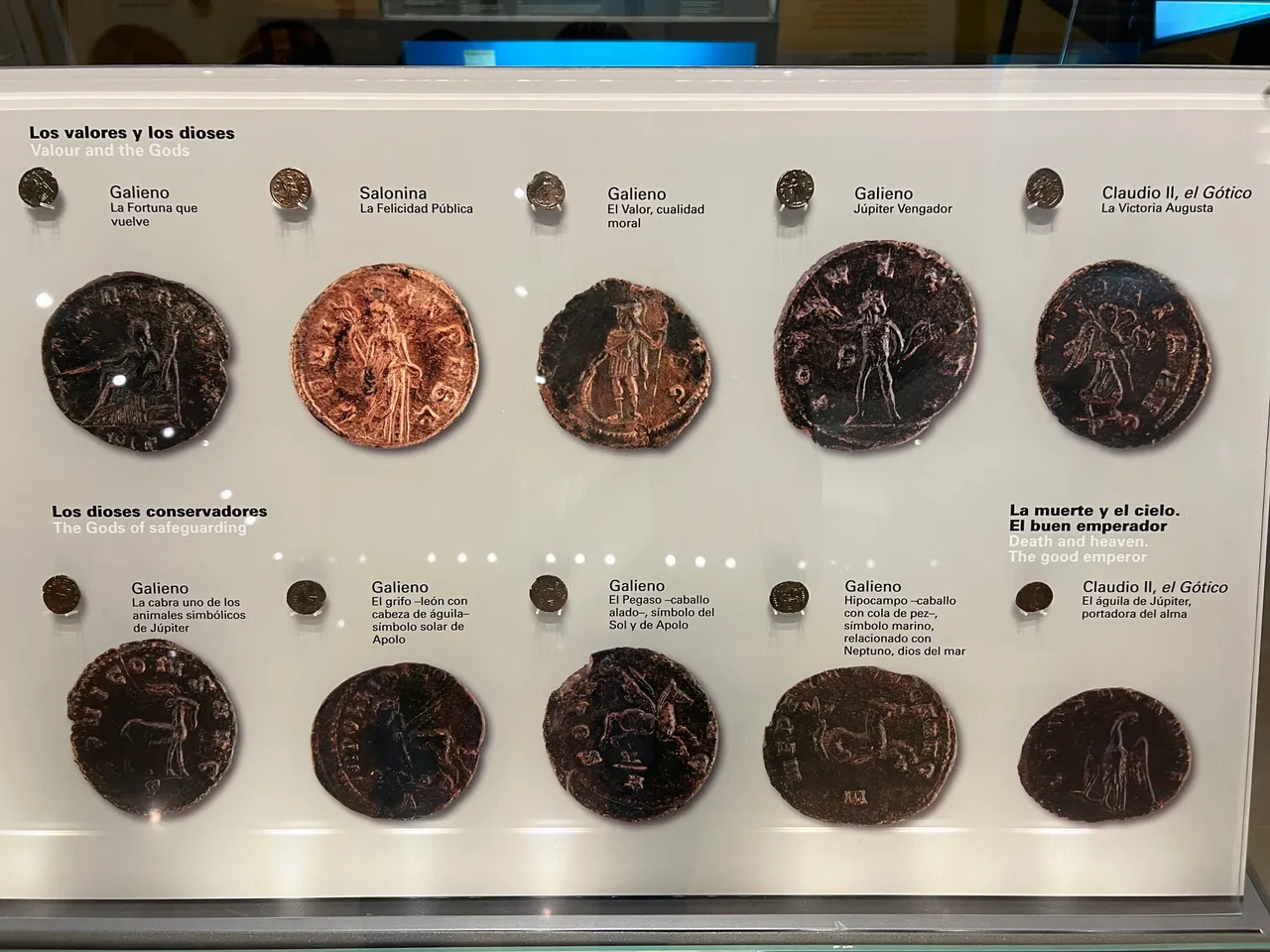
Estas monedas son parte del llamado "tesorillo" (tesoro pequeño). Algún desafortunado romano lo escondió y nunca pudo regresar a recuperarlo.


Ya en la época renacentista se levantó un palacio del que se conserva el patio casi intacto. Fue desmontado piedra a piedra y levantado de nuevo en el edificio de la actual sede del banco Ibercaja, que es la entidad más importante de la región. Otro día me acercaré allí y te lo mostraré. Para abrir boca tendrás que conformarte con este bonito ventanal que ha resistido a la carcoma. Imagina un montón de balcones y ventanas, todos cubiertos por piezas como esa. Desde luego pobres no eran sus dueños.


Ocupando el mismo espacio que la planta sótano encontramos una galería que nos amplía información sobre el teatro, incluida una reproducción de los elementos que los actores utilizaban en sus representaciones.

Esta me favorecía más que la otra pero no encajaba en altura. Puedes reírte a gusto, jeje.


Desde arriba se disfruta de una panorámica interna de todo el museo, como un nuevo patio moderno. Nos despide una maqueta que reproduce lo que pudo ser la Zaragoza romana, en la que vemos al teatro como segunda construcción principal tras el foro.
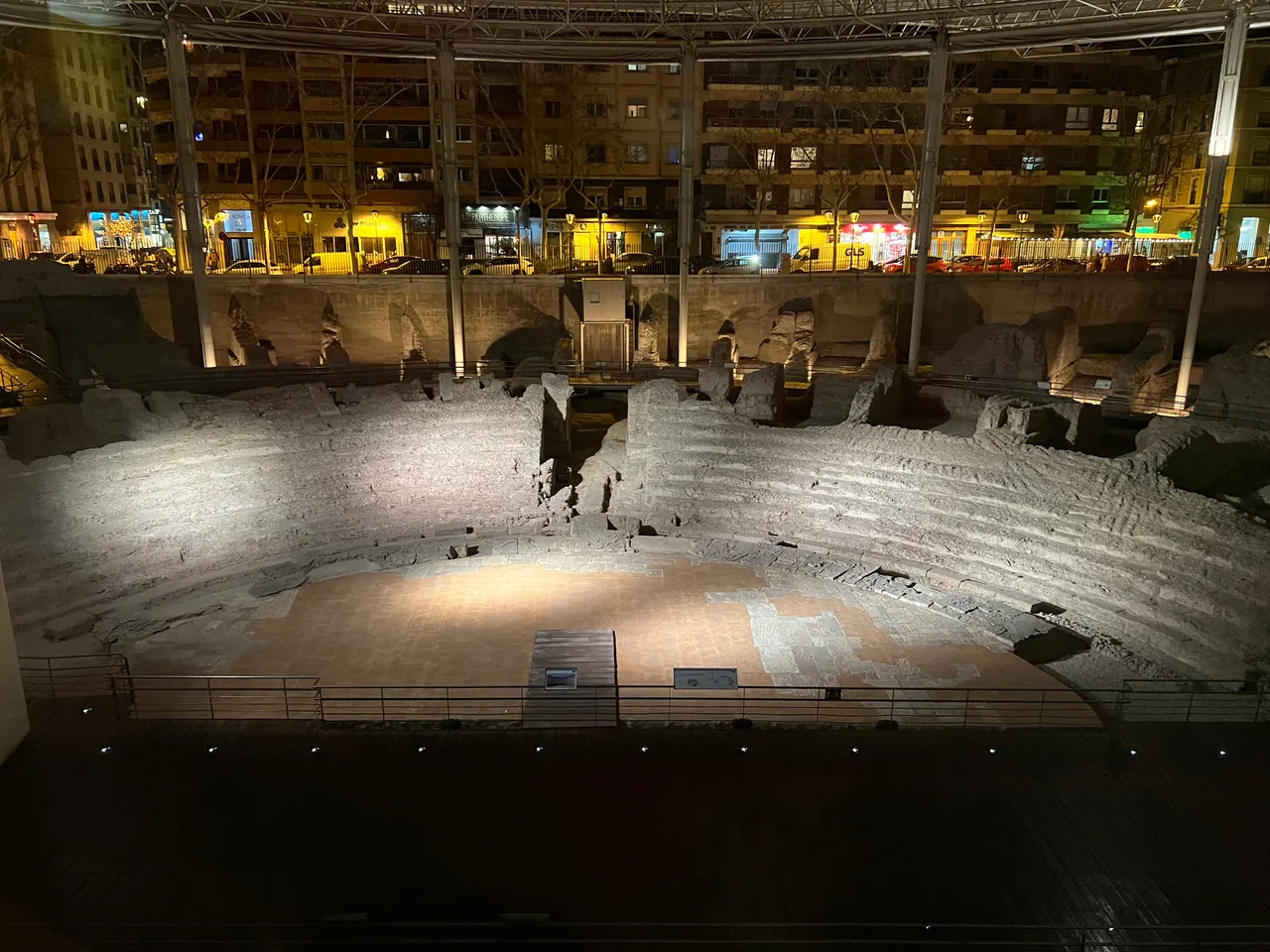
La noche cayó sin darme cuenta y me regaló una última vista del teatro de gran belleza. Espero que hayas disfrutado de la visita tanto como lo hice yo.
Hasta la próxima publicación. Mientras tanto, ¡cuídate!
Otras publicaciones de la Ruta Zaragoza Romana:
Museo del Foro de Caesaraugusta // Caesaraugusta Forum Museum
Museo del Puerto Fluvial de Caesaraugusta // Caesaraugusta River Port Museum

Herramientas: Cámara iPhone 13 Pro, editor de fotos Mac.
Si te gusta lo que publico, únete a mi Fanbase pinchando aquí

©️Copyright 2024 Paloma Peña Pérez. Todos los derechos reservados.

Hi, dear hiver.
After my visits to the Forum Museum and the River Port Museum, I continue with my Roman route of Zaragoza and today it is the turn of the Caesaraugusta Theatre Museum.
This museum is very particular, because you can see the remains of what was the theatre from the street and they are protected from the weather by a huge roof. In the image on the cover you can see all these elements without going through the doors.
As we walk around the block we come to the museum entrance, located on the street level. This only houses the information and ticket sales desk, a display case with objects for sale related to the Roman theme and a cafeteria. The museum is visited on the basement and first floors.
In order to respect the chronological order, we begin in the basement, where the ancient remains are located. There, an audiovisual presentation is shown to help us situate ourselves in the place and prepare us for what we are about to discover. When we finish, we enter the exhibition room and are greeted by this model that allows us to consider the dimensions and shape of the theatre. A construction that was used for a couple of centuries and which had the largest audience capacity in Hispania, as the Romans called Spain. Six thousand souls could enjoy what was performed here at any one time.
In this room, large elements recovered from the ruins share the space. Remains of statues, which I don't know why, always end up decapitated... also parts of the cornices of the stage front, placed in the approximate position they had.
The remains of the system that allowed the curtain to move are exhibited, as well as explaining that this theatre had a velum, a canvas that covered part of the stage like a visor and protected it from the sun or rain. It's funny to think that now it is also covered like in the old days.
Speaking of the bleachers, here is a reproduction of what those comfortable seats looked like, ahem....
We go outside and walk along some footbridges thanks to which we can walk among the stones without damaging them. Although we do not walk on the same stones, we do walk at the same height as the Romans at the beginning of our era. Along the way, informative signs guide us to interpret what has been preserved.
This access to the orchestra moat reminds me of gladiator films.... Oh, sorry, they used to do that in the circus! By the way, there is an idea of where the circus of Caesaraugusta might have been located, but it has not been discovered so far. If you feel like going down in history and you like digging, here I throw down the gauntlet, hehe.
Anyway, I'm going off topic for a change. Let's continue along the walkway, as there seems to be something to look at... the only access to the upper floor that is still preserved with the complete arch. I show you the image from the outside.
Almost at the end of the grandstand arch, you can see part of what remains of the superimposition of successive occupations. A large part of what covered this theatre ended up in the walls that surrounded the city and the concrete voids housed alcoves or were used as basements in dwellings built on the rubble.
Knowing this, it seems a miracle that part of the original floor of the orchestra has been preserved. Each slab came from a different corner of the Roman Empire, from inside and outside the Iberian Peninsula.
We return inside and go up to the first floor. A large panel shows a timeline of the most important events that affected the site where the theatre was located. The three cultures that have lived in Zaragoza have passed through it: it was where the Muslims settled when they arrived shortly after the year 700, and then became home to the Jews when they were expelled, until their own expulsion in the time of the Catholic Monarchs.
The three religions in the book are represented by means of a reproduction of what would have been its main room, from which an audiovisual is projected that gives us an idea of what life was like for those inhabitants. In addition, several showcases display objects from their daily lives.
These coins are part of the so-called "tesorillo" (small treasure). Some unfortunate Roman hid it and was never able to return to retrieve it.
A palace was built in the Renaissance period, of which the courtyard remains almost intact. It was dismantled stone by stone and raised again in the building of the current headquarters of the Ibercaja bank, which is the most important bank in the region. Another day I will go there and show it to you. To open your mouth you will have to be satisfied with this beautiful window that has resisted the woodworm. Imagine a lot of balconies and windows, all covered with pieces like this. Their owners were certainly not poor.
Occupying the same space as the basement floor, we find a gallery that provides further information about the theatre, including a reproduction of the elements that the actors used in their performances.
This one suited me better than the other one but it didn't fit in height. You can have a good laugh, hehe.
From the top you can enjoy a panoramic view of the whole museum, like a new modern courtyard. We say goodbye to a model that reproduces what could have been the Roman Zaragoza, in which we see the theatre as the second main construction after the forum.
Night fell before I knew it and gave me one last beautiful view of the theatre. I hope you enjoyed the visit as much as I did.
Until the next post. In the meantime, take care!
Other publications of the Roman Zaragoza Route:
Museo del Foro de Caesaraugusta // Caesaraugusta Forum Museum
Museo del Puerto Fluvial de Caesaraugusta // Caesaraugusta River Port Museum
Tools: iPhone 13 Pro camera, Mac photo editor.
Translated with DeepL
If you like my content, join my Fanbase clicking here

©️Copyright 2024 Paloma Peña Pérez. All rights reserved.
