

Always in a hurry and constantly without time, humanity understood its accelerated pace of life as the only possible one. Work, stress and lack of time, three magic words that we encounter every day. There are other factors that, it seems, we are looking to speed up and raise our adrenaline by ourselves.

For example, listening to music that speeds up my heart rate right now doesn’t contribute to a calming feeling. But still, remembering this walk through the streets of this small town lets me know that there is a way of life that is slower than what we really live.

This town, not far from where I live, is called Polop de la Marina, or just abbreviated, Polop. It is located in Marina Baixa, Valencian Community, Spain.

The streets here are typically Mediterranean, narrow, and with flowers on the balconies or in front of the houses. Somewhere we can see chairs in front of the main entrance because it was customary to sit outside with neighbours and talk. People used to hang out before, maybe in a more natural way than we do now. But this village proves that this custom may still be alive.

This town of Polop is also known not only for its narrow streets but also for its ups and downs. See the stairs in the middle of the street? It is of course for pedestrians, and that part on the side is for cars, believe it or not. You can drive this way.

Once my husband was driving this way because he got confused and ran into the narrow city centre. There weren't many options, he should have continued this way, and let's just say he didn't have the best feeling. That day when I was walking here and taking these pictures, I parked at the entrance to the city. Anyway, it is not a big town, you can visit every corner of it by feet, and it is nicer too.

I love these little passages in the streets, evoking some older age that is already past. It also gives a sense of that calmness I mentioned at the beginning of the text.

In the city centre, houses are usually two-storey or three-storey. The main feature is a large front door and balconies on higher floors.


If you may have read my post about the town of La Nucia two weeks ago, you might have read that I mentioned stone houses and narrow streets that provide freshness during hot summer days. The same is the case here, the thick stone walls probably provide much more pleasant moments during the heat.


As in every other village that I visit, the front doors attract my attention. Maybe it's because I used to live in a similar house, with a double huge wooden gate, even though it was a style of German construction from a century ago. I have the same feeling when I see these wooden gates. Okay, not exactly the same, but a reminder of another period in my life.


In the very centre of the town, we see the church, which is the decoration of the city when viewed from afar. From the neighbouring town, it is seen very well, and it rises above the houses with its tower. This is how we see it from close up, just a huge stone wall. This detail with the sundial was interesting to me. Can you see what time I passed this way? It shows the right time.


This is how it is seen from La Nucia, the nearby town:

Polop, in addition to providing peace, still gives other forms of enjoyment in it, such as exhibitions or small concerts in the cultural centre as well as a permanent exhibition in the museum.


This museum is entirely dedicated to the writer who spent part of his life here. His name was Gabriel Miró, and he was one of the Spanish writers of the late nineteenth and early twentieth centuries.
The museum has his name, and objects from the family treasury are on display.


Piano music could be heard during my visit to this museum. I learned that these were the piano compositions of his friend, Oscar Esplá, a Spanish pianist and composer.

After this beautiful time spent listening to piano music and watching the objects of Gabriel Miró, I continued my tour. I passed by ayuntamiento, (town house) which is a fairly simple construction. Nothing special but it still has some charm of its own.
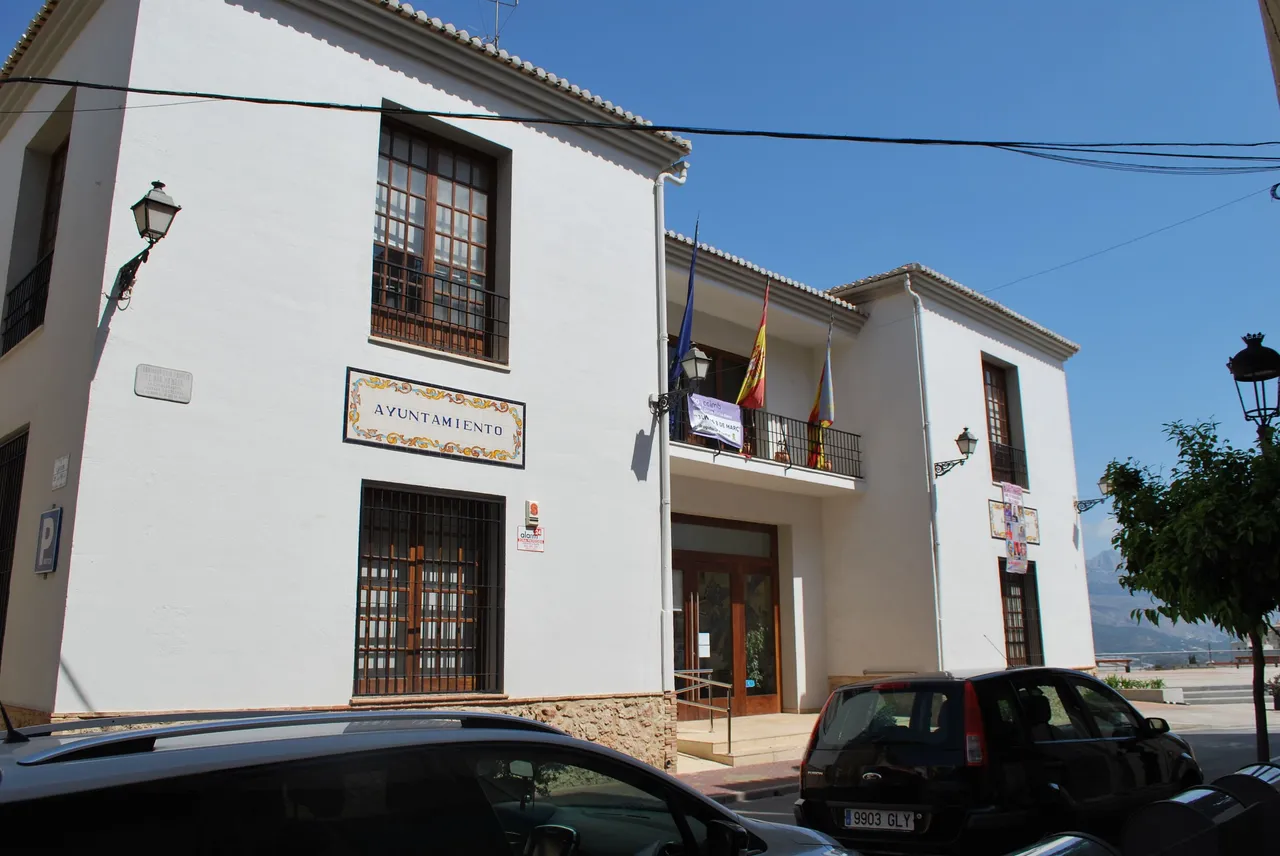

From the small square behind this building, you can also see the narrow city centre and the church with all the tower. But we can see a beautiful view from another place. We're going to go up there now.

The cover photo we could see in the beginning was taken from the path going up to the fortress. Not much has left from that fortress, which is of Muslim origin actually. It has witnessed some battles in history, and also it was used as a cemetery for over two centuries. (from the beginning of the 18th century until 1945). Now closed for that purpose and abandoned, it still attracts the attention of the tourists and curious people. The writer, that I mentioned before, Gabriel Miró, found a source of inspiration for his writings. I have found inspiration for this post, which now has to end. Hope you will consider walking through this small gem when visiting the Spanish litoral.

