
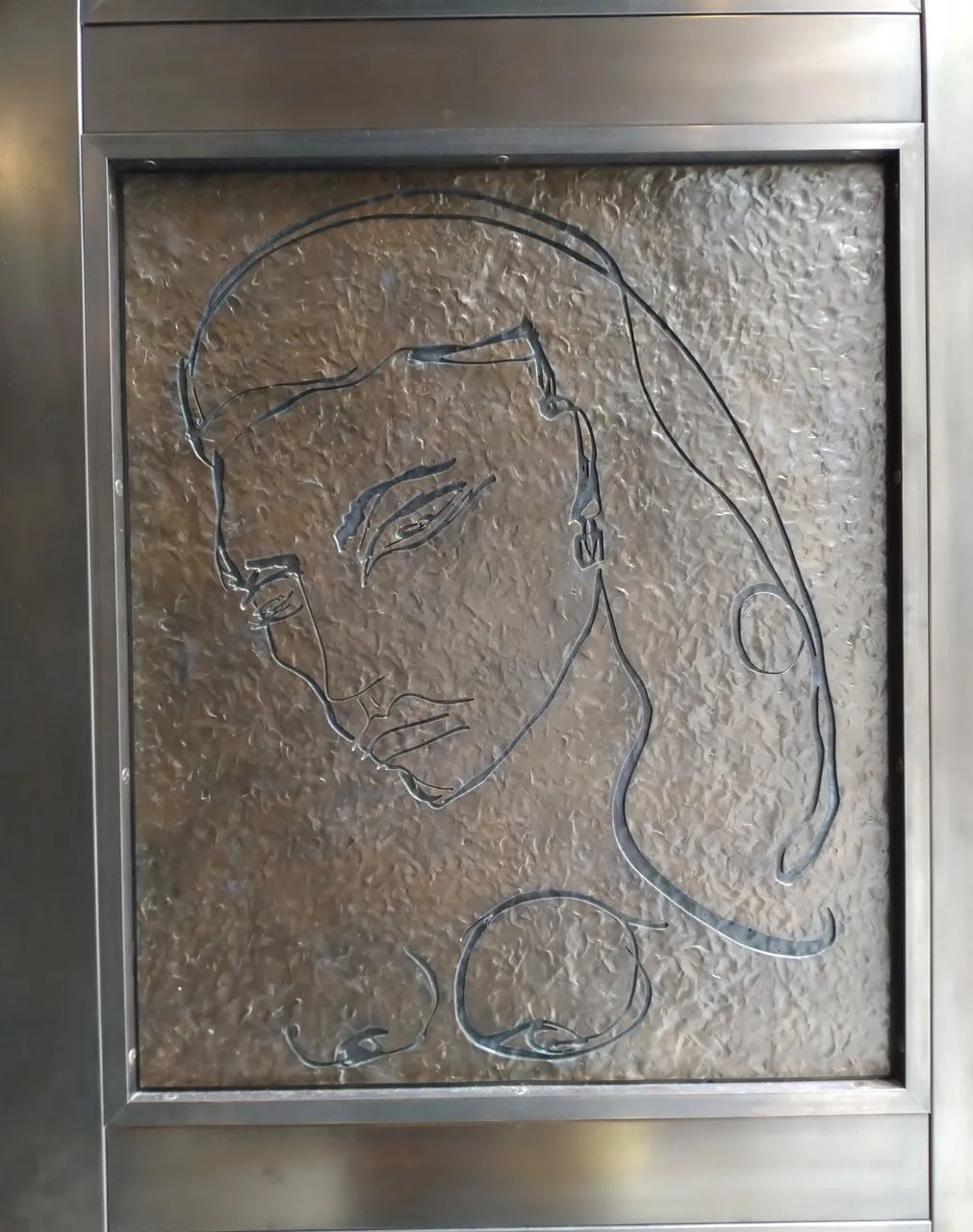
One of the bronze panels by Tracey Emin in the new entrance doors of the National Portrait Gallery.
Voices on Art. Part Two (Part One) was inspired by pictures submitted by members of the group. I've recorded some of the art works in the table at the bottom of the post.
It was all interesting and taking a theme is a fascinating way into exploring artworks. (I noticed one of the tags on a portrait was "spectacles" - I guess you could take any commonplace item as an entry point for exploring art works). The range we cover each week is huge. To explore any of them in depth would take a lot of time, and I've realised that I need to choose which paths to follow (doors to open)?
The group was large this week, it's organic an undulating wave, rising and falling, of people and voices. I think it was nine this time with ululating rounds of conversation as people explored their connections:
Yes, Lydia.
Lydia?
Lydia with the dog.
You know Lydia?
Yes, Lydia with the dog, she runs the book club.
Oh, which book club? I want to join a book club.
The one at The Churchill.
Oh, who runs that?
Lydia.
Lydia?
Yes, Lydia with the dog.
Oh, oh, Lydia with the dog.
I don't know Lydia. Lydia with the dog. I'm sure I'll get to meet her in time. Meanwhile, I like the gentle murmurations of voices around me.
Two paintings especially spoke to me: Rooms by the Sea by Edward Hopper, and Mr and Mrs Clark and Percy by David Hockney. I was intrigued by the stories that the Voices created for each of the paintings and did some research on both after the session.
Edward Hopper's paintings have become associated with alienation and loneliness, but I was more interested in other ideas about his work. Although he is associated with American Realism, his paintings are not uniform in detail, some areas are worked in more definition than others. For me and, I found, for other commentators, there were resonances with other art forms - film making and writing in particular for me. Film adaptations of The Great Gatsby (especially the 2000 version) and The Maltese Falcon kept coming to mind.
I liked Hopper's own thoughts about his work ("It's about me, I'm looking for me") and the idea of paintings as self-portraits; and another commentator, talking about the drama inherent in Hopper's paintings, that each one is about a story that is just about to start. I was intrigued, too, by the light. He liked painting sunlight on a building or light coming into a room.
The following day I visited the newly opened National Portrait Gallery. I was looking, not for doors this time, but for portraits of couples. I wanted to see how else couples had been displayed in portraits and, thinking about Hopper, how light was used by the artist or maker. I've chosen a selection here, in chronological order. You can see more in the Couples collection.
Henry and Millicent Fawcett

(Source) Henry and Dame Millicent Fawcett (1872), Ford Madox Brown, National Portrait Gallery.
Ford Madox Brown was a contemporary of the Pre-Raphaelites and one of the founders of the arts and crafts company set up by William Morris. Although he doesn't employ the intense jewel colours of the Pre-Raphaelites, I can see their influences in the subject matter, how the picture is composed and the depiction of the woman, together with the detail, for example, on the tiered skirt.
It's an intimate portrait, they're engaged, entwined, with each other, physically and emotionally. I think this picture is also listed in a collection about acts of kindness, but I think perhaps they were kind to each other (Henry Millicent had been blinded in an accident). They were both activists and Henry was a Parliamentarian. Some say he is dictating a letter to Millicent or frame it that they are writing a letter together.
John Maynard Keynes and Lydia Lopokava

(Source) John Maynard Keynes (Baron Keynes) and Lydia Lopokava (1932), William Roberts, National Portrait Gallery.
Ah, here's William Roberts again. I like this portrait so much more. Regardless of comments that they are not looking at each other (implying that they are not engaged with each other), I feel this portrait has more emotion and that they are close to each other - look how closely they are sitting. I like the way, too, she looks reflective (or bored, depending on your point of view) and he is thoughtful, perhaps surprised. They look like they might be having a genuine conversation.
Interesting in both portraits how (sets of) diagonals are used.
Prince Philip and Queen Elizabeth II

Source Prince Philip and Queen Elizabeth II (2011), Thomas Struth, National Portrait Gallery.
These two look companionable in the sharply focused setting of shades of green set against a more obscured background, a little island of tranquillity in an almost underwater setting. They're both in their eighties, a strong and stable couple with nothing to prove and no-one to impress. Diagonals again in this portrait, but much more gentle, joined by their elaborate seat, at their ease to look where they will.
I wonder what they did afterwards? I like to think it went like this:
Cup of char, Lizzie? Wet the old whistle, love?
The Perry Family

(source) The Perry Family (2012), Martin Parr, National Portrait Gallery.
A three for two with the Perry family, with Flo Perry, their daughter included. A riot of colour and pattern and plenty of misdirection: see but don't see, make of it what you can.
I love the repeating motifs and colours: the houndstooth check in the women's skirts, the red laces and bright lipstick sandwich of Philippa Perry, the trail of yellow from Grayson's shirt, down to the single cuff showing and on to Philippa's tights and surface they're standing on, the blue from Grayson's corsage, through Philippa's skirt to Flo's tights. The pull of the green from Philippa's skirt to Flo's blouse.
Such a lot to see that their faces are hidden in the midst of all the noise. Very clever.
Thelma and Duro

(source) Thelma Golden and Duro Olowu 'Thelma and Duro' (2017), Catherine Opie, National Portrait Gallery.
I went for a break before I wrote this one. I was thinking how striking it was, but how gentle the faces were. Composed, relaxed, but not unaware. The brilliant fabrics of Thelma's dress that allow her to express her personality, Duro with no socks or tie, their wedding bands, her touch connecting them.
Strong diagonals again, giving drama, their faces lit out of the dark background. This did seem to me to be connected with earlier portraits, from previous centuries: more formal, majestic, powerful.
Conclusions
I've no conclusions - nearly all the pictures seemed to invite more questions than answers when you peered into them more deeply. What was going on?
I kept tracing back to the original portrait that set me down this path: Mr and Mrs Clark and Percy by David Hockney. The triangular relationships that existed between the two subjects and the artist, the separate friendships, the technicalities involved in creating the painting, the way the picture had been composed and other elements (the lilies) added later, painted in the studio. Painting Mr Clark's head twelve times to try and get it right, express the relationship clearly.
We know what happened to Mr and Mrs Clark later and that seems to add more power to the picture. Commentators describe it as prescient and prophetic: but was it or only because we know the outcome?
I love a good crime novel, or something by Elmore Leonard, the twists and turns and flawed people never wholly the hero or the villain, humans, in fact. Venturing on this journey, trying to understand, each clue (the doorway, the light, the colours) leading you in another direction, looking for verification to confirm your thoughts: yes, he is the murderer, the embezzler, the murky corrupted Macbeth.
Love the way we create our own stories and dramas.
| VOICES' Picks: Doors in Art | Other Works |
|---|---|
| The Little Girl at the Door (1910), Harriet Halhed in the Beaney Museum, Canterbury; influences: John Singer Sargent and Whistler | Love Locked Out (1890), Anna Lea Merritt; The Visitor (c1952), Carel Weight; Carel Weight works, Tate Gallery |
| John Lennon (1961), Jurgen Vollmer | School of Athens (c.1500), Raphael; Re-modelling Photo History: Colonization (1981-2), Jo Spence; Jo Spence works, Tate Gallery |
| Door, Guitar, Bottle (1916), Pablo Picasso | Abstraction (1934), Jean Helion; Corps Etranger, (1994), Mona Hatoum; Mona Hatoum Exhibition |
| Rooms by the Sea (1951), Edward Hopper | Colour Field Painting, Rothko et al; Ellsworth Kelly |
| Mr and Mrs Clark and Percy (1970-1), David Hockney | The Arnolfini Portrait (1434), Jan van Eyck |