
Gentle & easy, deeply relaxing technique for the jaw, face, neck, and central nervous system.

This jaw relaxation technique can be done when we’re sitting (even at the computer), standing or lying down. It’s easy and painless, and you can start right now, if you’re in a quiet place.
This series of posts was created for people who use computers for long hours - from a chronic pain & rehab health professional more about my work in Post 1
My other posts in this series are:
1: Basic Computer Ergonomic Improvement Suggestions
2: Sorting Screen Angle Problems
3: DIY Recliner Chair Computer Station
4: Roll Out Your Muscle Contractions Safely with Tennis Balls
5: Relaxing Your Posture
This is the sixth post in a series aimed to reduce pain for people using computers.
Post 6: Jaw Relaxation & Re-alignment Self-Help (Jaw Yoga/ Jaw Tai Chi)
This is also highly beneficial and safe for people who have:
- Old or recent whiplash strain or neck injuries
- Clenched jaws at night or during the day, or grinding teeth
- Dental problems, particularly history of dental surgeries, wearing braces & corrective devices, & dentures/implants
- Migraines and/or headaches
- High levels of stress
- Neck pain
- Sinus trouble
- TMJ (Jaw) disorder, diagnosed, or undiagnosed
- Tinnitus or other inner ear problems, including vertigo & ear infections
- Cranial injuries, old or new (as far back as birth with forceps, ventouse, breech etc)
- Facial injuries & facial muscle problems, including neuro/muscular tics
- Palate problems
- A desire to try a very easy and beneficial relaxation technique
Softening muscles and connective tissues can treat pain and eliminate trigger points. A trigger point is a point in the muscle or connective tissue that may be in a chronically semi-contracted state (semi-spasm). A muscle also might be locked, or the fibers may be matted and clogged with lactic acid. The trigger point may be referring or radiating pain to an area near by or further along the nerve track or nerve zone. When this happens in the area of the neck, jaw and face, it may cause headaches, migraines, sinus pressure (or mimic tooth aches), sometimes chronically. Softening muscles brings new blood flow and flushes the area to relax it.
Re-aligning and softening the jaw with this ‘Jaw Yoga’ technique can eliminate these trigger points over time. If you’ve had problems for years or months though, it will not be corrected in a day or a week. It may require daily practice of Jaw Yoga, and doing it more than once a day is absolutely fine.
This technique is NOT AN EXERCISE, it’s a relaxing, deep, gentle alignment technique that comes from Cranio-Sacral Therapy, but I think of it as a very simple, but powerful kind of Jaw Tai Chi or Jaw Yoga.
This technique relaxes more than just the muscles of the TMJ (Temporomandibular Joint) - it can relax many structures within the connective network of the jaw and neck.
Check out some of the anatomy geek stuff going on in the complex system of our jaws:
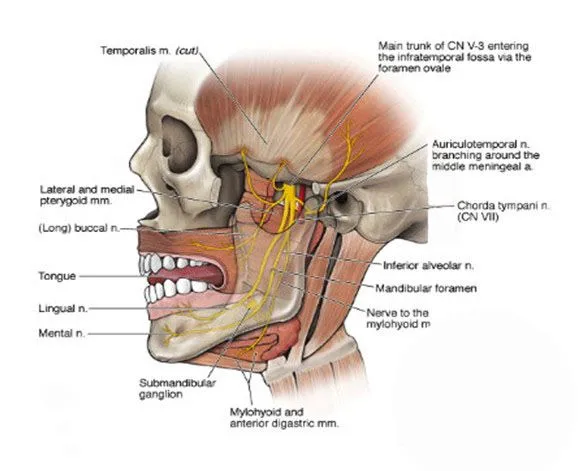
Jaw muscles are incredibly powerful.

4
The strongest muscle in the HUMAN body, (in relation to its weight) is the masseter, which is the main jaw muscle. With all muscles of the jaw working together, the teeth can close with a force as great as 170 pounds of pressure on the molars, some people have developed a force up to 275 pounds.

During longs periods of stress, it can become a muscular habit to store tension in the jaw muscles.
This Jaw Yoga technique is great for general relaxation, because the jaw is one of the most important fight, flight or freeze contraction points in our bodies. It’s one of the most powerful self-treatment techniques I have learned in my practice.

Getting Started
Make yourself comfortable, seated anywhere quiet (in front of the computer while you read is fine too), or lie down on the bed or floor.

7 8

9
Check your spine is relaxed- not holding tense. Imagine your Sky Hook Relaxing Posture lifting you effortlessly, as your head floats up and your neck & shoulders fall relaxed, into place. Sky Hook is described in Post 5.

10
Beginning Phase: Breathing

11
Begin taking very slow deep breaths (closing your eyes is helpful). When you breathe in deeply from the diaphragm, your belly will expand and your belly button will move forward. Your chest should not be moving with your deep slow breaths, because you’re breathing from the diaphragm, expanding your belly.
Make your out-breath twice as long as your in-breath if you can. A single out-breath can be as long as 5 seconds or more.
Mentally check through your body slowly: from your scalp and face to the soles of your feet. While you breathe slowly and deeply, let go of tension where you find it, as you breathe out. Take as many breaths doing this as you like.
Become aware of your jaw, and the muscles of your face and tongue.
Breathing, Jaw Opening and Closing
Note the starting position of your jaw:
- Are your teeth clenched or grinding?
- Are you teeth closed, but not clenched?
- Are you teeth parted?
- Are your lips parted?
Any of these starting points is fine. Please do not tighten or clench your jaw closed to start this technique. Just start from whatever starting point you find.

12
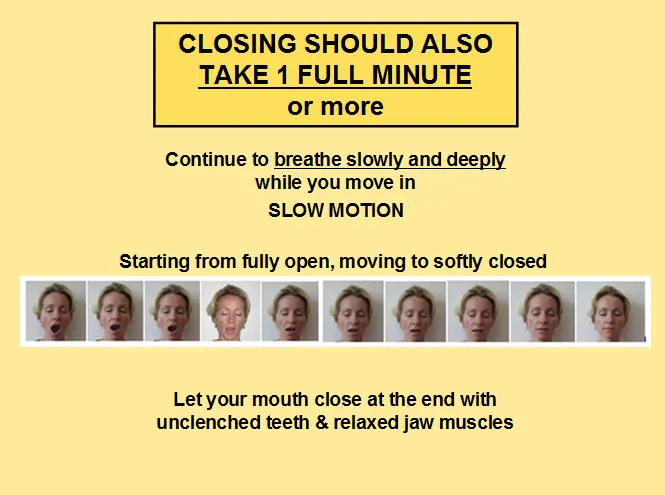
As you breathe slowly & deeply BEGIN OPENING YOUR MOUTH---
Move in slow motion as slowly as you can.

Imagine clouds dissipating in undetectable slow motion.

Let the tension in your muscles dissipate and dissolve in the super slow opening of your mouth.

If you experience any of the following, don’t worry. Breathe and rest through it, and continue slowly:
- Jaw gets sticky or stuck
- Small twinge of pain
- Jaw jigs or wobbles to the sides
- You need to swallow (swallowing with your mouth open is better than closing & starting over)

Continue breathing and pause for any of the above. If you take another very slow breath or two, your jaw will usually find its way through comfortably, relaxing more than you expected.
Really breathe

When your jaw has reached the fullest comfortable opening, take another two slow breaths and begin closing, at the same slow motion rate, continuing to breathe slowly.

One of the best times to do this technique is just before going to sleep. This can help reduce or eliminate teeth grinding or clenching at night.

18
Chewing gum is TERRIBLE for the jaw muscles

For the jaw, like all of our muscles, strength must be balanced with a relaxed muscle tone for optimum use and health. Chewing gum does not help the jaw muscles in any way. The strength it gets from talking and eating is all it needs. We know this because chewing gum isn’t found in nature, per se. Certainly not ubiquitously…
I look forward to your comments :)
All images are my own except those cited.

